
 Brij Khandelwal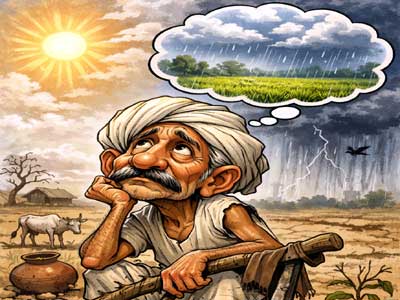
June has come and gone. The calendar has turned another page, but the fields remain parched.
In the Banda district of Uttar Pradesh, farmer Ramdeen still begins every morning by looking at the sky. He waits for dark clouds, but all he sees is dust swirling in the hot wind. His fields have cracked open. Deep fissures run across the earth, as if the land itself is crying out in pain.
Read in Hindi: मानसून जो रास्ते से भटक गया, आसमान जो बरसना भूल गया...
This June went down as one of India's driest in recent memory. Across large parts of the country, rainfall remained 30 to 40 per cent below normal, while several regions received barely half of their usual rainfall. The southwest monsoon, which normally sweeps into Kerala in early June before spreading across the country, seemed to lose its way this year. It arrived late, advanced sluggishly, and in many places barely arrived at all.
Ramdeen's story is not unique. It is the story of millions of Indian farmers whose lives still depend on the mercy of the monsoon.
From Madhya Pradesh to Rajasthan, Gujarat, Maharashtra, Karnataka, and Bundelkhand, fields that should have been lush with paddy, soybean, pulses and millets remain largely empty. Kharif sowing has fallen far behind schedule. Tractors stand idle. Seed and fertiliser shops look deserted. Every passing day without rain deepens anxiety.
Nowhere is the crisis more painful than in Bundelkhand, where water scarcity has become a way of life. Every weak monsoon pushes farming families deeper into debt. Many borrow money from local lenders at crushing interest rates simply to buy seeds and fertilisers. When the rains fail, crops fail too, leaving them trapped in a cycle of debt and despair.
The country's reservoirs offer little comfort. Water storage levels have fallen sharply, threatening irrigation, drinking water supplies and even hydropower generation. Several districts are already facing drought-like conditions. The crisis is no longer confined to villages. India's cities are beginning to feel the thirst as well.
Mumbai's reservoirs are shrinking rapidly. Bengaluru has witnessed a sharp rise in demand for water tankers. Groundwater levels continue to fall in Delhi, Chennai, Hyderabad, Pune and many other cities. Water rationing has begun in some places. Restrictions have been imposed on construction activities and the filling of swimming pools.
The most worrying trend is the relentless depletion of groundwater. Every year, India extracts enormous quantities of underground water but replenishes very little. The result is painfully visible. Water tanker operators are thriving while ordinary families wait for hours to collect enough water for daily needs. If July also disappoints, several Indian cities could move dangerously close to a ‘Day Zero’ situation, where taps simply run dry. A failed monsoon does not stop at the farm gate. It eventually reaches every household.
Poor harvests mean higher prices for pulses, edible oils, vegetables and cereals. Inflation tightens its grip on family budgets. Falling rural incomes reduce consumer spending, slowing businesses and industries alike. The ripple effects spread across the entire economy.
Climate scientists point to El Niño and the growing impact of climate change as major reasons behind the erratic weather. India's monsoon is becoming increasingly unpredictable. Instead of steady seasonal rain, many places now experience long dry spells interrupted by short bursts of intense downpours. The old rhythm of the seasons appears to be breaking down.
Governments have announced drought relief measures, crop insurance, climate-resilient seeds and subsidies for fertilisers. Yet these promises remain distant for farmers staring at empty skies. Policies may be drafted in air-conditioned conference rooms, but hope still arrives on the wings of rain clouds.
As evening falls, the setting sun paints the horizon crimson. Ramdeen gathers his tools and quietly says, "We've seen difficult years before. But there was always hope that the rains would come. This year, it feels as though even the sky has forgotten us."
Ramdeen is more than one farmer. He represents millions of families whose future depends on every drop that falls from the sky.
Today, the hopes of an entire nation rest on July. If the monsoon revives, crops may yet be saved. If it fails again, India could face a triple challenge—an agricultural crisis, an urban water emergency, and rising inflation.
The sky remains silent. The question is no longer whether it will rain. The question is whether it will rain before it is too late.
Related Items
Will West Asia’s 40-day inferno hijack India’s Monsoon?
Ancient pollen hidden below lake tells the story of a stronger monsoon
When high-speed development turns roads into killing fields...