
 Brij Khandelwal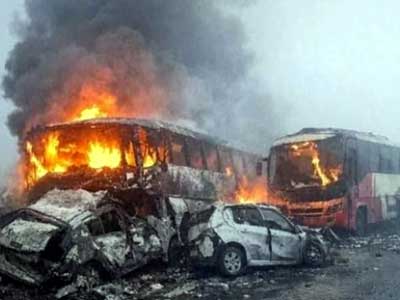
The bodies are pulled out one by one from twisted metal that, minutes earlier, was a laughing family on holiday. A child’s shoe lies in a blood-smeared aisle. A crushed steering wheel pins a lifeless torso. Skulls crack against seat frames, limbs snap beneath overturned chassis. This is not the exceptional horror of a freak crash; it is the routine forensic reality of India’s fastest roads. On Uttar Pradesh’s expressways, death has become an everyday commuter.
Each collision does more than end lives. It vaporises years of savings invested in tractors, trucks, buses and private cars, turning livelihoods into scrap in seconds. When an earning member dies, school fees disappear, medical care becomes unaffordable, and food security collapses for entire households. Mangled vehicles, burnt consignments and destroyed cargo translate into crores lost annually in goods, productivity and insurance payouts. Grief here is not just personal, it is economic, systemic and enduring.
Read in Hindi: लापरवाह तेज़ रफ़्तार सड़कों को बना रही है क़त्लगाह
Yet, night after night, on ribbons of asphalt designed to symbolise progress, families continue to shatter. A bus thunders down the Agra–Lucknow Expressway at 140 kmph, slicing through darkness. Somewhere between milestones, it meets fate. Another statistic is logged. Another condolence tweet is drafted. Another promise of ‘review’ evaporates by morning. What were once marketed as lifelines of development have quietly mutated into death traps, state-built, state-run, and state-neglected.
The numbers tell a story too grim to ignore. In the first nine months of 2025 alone, the Agra–Lucknow Expressway recorded 1,077 accidents and 94 deaths. A staggering 70 per cent of those fatalities occurred at night. This nocturnal lethality, nearly double the daytime rate, exposes a catastrophic enforcement blind spot. As one veteran road safety expert warned bluntly, without urgent corrective action, these highways will fully earn a new name: “Express Deathways”.
The Yamuna Expressway has already cemented that legacy. Between 2012 and 2023, it claimed 1,320 lives and injured over 11,000, an average of 110 deaths every year. In 2024 alone, the 165-kilometre stretch recorded 462 fatalities, making it among the deadliest highways in the country at nearly three deaths per kilometre. Compare that with the Mumbai–Pune Expressway’s 82 deaths over 94 km, or the Delhi–Meerut Expressway’s 33 deaths over 96 km, and Uttar Pradesh’s grim distinction becomes impossible to defend.
Recent months have read like a roll call of avoidable tragedies. A bus–truck collision in November 2024 killed five. A speeding canter rammed into cars, killing one. A tyre burst sent an SUV spinning in March 2025, killing three. Multiple crashes near Mathura in July claimed six more. In November, a student-filled car overturned, killing two; days later, a bus flipped, injuring fourteen. Each incident had familiar causes—speeding, fog, fatigue, mechanical failure—and each unfolded on roads that are supposedly access-controlled and ‘world-class’.
The root of the crisis is not flawed engineering alone. It is a toxic cocktail of reckless driving and monumental institutional apathy. Speeding, drowsiness and intoxication are the immediate triggers, but they thrive in an ecosystem where enforcement is sporadic, and consequences are rare. Experts have repeatedly urged the implementation of reduced nighttime speed limits, mandatory rest zones, and round-the-clock monitoring. “Our pleas have fallen on deaf ears,” says one senior safety consultant who has advised multiple state agencies.
Responsibility ultimately rests with authorities such as the Uttar Pradesh Expressway Industrial Development Authority and the traffic police, whose inaction has proven deadly. Speed cameras exist, but only as punctuation marks in vast stretches of lawlessness. Physical patrols are scarce. Emergency medical services are patchy and slow. Properly lit, accessible rest areas, critical to combating driver fatigue, are woefully inadequate. Despite toll collections running into crores every month, investment in life-saving infrastructure, such as automatic number plate recognition systems at regular intervals, remains pitiful.
Even more alarming is the rising number of pedestrian deaths on access-controlled expressways, a contradiction that exposes glaring security and oversight failures. How are people and animals entering these supposedly sealed corridors of speed? The question is asked after every tragedy, then quietly buried beneath the next.
Major disasters underline the pattern. The Unnao bus–tanker collision of 2024 that killed 18 was not a bolt from the blue. Neither are the frequent, horrifying overturns of overloaded buses and trucks. Vehicles routinely travel at aircraft speeds while enforcement remains a ghost. The promise of sub-three-hour journeys between cities has come at a grotesque price: shortened lives and shattered families.
This is no longer a matter of road safety alone; it is a full-blown governance crisis. Agencies entrusted with public welfare have failed in their basic duty of care, prioritising ribbon-cutting ceremonies and revenue collection over human lives. Without immediate, drastic intervention, zero-tolerance nighttime enforcement, mandatory driver education, scientifically designed rest infrastructure, and the diversion of toll revenues into advanced, AI-based monitoring, the carnage will continue.
India’s expressways stand today as concrete proof of a brutal truth: speed may kill, but institutional failure orchestrates the disaster. Until accountability replaces apathy, these roads will keep delivering not development, but death, at record pace.
Related Items
Western Media is ‘tough’ on India but ‘soft’ on China!
Small families, Fractured bonds! Blame it on family planning!
From 'Beacons' to 'Landmarks', India’s changing ‘Lighthouse’ story…