
 Brij Khandelwal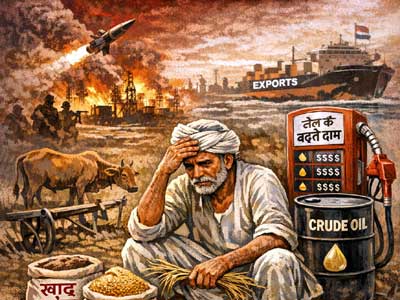
The sky has changed its colour. Blue has given way to a bruised purple. Smoke hangs like a curse over the Persian Gulf. War has paused, but its shadow has not. The guns may fall silent, but the air does not.
For forty days, fire rained on oil fields, refineries, and gas plants. What burned was not just fuel, but the atmosphere itself. Now the battlefield has shifted. Winds have taken over where missiles stopped. A slow, invisible invasion has begun.
Read in Hindi: पश्चिम एशिया युद्ध की आग का बिल चुकाएंगे भारत के किसान!
A toxic plume of soot, sulfur, and fine dust is drifting across the Arabian Sea. It moves quietly, but carries the weight of a “climactic bomb”. Pakistan may be first in its path. India stands next in line. No sirens will sound. No borders will stop it.
Tehran has already seen the warning. Black rain fell from its skies. Water mixed with carbon. Drops turned dark, almost sinister. It looked like rain, but felt like fallout. India now waits under a fragile sky.
The monsoon is not just a season. It is a lifeline. A delicate dance between a heating land and a breathing ocean. A rhythm perfected over centuries. War has stepped in like an uninvited drummer, breaking the beat.
Scientists are uneasy. They speak in data, but their message is stark. Three threats loom, each capable of turning the monsoon into a gamble.
First comes black carbon. Born from burning oil, it drinks sunlight greedily. The air heats up fast. Clouds grow restless. When they burst, they do not drizzle; they attack. Rain may fall in violent spells. A month’s water in a single night. Cities drown. Villages disappear. Crops choke under acidic showers. Soil loses its strength. Farmers lose their sleep.
Then arrive sulphate aerosols. Quiet, deceptive, almost polite. They reflect sunlight into space. The land cools down. The monsoon weakens. Clouds hesitate. Rains arrive late, or not at all. Fields crack open. Seeds lie waiting, then dying. The sky turns into a miser.
The third threat is the most frightening. If this smoke climbs high enough, it reaches the stratosphere. Then it behaves like a volcanic winter. Sunlight dims. Temperatures drop. Monsoons falter for years, not months. Drought becomes a habit. Hunger follows silently.
History offers a chilling reminder. In 1991, Kuwait’s burning oil wells sent smoke as far as the Himalayas. Black rain-stained distant lands. That was one country on fire. Today, the scale is wider. The timing is worse.
And nature is already in a tricky mood. El Niño is forming in the Pacific. It has a known habit of weakening India’s monsoon. Now imagine this strange tug of war. War smoke may trigger extreme rainfall. El Niño may suppress it. The result could be chaos. Floods in one state. Drought in another. Punjab may be submerged under water. Gujarat may stare at empty skies.
The oceans, too, are wounded. Oil spills in the Gulf choke the sea surface. Evaporation slows down. Clouds form reluctantly. Less moisture rises. Less rain returns. The cycle turns vicious. Dirty seas. Thinner clouds. Thirsty land.
For India, this is not an abstract threat. Agriculture runs on the monsoon’s clockwork precision. A delay of days can ruin sowing. A sudden burst can wash away hope. Farmers in Rajasthan, Haryana, and Punjab stand on the edge. One wrong turn of the wind, and a season collapses.
The truth is as harsh as it is simple. Modern wars do not stay local. Their smoke travels. Their damage migrates. A fire in the Gulf can rewrite the fate of a farmer in Kerala. Air has no passport. Winds need no visa.
Soon, the first monsoon clouds will gather over India. People will look up, as they always do. But this time, there will be doubt in their eyes. Will the rain bring relief or ruin? Will it nourish, or destroy?
Nature keeps accounts with ruthless honesty. It does not care who started the war. It only settles the bill. And too often, the innocent end up paying.
Related Items
Western Media is ‘tough’ on India but ‘soft’ on China!
From 'Beacons' to 'Landmarks', India’s changing ‘Lighthouse’ story…
“Only five minutes…” has shaken France and forced India to think…