
 Brij Khandelwal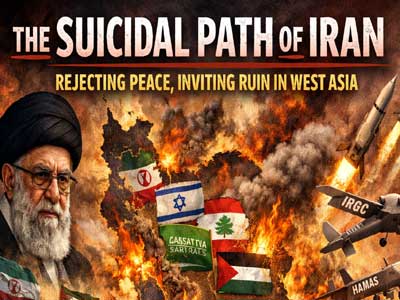
Expecting courtesy or compassion from them is like striking an axe on one’s own foot. Blunt, unpredictable, and unapologetic, Trump fears neither divine judgment nor global opinion. He has often mocked international law and undermined global institutions. Engaging recklessly with such a leader offers little gain and immense risk.
The pressing question is this: why is Iran, along with its allies, choosing a self-destructive course that threatens to drag the Gulf nations and much of the developing world into chaos? An energy crisis triggered by escalating conflict would hit economies like India hard, even though they have no role in the confrontation.
In the scorching geopolitics of 2026, as the region sits atop a powder keg, Tehran has effectively shut the door on reconciliation. Overtures for peace have been met with silence, defiance, and a hardened posture. This is no longer mere political stubbornness; it is a calculated march toward self-destruction.
Iran’s economic foundations are already fragile. Inflation has surged beyond 40 per cent. The rial has collapsed dramatically, trading at nearly 1 to 1.7 million per US dollar in informal markets. Sanctions continue to suffocate growth, while public discontent simmers beneath the surface. A prolonged naval blockade in the Gulf could choke Iran’s economic lifeline entirely.
The truth is harsh but unavoidable. Iran depends heavily on maritime imports for essential goods. If these supply routes are cut off, factories will grind to a halt, medicines will disappear, power systems will falter, and ordinary citizens will be pushed to the brink. This crisis is the cumulative result of years of flawed policies and rigid posturing.
Tehran’s foreign policy has hardened into ideological obstinacy. Revolutionary rhetoric, nuclear ambitions, missile programs, and proxy conflicts have led to deep international isolation. Iran’s growing dependence on has offered limited relief but increased vulnerability. Selling discounted oil to a single dominant buyer—often 80–90 per cent of exports—is not a strategy; it is compulsion.
Even now, as conditions worsen, Tehran appears unwilling to recalibrate. History offers a grim warning. The devastation of sanctions in the 1990s—marked by hunger, disease, and social collapse—should serve as a cautionary tale.
Critical sectors within Iran are already under strain. The world’s largest natural gas field has suffered damage. Oil exports face mounting risks. Industries reliant on imports remain vulnerable. A disruption in supply chains would paralyse production, shut factories, eliminate jobs, and send inflation spiralling further. Public anger could erupt onto the streets.
This is not merely an economic crisis; it is a threat to regional stability. Iran’s proxy networks—including the —are already under pressure. Reduced funding could trigger desperation and escalation. The Gulf’s vital shipping lanes, through which nearly 20 per cent of the world’s oil flows, could be at risk. A single spark may ignite a global crisis.
Tehran’s current trajectory resembles self-sabotage. Its circle of allies is shrinking, and those that remain are driven largely by self-interest. Yet, there is still a narrow window for course correction. Diplomatic space exists—but time is slipping fast.
What is needed is a shift in approach: abandon rigid posturing, return to negotiations, seek a pragmatic resolution on the nuclear issue, rebuild ties with Gulf neighbours, and prioritise citizens’ welfare. A nation cannot run on missiles and slogans alone. It runs on jobs, electricity, healthcare, and hope.
If denial persists, the consequences are predictable: prolonged isolation, economic collapse, and internal unrest. History is unequivocal—nations that refuse to adapt in time often break under pressure.
Iran now stands at a crossroads. One path leads to peace, reform, and reintegration. The other leads to confrontation, isolation, and devastation. The choice rests with Tehran, but the repercussions will be global—especially for energy-importing nations like India. Rising oil prices would fuel inflation, disrupt industry, and strain developing economies.
Iran must recognise that defiance alone is not strength. Its nuclear rigidity has deepened isolation, and proxy engagements have drained resources. The moment calls for pragmatism: nuclear restraint, sanctions relief, and regional stability through dialogue.
The stability of West Asia is vital for the global economy. Countries like India, heavily dependent on Gulf energy supplies, stand to suffer the most from prolonged instability. Iran must turn away from this self-destructive path. Otherwise, history may remember it as another Iraq—a nation undone by its own stubbornness.
Choosing peace is not weakness; it is wisdom. Abandon rigidity, embrace dialogue, and safeguard the future. Otherwise, this invitation to disaster will engulf not just Iran, but the entire region.
Related Items
London for a ‘few days’ with a ‘Global Family’
When East and West mix to cook a delicious Biryani!
From the ‘Tree of Life’ to ‘Global Prominence’...