
 Dharmendra Kumar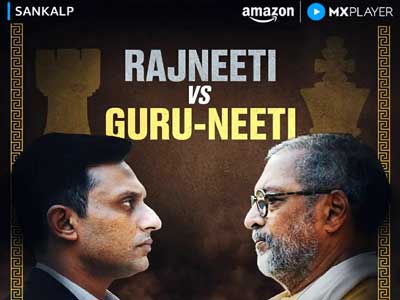
Once upon a time, a ‘Chanakya’ created a ‘Chandragupta’. But what happens when, in today’s age, a teacher walks in Chanakya’s footsteps and creates not one but many ‘Chandraguptas’? And what if all these ‘Chandraguptas’ together become capable of running the entire system on their own terms? And then, what if one of these ‘Chandraguptas’ rebels and stands against his own ‘Chanakya’…? This entire web is woven in Prakash Jha’s new web series 'Sankalp'.
The story follows a teacher, much like ‘Chanakya’, who selects children from the lower strata of society, tests them against his own criteria, brings them into his ‘gurukul’, and trains them to become significant forces in society. Once these students are strategically placed from Patna to Delhi, begins a tale of revenge…
Read in Hindi: सत्ता, शिक्षा और संघर्ष का तानाबाना है 'संकल्प'
The series has 10 episodes. In the first five, the story often feels stretched and illogical. But if one patiently watches through them, by the end of the sixth episode, the dots begin to connect. From here, viewers start to feel engaged with the narrative.
Written by 'Haq' fame Reshu Nath, the entire series rests on Nana Patekar’s shoulders. This is his first web series. The screenplay is by Prasad Kadam, also his first foray into web series. Chandan Kumar’s dialogues are outstanding: "Koshish karte raho! Success kahaan jata hai, kosish ke ird-gird hi mandrata rehta hai..." (Keep trying! Success doesn’t go anywhere; it hovers around effort…); "Tumhari mamta ke bavandar mein is Deepak ko hum bujhne nahin denge..." (In the storm of your motherly love, we will not let this lamp extinguish…”); "Kismat matha par likhi ho ya hatheli pe, usko badlne ka taqat isi hath mein hota hai..."(Whether fate is written on the forehead or the palm, the power to change it lies in this hand…); "Guru Dakshina hai, Aditya! Kisi Hotel ka menu card nahin, ki itom badal dein..."(Guru Dakshina, Aditya, is not a hotel menu card that items can be changed…); "Mein woh eklavya hoon jisne apnaa angootha kaatkar dene se inkaar kar diya..." (I am that Eklavya who refused to cut off his thumb…); "Sahi waqt aane mein waqt to lagta hi hai..."(The right time takes time to arrive…); "Sach ka apna khud ka koi Astitva ho toh bataiyen. Woh to bas nazariye aur haalaat ki baisakhiyon par tikaa hai. Mano toh satya. Aadha mano toh ardhasatya. Na mano toh asatya..." (If truth has its own existence, show me. It only stands on the crutches of perspective and circumstances. Believe it, and it is true. Half believe it, and it is half-truth. Don’t believe it, and it is a falsehood…). Most of these lines belong to Nana Patekar, and they linger long after.
Mohammed Zeeshan Ayyub, Neeraj Kabi, Kranti Prakash Jha, Kubra Sait, Saurabh Goyal, Bhagwan Tiwari, and Meghna Malik shine in their roles, while Sanjay Kapoor leaves little impact.
The screenplay, however, has several loopholes. For instance, in a highly secure ‘gurukul’, a local journalist easily installs large CCTV cameras; hidden cameras would have been more plausible. Similarly, the way an IPS officer goes to give his DNA sample is unrealistic; blood samples aren’t always necessary. There are many such ‘excesses’ that could have been avoided. Editing, too, could have been tighter; episodes don’t need to be overly long to tell a story. Though there are twists, they don’t shock. And by the end of the series, several questions remain unanswered, likely to be addressed in the next season.
Related Items
The biggest ‘Cosmic Con’ of ‘Power Brokers’
Walking, a ‘fundamental right’ but a ‘struggle’ in Agra
Hello to Heidelberg, from money to education and a little romance…