
 Brij Khandelwal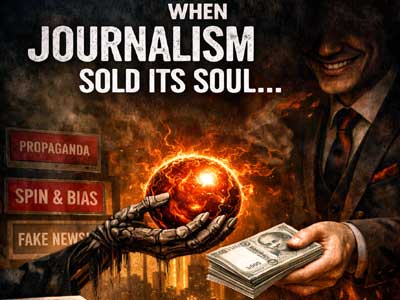
Who keeps watch on the watchdog? That uncomfortable question hangs over modern journalism like a dark cloud. The profession that once challenged kings, exposed scams and rattled governments is itself standing in the dock. The watchdog has not merely stopped barking. In many places, it has learned to wag its tail.
Journalism was never meant to be a comfortable profession. It was supposed to disturb the comfortable and comfort the disturbed. Today, too much of the mainstream media has turned that principle upside down. Those in power sleep peacefully. It is the ordinary citizen who is left restless, confused and poorly informed.
Read in Hindi: सत्ता के आगे लगातार घुटने टेक रही है पत्रकारिता…
The newsroom has become a marketplace. Editors once debated facts, verified sources and chased uncomfortable truths. Now they chase ratings, clicks and advertisers. The biggest question is no longer, "Is this story true?" It is, "Will this story trend?" Truth has become a guest. Revenue has become the host.
Advertising no longer follows the news. It often decides the news. Across India, media ownership is steadily shrinking into fewer hands. A handful of powerful newspaper groups dominate the Hindi market, while similar giants control much of the regional press. Many media companies are tied to business empires whose fortunes depend on government goodwill. Under such circumstances, biting the hand that feeds you is not just difficult. It is bad business.
Then entered another silent ruler: the PR industry. Press releases now arrive polished like wedding invitations. They come wrapped with glossy photographs, emotional quotes and ready-made headlines. All the reporter has to do is copy, paste and smile. Why spend three weeks digging for a scandal when a perfectly packaged success story lands in your inbox before lunch?
Investigative journalism has become an endangered species. The reason is simple. Digging for facts is expensive. Printing handouts is cheap. Asking hard questions creates enemies. Publishing flattering stories creates friends. Guess which one many organisations now prefer?
Television news has become the biggest circus under the brightest lights. Every evening, familiar faces gather for another shouting contest. The script rarely changes. One person interrupts. Another shouts louder. The anchor bangs the table. The audience gets entertainment dressed up as journalism. By the time the debate ends, plenty of noise has been generated, but precious little understanding.
The anchor, once expected to question power, has increasingly become the main attraction. Some behave like prosecutors. Others resemble political spokespersons. A few sound like motivational speakers addressing election rallies. Decibel levels rise. Credibility falls.
Volume has become the new evidence. The digital revolution made things faster but not necessarily better. Being first has become more important than being right. Rumours sprint across mobile phones while facts limp behind, struggling to catch up. Corrections appear quietly the next morning, long after lies have collected millions of views.
Journalism schools continue producing bright young graduates filled with dreams of changing society. Reality greets them at the newsroom door. Low salaries, endless deadlines, shrinking job security and the tyranny of algorithms quickly crush idealism. Many talented reporters leave for public relations, corporate communications or social media influencing. Ironically, telling flattering stories now often pays better than uncovering uncomfortable truths.
The consequences are dangerous. A citizen who receives half the truth eventually loses the ability to recognise the whole truth. Democracy does not die only through censorship. Sometimes it slowly suffocates under an avalanche of distractions, propaganda and carefully managed narratives. When questions disappear, accountability quietly follows them out of the room.
Freedom of the press was never meant to protect media empires. It was meant to protect fearless journalism. Those are not always the same thing. Yet all is not lost. Across India, many courageous reporters continue to expose corruption, document injustice and speak truth to power despite lawsuits, intimidation and economic pressure. They remind us that journalism is still a mission, not merely a profession.
But they need stronger legal protection, transparent media ownership, independent funding and editors who value evidence more than ideology. Above all, journalism needs courage; not the courage to shout in television studios, but the courage to ask one more uncomfortable question. Power has always preferred applause over scrutiny. Democracy survives only when someone refuses to clap.
A nation can survive bad roads, bad weather and even bad governments. It cannot long survive bad journalism. When the Fourth Estate becomes another branch office of power or profit, the people lose their sharpest weapon: the truth. And when truth goes missing, every headline becomes a suspect.
Related Items
The ‘H’ Puzzle in Journalism and Politics
Journalism's influence on literature: Democratisation or Vulgarisation?
Soul of India's sacred sites betrayed by concrete and commerce