
 Brij Khandelwal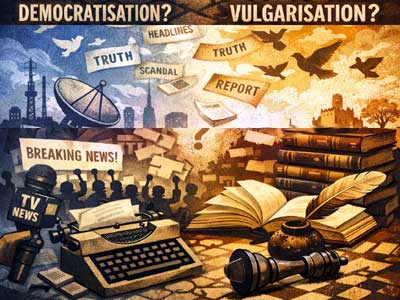
Journalism is often described as literature written in a hurry. The dividing line between the two is thin, sometimes almost invisible, because both share several features of expression, narration, and engagement with readers. Yet, despite these similarities, the differences in content, style, purpose, and permanence are too obvious to ignore. Literature tends to possess an enduring, timeless quality, while journalism is often immediate, transient, and at times superficial. What appears in a newspaper today may become outdated tomorrow.
Literature is frequently seen as the spontaneous overflow of powerful feelings, shaped by imagination and artistic sensitivity. Journalism, on the other hand, is generally prosaic, deliberate, and often technical. It is rooted in facts, deadlines, and the necessity of communication. However, there are moments when journalism rises above its routine function. A well-crafted human interest story, for instance, can stir emotions and present reality with a lyrical touch, blurring the boundary between fact and art. Many light essays, middles, and feature pieces published in newspapers and magazines have, at times, rivalled the charm and depth of literary works by celebrated writers.
Over the years, concerns have been raised about the possible degeneration of journalism into a crude and commercially driven profession. Yet, it would be unfair to overlook its immense contribution to the growth of literature. In fact, literature has become richer and more diverse alongside the development of journalism. Many distinguished literary figures have been closely associated with newspapers and journals, which have served not only as platforms for political and social ideas but also as training grounds for literary expression and aesthetic sensibilities.
Charles Dickens began his career as a parliamentary reporter and court journalist in the 1830s, covering elections and legal proceedings for publications like the Morning Chronicle. This experience honed his sharp eye for social detail and character, which later infused novels such as Bleak House and Oliver Twist with vivid portrayals of urban poverty and injustice. George Orwell worked as a journalist for the BBC and Tribune, experiences that directly informed his dystopian masterpiece 1984 and essays like “Shooting an Elephant”.
Ernest Hemingway started at The Kansas City Star, where he learned to write concise, declarative sentences, a style that defined The Sun Also Rises and For Whom the Bell Tolls. Other notable figures include Mark Twain, who reported for Nevada and California newspapers before crafting The Adventures of Huckleberry Finn; Gabriel García Márquez, a working journalist in Bogotá and Europe whose reporting sharpened the observational power behind One Hundred Years of Solitude; and Joan Didion, whose crisp New Yorker and Life magazine pieces fed into her literary essays and novels.
Conversely, many journalists have crossed into literature with a lasting impact. Truman Capote’s In Cold Blood (1966) pioneered the “nonfiction novel,” blending rigorous reporting with novelistic narrative techniques. Tom Wolfe and Gay Talese exemplified “New Journalism” in the 1960s–70s, using literary devices like scene-by-scene construction and dialogue in pieces such as Wolfe’s The Electric Kool-Aid Acid Test or Talese’s “Frank Sinatra Has a Cold.” John Hersey’s Hiroshima (1946), first published in full in The New Yorker, reads like a novel yet remains a landmark of factual reporting. In India and beyond, figures like Mulk Raj Anand drew from journalistic observations of social realities, while contemporary writers such as Arundhati Roy and Chetan Bhagat have moved fluidly between activist essays, often journalistic in form, and fiction.
The regular publication of reviews, essays, poems, and short stories in newspapers and periodicals has played a significant role in bridging the gap between writers and readers. Journalism has brought literature closer to the common man, making it accessible and relevant. Much of what informs, entertains, or provokes thought among the masses today comes through journalistic writing, which has become an integral part of our popular literary heritage.
For example, 19th-century serialised fiction in newspapers, such as Dickens’s own works published in instalments, turned reading into a communal, weekly ritual, much like today’s viral long-form features. This democratisation expanded audiences dramatically.
In modern times, the distinction between journalism and literature has become increasingly blurred. It is conceivable that in the future, separating the two may become even more difficult. Journalism is evolving beyond a purely technical exercise, while literature, in some cases, risks losing its romantic aura and becoming entangled in everyday realities. The focus today appears to be shifting towards grassroots narratives and realistic portrayals of life, reflecting the changing concerns of society.
A literary work may be written with a specific audience in mind, but it generally enjoys creative freedom. Journalism, however, is shaped by the tastes, expectations, and limitations imposed by its medium and its readership. A journalist must constantly balance expression with responsibility, ensuring that the message reaches a broad audience effectively.
At its core, journalism is a vehicle of mass communication. It facilitates the rapid dissemination of ideas, information, and opinions, contributing to the formation of a mass society and culture. Messages are no longer confined by proximity; they travel swiftly across distances, reaching diverse audiences. This transformation has fundamentally altered how people perceive and engage with the world.
One significant difference between journalism and creative writing lies in feedback. A journalist is continually aware of the reactions of readers, often receiving immediate responses that influence future work. This awareness can limit the freedom of expression, but also ensures relevance and accountability. A creative writer, in contrast, may not have the same opportunity to gauge reader response directly, which can lead to a sense of detachment but also allows greater independence in thought and style.
The advent of the printing press around 1450 marked a revolutionary moment in the history of literature. It brought about profound changes in both form and content, enabling writers to reach larger audiences and earn recognition and financial reward. Literature gradually moved out of the exclusive domain of the elite and entered the lives of ordinary people. The rise of paperback editions and affordable books further expanded its reach, giving literature a popular dimension. Newspapers amplified this: early American and British periodicals carried essays by Joseph Addison and Richard Steele, blending wit and observation in ways that influenced the essay form in literature.
Newspapers have played a crucial role in introducing readers to literature. For many, their first encounter with literary writing comes through newspaper columns. However, this accessibility has also had its drawbacks. The abundance of ready-made opinions, reviews, and commentary can sometimes discourage independent thinking. Critics, through their influence, can shape or even determine the success of emerging writers, while readers often adopt trends and tastes without deeper reflection. Some traditionalists argue this has led to a “vulgarisation”, a dilution of artistic depth in favour of sensationalism or commercial appeal, as seen in critiques of tabloid-style literary coverage or the rise of click-driven book reviews.
The most enduring impact of journalism on literature has undoubtedly been its democratisation, a process that some critics dismiss as vulgarisation. The increased popularity of literature today owes much to journalism, which has provided space for experimentation with new ideas, forms, and styles. This trend, which began in the nineteenth century, led to the growth of middle-class and working-class literature, expanding the scope and diversity of literary expression. Muckraking journalism by Ida Tarbell and Lincoln Steffens exposed corporate excesses and inspired realist novels addressing social ills. In the 20th century, Depression-era reporting by James Agee (Let Us Now Praise Famous Men) and Martha Gellhorn fed directly into socially conscious fiction.
In the contemporary context, journalism can be regarded as a form of “instant literature.” While it emphasises speed, clarity, and presentation, it often relies more on technique than artistic depth. Literature, by contrast, remains concerned with fundamental values and frequently draws upon imagination, poetry, and creative exploration.
Historically, journalism did not always enjoy the respect it commands today. In earlier centuries, newspaper writers were often viewed with suspicion and even labelled as unreliable. Today, however, journalism has emerged as a respected profession and a parallel vocation, often serving as a stepping stone for those aspiring to enter the world of literature.
Ultimately, journalism and literature are not adversaries but complementary forces. Each influences and enriches the other in different ways. As George Bernard Shaw once remarked, good journalism is rarer and perhaps more important than good literature. This observation underscores the vital role journalism plays in shaping public discourse and cultural development. Oscar Wilde quipped that “the difference between literature and journalism is that journalism is unreadable and literature is not read,” yet many writers have proven that the two can enhance each other.
The debate between democratisation and vulgarisation will likely continue. Yet, there is little doubt that journalism has opened the doors of literature to the masses, transforming it from an exclusive art into a shared cultural experience. Through training grounds like newsrooms, platforms for new voices, and techniques that bring immediacy and relevance, journalism has made literature more alive, inclusive, and responsive to the human condition.
Related Items
Vanishing newspaper, Fading TV, and the tyranny of tiny screen…
The ‘H’ Puzzle in Journalism and Politics
The Odyssey: A timeless epic for every generation…