
 Brij Khandelwal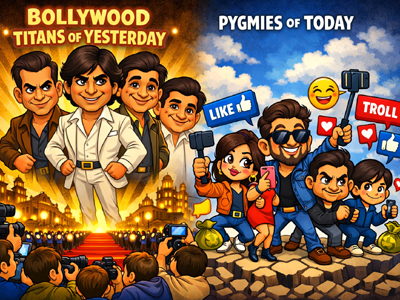
In the golden age of Bollywood, stars weren’t just actors; they were titans who towered over the silver screen, etching their personas into the nation’s collective memory.
Boys mimicked their swagger and hairstyles; girls swooned over their romantic gestures and copied their saree drapes and kohl-lined eyes. Their dialogue delivery was poetry in motion, their mannerisms magnetic, their films drawing houseful crowds for silver jubilees and golden jubilees. Today, that star system has crumbled.
The pygmies straddling screens, here one day, forgotten the next, leave no imprint. Nobody apes their fashion, nobody hums their songs at antakshari parties, and nobody remembers their names beyond the weekend box-office chatter. The fading of true stardom is cinema’s greatest loss.
Consider the male legends who defined an era. Ashok Kumar, the suave patriarch of early talkies, brought understated elegance to films like Kismet (1943), his baritone voice and refined gait making him the first superstar. Sunil Dutt, with his intense eyes and brooding presence, delivered powerhouse performances in Mother India (1957) and Guru Dutt in Pyaasa (1957), blending raw emotion with quiet strength that young men emulated in their kurtas and serious demeanour. Raj Kapoor, the eternal showman, embodied the common man’s dreams in Awara (1951) and Shree 420 (1955). His Chaplinesque walk, the iconic “Mera Joota Hai Japani” number, and lines like “Awara hoon” made him a global icon; boys across India slicked their hair back and donned the Raj Kapoor cap.
Shammi Kapoor, the “Yahoo” rebel, exploded onto screens with wild energy in Junglee (1961). His swivel-hipped dance to “Yahoo! Chahe koi mujhe junglee kahe” set hearts racing; fans copied his leather jackets, tousled hair, and uninhibited style. Dev Anand, the evergreen romantic with his trademark puff hairstyle and tilted cap, charmed in Guide (1965) and Jewel Thief (1967). His cool, sophisticated dialogue delivery and effortless gait made him the style guru for generations. Jeetendra, the dancing star in white pants and cap, lit up Farz (1967) with “Mast Baharon Ka Main Aashiq,” inspiring street dancers everywhere.
Dharmendra, the he-man with his rugged charm and baritone, ruled Sholay (1975) as Veeru. His swagger, the way he delivered punchlines with a mischievous grin, and his earthy appeal in Phool Aur Patthar (1966) turned him into a mass idol; village boys grew moustaches like his. Rajendra Kumar, the “Jubilee Kumar,” delivered hit after hit with his gentle heroism. Balraj Sahni brought realism and gravitas in Do Bigha Zamin (1953), his intense, method-acting style influencing serious theatre actors. Dilip Kumar, the Tragedy King, owned the screen with soul-stirring intensity in Devdas (1955) and Mughal-e-Azam (1960). His measured pauses, piercing gaze, and poetic Urdu delivery in “Pyaar Kiya To Darna Kya” made him the benchmark for depth.
Then came Amitabh Bachchan, the Angry Young Man who redefined heroism in Zanjeer (1973) and Deewaar (1975). His towering frame, clenched fists, and brooding intensity spawned a thousand imitators in bell-bottoms and sideburns. Manoj Kumar, the patriotic hero in Purab Aur Paschim (1970) and Kranti (1981), inspired nationalism with his upright posture and fiery speeches. Even supporting giants left marks: comedian Mehmood’s rubber-faced antics and infectious laughter in Padosan (1968) had families rolling; villain Pran’s menacing stare, gravelly voice, and twisted smile in Zanjeer made him the face of pure evil; boys shivered and copied his villainous gait for fun.
Actresses were no less enviable symbols of glamour and grace. Meena Kumari, the tragedy queen, mesmerised in Pakeezah (1972) with her ethereal beauty. Her kohl-rimmed eyes, flowing ghagra-choli, and melancholic dialogue delivery made her the ultimate muse, women draped sarees like hers. Waheeda Rehman’s graceful poise in Guide (1965) and Kaagaz Ke Phool (1959) combined dance mastery with subtle acting; her elegant salwar-kameez and expressive eyes set trends. Nanda’s innocent charm in Gunga Jumna (1961) and Sadhana’s stylish fringe haircut in Woh Kaun Thi? (1964) became fashion staples.
Vyjayanthimala’s classical dance grace shone in Nagin (1954) and Sangam (1964); her vibrant sarees and expressive eyes inspired a generation. Hema Malini, the Dream Girl, ruled with her fluid dances in Sholay and Seeta Aur Geeta (1972), her long tresses and radiant smile copied by brides nationwide. Mala Sinha’s poised beauty in Pyaar Kii Kasam and Dillagi (1966) added quiet elegance. Vamps like Helen brought sizzling item numbers, “Piya Tu Ab To Aaja” in Caravan (1971), while Zeenat Aman redefined sensuality in Hare Rama Hare Krishna (1971) with “Dum Maro Dum,” her bell-bottoms and bohemian vibe becoming youth icons.
These titans’ films, Mughal-e-Azam, Pakeezah, and Sholay, still draw crowds decades later. Songs haunt, Lata Mangeshkar’s “Pyaar Kiya To Darna Kya,” RD Burman’s pulsating rhythms, Sahir Ludhianvi’s poetic lyrics. Dialogues are quoted in weddings, politics, and daily life. The star system created jubilee hits; fashion houses thrived on their own-screen styles.
The fading of this system is cinema’s heaviest loss. No more larger-than-life icons. Today’s actors come and go like nine-day wonders. Rakhi Sawant remains a loud reality-TV fixture more than a screen legend. Huma Qureshi and Nora Fatehi flash in item numbers or web series but evoke no mass frenzy or copycat fashion. New boys and girls, flashy debuts, quick exits, lack the aura. OTT platforms have trivialised stardom: profanity-laced “realistic” cinema replaces nuanced dialogue. Who recalls a single line from recent blockbusters the way “Kitne aadmi the?” from ‘Sholay’ still echoes?
Storytelling has plummeted. Gone is the era of soft, soothing romanticism, Guide’s soul-searching or Pakeezah’s tragic poetry. Now it’s ugly, gory, loud violence and cacophonous soundtracks. Characterisation is shallow; messaging is preachy or absent. Music? Lyrics are forgettable, beats thumping but soulless, no RD Burman melodies to sing in the bathroom or belt at parties. Songs barely last a month. When almost-nude sequences dominate, where is the scope for elegant fashion, new clothing designs, or styling? Sarees and suits gave way to generic gym wear and ripped jeans that set no trends.
Bollywood’s decline is stark. The star system once built empires; today’s fleeting fame, algorithm-driven releases, and abuse-heavy scripts have eroded lasting appeal. Yet, old remains precious gold. Mughal-e-Azam’s grandeur, Sholay’s camaraderie, and Pakeezah’s elegance still sell tickets and stream endlessly. Their songs endure in antakshari; their mannerisms in cultural memory. The titans built Bollywood’s soul. The pygmies merely rent screen space. In an age of disposable stardom, nostalgia whispers: the past wasn’t just better, it was timeless. As long as classics play, the golden era refuses to dim.
Related Items
When the ‘Hanuman Chalisa’ resounded on the silver screen...
Vanishing newspaper, Fading TV, and the tyranny of tiny screen…
When a classical melody wove an immortal love story on screen…