
 Samiksha Bharti News Service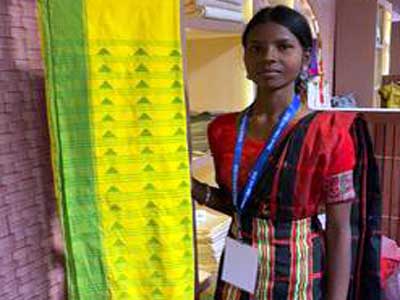
India’s tribal communities are redefining their place in the global economy, transforming forest-based livelihoods into sustainable, high-value products that resonate with modern consumers. This shift from subsistence to enterprise reflects a broader reimagining of tribal economies, where tradition is no longer isolated but integrated into national and global markets.
This transformation is driven by targeted policy interventions, including RISA: A Premium Tribal Brand, alongside programmes like the Van Dhan Yojana and the Tribes India network. Tribal artisans are transitioning from forest-based livelihood economies to active participation in global value chains. What emerges is a story that is equal parts heritage and ambition, where forests meet fashion, and ancient skills find their true market value.
Read in Hindi: ‘वन’ धन से ‘फैशन’ तक, जनजातीय भारत का अतुल उन्नयन
India's tribal economy is being systematically reshaped through institutional frameworks that combine livelihood security with market access. This model enables collective procurement, shared processing infrastructure, skill development, and stronger market linkages, thereby enhancing efficiency and bargaining power. Women in Bastar who process mahua or tamarind are no longer just cultivators; they are emerging as micro-entrepreneurs integrated into formal value chains. At the same time, RISA is elevating tribal craftsmanship, repositioning it as a premium offering in the global marketplace.
Tribal producers bring raw forest produce, minor forest produce and handicrafts to these Van Dhan Vikas Kendras, where quality-grading, value addition, packaging and documentation are done. From there, the products move through Tribes India’s retail network- stores in major airports and premium malls, as well as e-commerce platforms, before reaching international buyers and fair-trade markets.
TRIFED has also forged partnerships with design institutions, including the National Institute of Fashion Technology, to ensure that traditional craft forms are adapted for contemporary consumer preferences without diluting their cultural authenticity. A Dokhra pendant from Chhattisgarh, once sold for a nominal sum to a local intermediary, now commands several times that value under its own certified identity.
The most transformative thread in this story is gender. Women are not passive beneficiaries- they are the producers, leaders, and quality guardians driving change. Women-led cooperatives have become hubs of economic empowerment, enabling collective savings, micro-lending, and shared investment in raw materials. For many, TRIFED has provided their first formal economic identity, turning previously unrecognised subsistence work into documented labour.
24-year-old, Debongshi Chakma, a young entrepreneur from the Chakma tribe, hailing from Kamalanagar in Mizoram’s Lawngtlai district, is quietly scripting a powerful story of change, where tradition is not left behind, but carried forward into the global marketplace. Rooted deeply in Chakma cultural heritage, she is reimagining indigenous knowledge systems as pathways to dignity, identity, and economic empowerment.
As the founder of the Bodhibloom Society, Debongshi leads a vibrant collective of over 500 members, with a strong and conscious emphasis on empowering women, particularly those facing social and economic vulnerabilities, including divorced women. Her initiative goes beyond a single craft, embracing a diversified, community-driven model of livelihood creation. From handwoven textiles and traditional food practices to jhum cultivation and bamboo-based products, her work seamlessly integrates ecology, culture, and enterprise.
Operating in a region where mechanised infrastructure is lacking, Debongshi’s journey highlights the resilience and ingenuity of tribal communities. Her products now reach audiences far beyond local markets, turning traditional practices into sustainable income while preserving cultural authenticity. With global consumers drawn to handcrafted, eco-friendly goods, her work sits at the intersection of sustainability and heritage.
At 23, Urmila Sonwar, a Santhal artisan from Kajri village in Jharkhand, is emerging as a young designer inspired by her cultural and ecological surroundings. Her work draws on “Barah Khand”, a sacred local ritual, and the mountainous landscape of her village, translating these elements into handwoven sarees that are both visually striking and deeply rooted in identity.
Having completed her schooling up to Class 12, Urmila dedicated herself to weaving, turning heritage into livelihood while preserving indigenous traditions. Her designs not only sustain her economically but also bring wider recognition to Santhal culture, positioning local crafts in broader national and global markets. Through her work, she embodies a new generation of artisans who are cultural ambassadors, carrying forward their community’s legacy with creativity and purpose.
For 42-year-old Sangeetha, a Toda artisan from the Nilgiri Hills of Tamil Nadu, embroidery is not a learned skill but a lifelong inheritance. Working with red and black thread on coarse white cotton, she creates intricate geometric patterns passed down through generations of women.
With the Toda community numbering barely a thousand, this tradition remains deeply fragile. Most pieces seen beyond the Nilgiris are the result of decades of practice, begun as early as adolescence. Sangeetha serves as both practitioner and bridge, carrying this craft to wider platforms while ensuring recognition and returns reach the women who sustain it.
At 45, Anita Rana, of the Tharu tribe in Udham Singh Nagar, Uttarakhand, demonstrates how traditional ecological knowledge can power sustainable livelihoods. As part of a women’s collective now spanning over 300 members, she has gained better market access, fair pricing, and opportunities to showcase her work at platforms like the SARAS Fair and tribal festivals.
Her craft centres on Munja grass weaving- a seasonal, biodegradable resource transformed into functional items such as roti hot cases, offering an eco-friendly alternative to plastic. By training younger women, Anita is preserving this indigenous practice while enabling dignified livelihoods within her community. Her journey reflects how sustainability, tradition, and enterprise can come together to create a lasting impact.
As India’s tribal communities step into global value chains, one thing is clear- what tribal artisans create cannot be replicated by machines, and that very uniqueness has become their strongest advantage in an era of mass production.
Overall, from forest produce to global design spaces, tribal India is not just producing goods- it is shaping a model of development that is sustainable, inclusive, and deeply rooted.
Related Items
Western Media is ‘tough’ on India but ‘soft’ on China!
From 'Beacons' to 'Landmarks', India’s changing ‘Lighthouse’ story…
Where the forest whispers and the cuckoo keeps time…