
 Samiksha Bharti News Service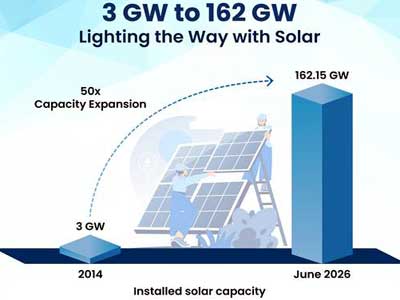
A decade ago, solar power occupied only a small place in India's electricity mix. Today, it forms the largest share of the country's renewable energy capacity. From an installed capacity of approximately 3 GW in 2014, the sector has expanded more than fiftyfold, reaching 162.15 GW as of June 30.
This transformation is driven by policy support, infrastructure development, manufacturing expansion, and citizen participation. Initiatives such as solar parks, rooftop systems, and solarised agricultural pumps are accelerating deployment across the country.
Read in Hindi: सौर ऊर्जा विकास के एक नए युग में प्रवेश कर रहा है भारत
The coordinated momentum has translated into measurable outcomes. The country has added 37 GW of solar capacity in 2025, surpassing the United States in annual additions. India has also emerged as the world's second-largest solar growth market, underlining its growing role in the global clean energy transition.
Solar deployment spans diverse geographies and climatic zones. Rajasthan, Gujarat, Karnataka, Tamil Nadu, Andhra Pradesh, and Maharashtra account for a significant share of installed capacity. Large solar projects contribute 118.79 GW of installed capacity. Some of the large solar projects include the Bhadla Solar Park (Rajasthan), Pavagada Solar Park (Karnataka), and Rewa Ultra Mega Solar Park (Madhya Pradesh).
Rooftop solar systems connected to the electricity grid contribute another 27.88 GW. The remaining capacity comes from hybrid solar projects and off-grid solar systems. Hybrid projects combine solar power with battery storage or other power sources, while Off-grid systems provide electricity in areas not connected to the grid.
FY 2025–26 marked a milestone year for India's RE sector, with record additions in both solar and non-fossil fuel capacity. India added 44.61 GW of solar capacity, nearly double the 23.83 GW added in FY 2024–25. Solar module manufacturing capacity increased from 2.3 GW in 2014 to about 172 GW as of 31 March 2026.
Total non-fossil fuel capacity reached 283.46 GW, including 274.68 GW of renewable energy capacity. Highest-ever annual addition of non-fossil fuel capacity recorded at 55.29 GW.
On 29 July 2025, renewable energy sources met 51.5 per cent of India's electricity demand, the highest monthly share recorded so far. A stable policy framework, competitive bidding mechanisms, and long-term targets have helped create a conducive environment for large-scale solar deployment.
Strong and sustained demand has been central to India's solar growth. The National Solar Mission established long-term capacity targets and provided an early impetus to solar deployment.
Procurement agencies such as the Solar Energy Corporation of India have played a key role in scaling this transparent tariff discovery mechanism. As more developers participated, the tariffs declined from around ₹18 per unit in 2010 to a record-low of ₹2.44 per unit. This remarkable achievement was attained at the Bhadla Solar Park auction in 2017. This made solar power more affordable and accelerated its adoption across India.
The decline in tariffs has made solar power increasingly affordable. As a result, India has emerged as one of the world's lowest-cost solar power markets. In 2025, the Levelised Cost of Electricity from utility-scale solar PV stood at USD 35 per MWh, well below the global average of USD 44 per MWh.
Launched in 2021 with an initial outlay of ₹4,500 crore, the PLI Scheme for High-Efficiency Solar PV Modules was expanded in 2022 with an additional ₹19,500 crore. The scheme promotes domestic manufacturing, reduces import dependence, and encourages value addition across the solar value chain. By October 2024, the scheme had attracted investments of around ₹35,000 crore. It had also generated direct employment for about 10,000 people.
Introduced in 2019, the Approved List of Models and Manufacturers (ALMM) is a quality assurance framework for solar PV modules and cells. It ensures that solar equipment used in eligible projects meets specified quality and performance standards. Only manufacturers and models included in the approved lists are eligible for specified government-supported and competitively bid solar projects. The framework also promotes domestic manufacturing by encouraging the use of approved products.
Together, the PLI Scheme and ALMM have strengthened India's domestic solar manufacturing ecosystem. They have supported greater self-reliance while enabling rapid expansion of solar deployment. The framework also provides greater confidence to consumers and project developers by ensuring the use of approved solar equipment.
India's solar transition extends beyond large-scale power plants. Through dedicated schemes for households and farmers, solar is improving energy access, reducing electricity costs, and creating new livelihood opportunities.
India's leadership in solar energy extends beyond its borders. The country is strengthening international cooperation, technology exchange, and capacity building.
Co-founded by India and France at COP21 in Paris in 2015, the International Solar Alliance has emerged as a key platform for global solar cooperation. The Alliance brings together countries including the Maldives, Greece, Germany, Italy, Bhutan, Luxembourg, and Argentina to accelerate solar deployment and share knowledge and technology. The ISA has evolved into an important platform for cooperation among member countries.
Proposed by India in 2018, One Sun One World One Grid is a vision for an interconnected global renewable energy network. To advance this vision, India and the United Kingdom launched the Green Grids Initiative–One Sun One World One Grid (GGI–OSOWOG) at COP26 in 2021. The initiative is supported by Australia, France, the United States, and the International Solar Alliance. It promotes cross-border RE trade through interconnected electricity grids, strengthening energy security and accelerating the clean energy transition.
Through the ISA and other partnerships, India has strengthened renewable energy cooperation across the Global South. During its G20 Presidency, India also helped build consensus on tripling global renewable energy capacity by 2030.
India's achievements in the solar market reflect sustained policy support, expanding manufacturing, strengthened infrastructure, and growing public participation. As India progresses towards its Panchamrit commitments and net-zero target by 2070, solar power will remain a key pillar. It will continue to drive the clean energy transition.
Related Items
The biggest ‘Cosmic Con’ of ‘Power Brokers’
Western Media is ‘tough’ on India but ‘soft’ on China!
Building the infrastructure for growth in Jammu and Kashmir…