
 Brij Khandelwal
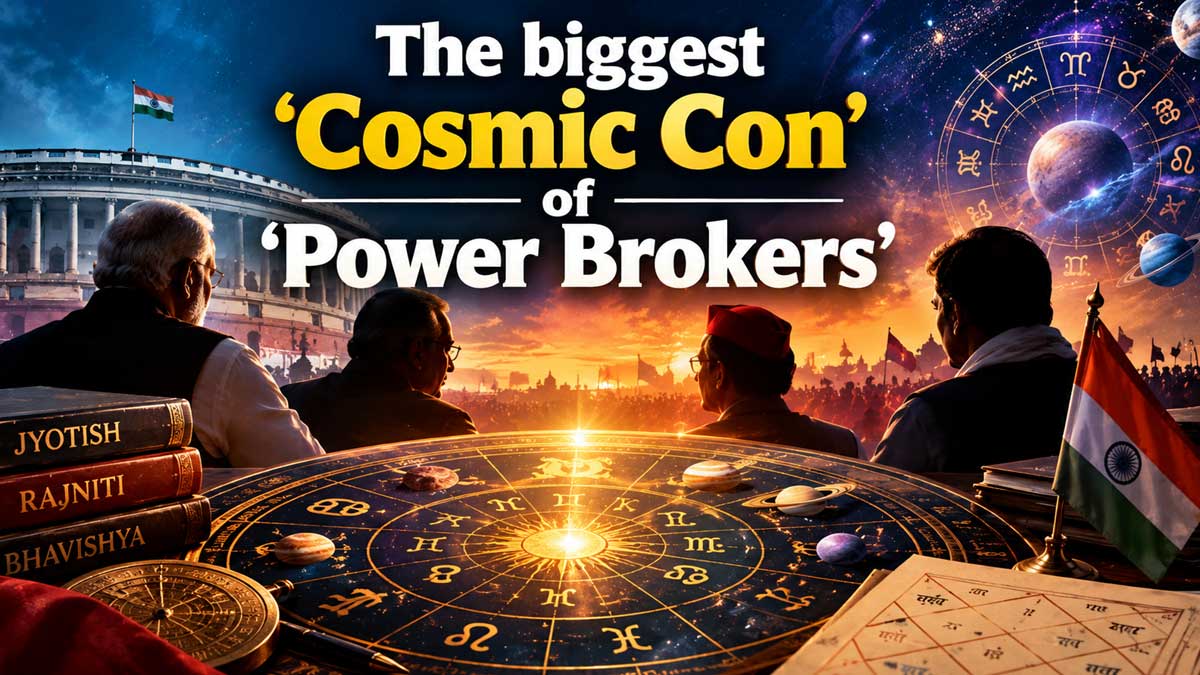
Tamil Nadu Chief Minister C Joseph Vijay recently appointed his personal astrologer as an Officer on Special Duty in the Chief Minister’s Office. The news spread like wildfire. Reports claimed that this very astrologer had ‘predicted’ years ago that Vijay would one day rise to power. Within hours, political circles erupted. Alliance partners objected. Rationalism, constitutional values, and scientific temper were invoked. Eventually, the government was forced to retreat.
Yet the larger question still hangs in the air. Will democracy now run according to planetary movements? Will Saturn, Rahu, and Mars decide the destiny of millions? Or is this merely the oldest business of fear, insecurity, and power: repackaged for every generation in glittering cosmic wrapping?
Also read: सत्ता के सौदागरों का सबसे बड़ा ‘कॉस्मिक झांसा’
India’s relationship with astrology is ancient. Kings once marched into battle only after consulting royal astrologers. Families still match horoscopes before marriage, even as broken relationships continue to rise. Traders once studied birth charts before long journeys. Reading daily horoscopes with morning tea has become a social ritual, as though every sunrise carries a confidential celestial order.
But election season turns this business into a carnival. Television studios suddenly resemble cosmic war rooms. Every channel parades its resident ‘star expert’. One astrologer topples governments through Saturn. Another predicts electoral victories through Rahu. A third calculates the lifespan of coalitions from Mercury’s movement. Democracy begins to resemble a reality show scripted by planets.
Political parties enthusiastically join the spectacle. Candidates file nominations only at ‘auspicious’ moments. Rally dates are chosen according to planetary alignments. Gemstone dealers, numerologists, and fortune-tellers roam party offices like permanent campaign consultants. Politics begins to look less like governance and more like a travelling mystical fair.
The truth is simple. Elections are seasons of fear and uncertainty. Politicians crave power. Television channels chase ratings. Citizens struggle with inflation, unemployment, and anxiety. In such moments, logic weakens, and emotional reassurance becomes attractive. Astrology sells certainty in uncertain times.
The media’s role in this drama is equally troubling. Celebrity astrologers are often presented with the same seriousness as scientists or economists. One predicts economic collapse. Another warns of political instability. A third announces national disaster. If nothing happens, there is no accountability. The same experts return to television screens the following week, brighter and more confident than ever.
Most dangerous of all are the merchants of fear: the doomsday babas who turn planets into instruments of panic. Through dramatic warnings of war, pandemics, destruction, and national catastrophe, they market anxiety as wisdom. Fear has always been profitable. Calm reasoning rarely is.
India’s spiritual tradition is profound. It carries centuries of philosophy, introspection, and intellectual inquiry. But sensational television prophecies and blind faith packaged as entertainment are steadily weakening society’s rational instincts. Democracy survives on informed, alert citizens: not frightened horoscope addicts.
The scientific reality is uncomfortable for astrology’s defenders. Astrology has repeatedly failed rigorous scientific testing. Its central claim is that distant planets influence personality, relationships, careers, and destiny. Yet no credible scientific explanation exists for how Mars or Saturn, millions of kilometres away, can determine someone’s marriage, job, or electoral fortune.
Physics does acknowledge gravitational influence between celestial bodies. But that influence is so microscopic that medical equipment present in a delivery room can exert a stronger physical effect on a newborn than distant planets ever could. Still, belief persists. Why? Because astrology functions more through psychology than science.
Human beings are natural pattern-seekers. We search for meaning in chaos. During difficult times, we crave reassurance, hope, and emotional anchors. Astrology provides all three, wrapped in mysterious language and theatrical certainty.
Most horoscopes are deliberately vague: “A challenge may arise today.” “An old relationship could return.” “Exercise caution in financial matters.” Such statements apply to almost everyone at some point. Psychologists call this the Barnum Effect: the tendency of people to interpret broad, generic statements as deeply personal truths.
A famous experiment published in the journal Nature in 1985, along with several later studies, found that professional astrologers performed no better than random chance. Different astrologers interpreted the same birth chart differently. Many celebrated predictions repeatedly failed. Yet occasional lucky guesses received massive publicity, while failed prophecies quietly disappeared into silence.
There is nothing wrong with reading a horoscope over morning tea. The danger begins when planetary positions replace reason, evidence, and common sense in major life decisions. A businessman delays investment because Mercury is ‘in retrograde’. A family rejects a perfectly suitable marriage proposal because horoscopes clash. A patient abandons medical treatment because “Saturn is heavy.” A political leader stops listening to citizens and starts listening to astrologers.
The night sky is magnificent. Stars inspire awe. Planets ignite imagination. The universe is filled with wonder. But beauty is not proof. And mystery is not always truth.
Related Items
Income disparity between partners at home stalls women’s careers
Rival firms make the best partners when developing new technology
'GDN' documents the industrial and political challenges of GD Naidu's era