
 Brij Khandelwal
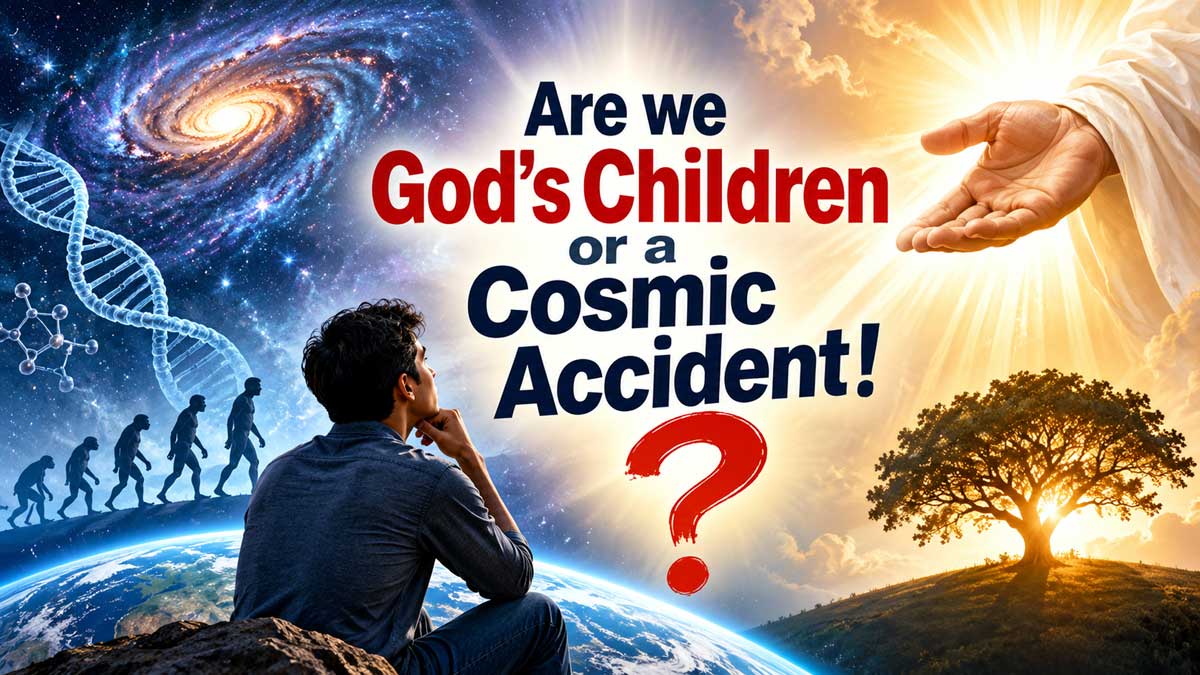
How did this universe come into existence? Who arranged this magnificent caravan of stars? Who lit the fire inside the Sun and gave the Moon its glow? How did oceans, mountains, forests and finally human beings appear on Earth? And now, here we are, chest out, asking the biggest question of all: Who created us?
Are we special children of God? Or merely the result of a series of extraordinary accidents billions of years ago? Did some mysterious chemical experiment turn lifeless matter into living creatures? Was life the lucky winner of the greatest lottery in the history of the universe? The question is fascinating. The answer is far more complicated.
On November 24, celebrated worldwide as Evolution Day, in 1859, Charles Darwin published his revolutionary book, On the Origin of Species. It shook centuries-old beliefs and changed our understanding of life.
Darwin argued that living creatures were not always the way we see them today. They changed over millions of years. Species gradually adapted to their surroundings. Those better suited to survive had greater chances of producing offspring and passing on their characteristics.
This process is called natural selection. Nature runs a strange court. There are no recommendations, no bribes and no special privileges. Survival depends largely on adaptation. Those who cannot adjust may disappear. Those who adapt successfully continue their journey.
Darwin's theory transformed biology. But hold on! Did the gentleman solve every mystery of life? Certainly not. His theory explains how living organisms change and evolve after life has begun. It does not explain how the first living organism appeared. In other words, Darwin helped explain the middle chapters of the story. The opening chapter remains unfinished.
Modern science tells us that Earth formed about 4.6 billion years ago. A massive cloud of gas and dust collapsed under gravity. The Sun emerged, followed by planets formed from the remaining material. Early Earth was extremely hot. Gradually, it cooled, water accumulated, and oceans appeared. Then something extraordinary happened. Lifeless chemicals somehow gave rise to life. But how? Here, the pages of science's book become less certain.
Scientists believe that chemical reactions involving water, gases and minerals may have produced the building blocks of life. Deep-sea hydrothermal vents are another possible birthplace. Laboratory experiments have successfully produced several important organic molecules under conditions resembling those of early Earth.
But producing chemicals is one thing. Creating a living cell is quite another. How did lifeless matter develop the ability to reproduce? How did the first cell acquire its complicated machinery? Where did its biological instructions come from? How did it learn to obtain and use energy?
Scientists across the world are investigating these mysteries. The study of life's emergence from non-living matter is called abiogenesis. Some important clues have emerged, but no complete explanation has yet been established.
Perhaps nature conducted the greatest experiment ever performed. Unfortunately, the laboratory records are missing. The scientist responsible has also left no visiting card. Even the watchman seems to have gone on leave!
Another popular misunderstanding needs correction. Darwin never claimed that today's monkey suddenly turned into a human being. Humans and modern monkeys share ancient common ancestors. Their evolutionary branches separated millions of years ago and followed different paths.
The fossil record also presents interesting puzzles. Around 540 million years ago, during the Cambrian period, many major animal groups appeared in the fossil record within a relatively short geological interval. Scientists call this the Cambrian explosion.
Was it really an overnight miracle? No. It involved biological and environmental developments over millions of years. Yet many details of this extraordinary period remain subjects of research.
What about the human eye, the brain, the immune system and the astonishing machinery inside our cells? Evolutionary biology offers explanations for many aspects of their development. Research continues to refine our understanding. Missing details do not automatically destroy an established scientific theory. They simply remind us that discovery is unfinished business.
But why worship Darwin in the name of science? Some admirers treat him almost like a new god who solved every mystery of existence. Science needs no new gods. It needs evidence, questions, experiments and healthy arguments.
Religion has its own world of explanations. The Bible describes creation through God's will. Hindu philosophy speaks of endless cycles of creation and destruction. Faith offers spiritual meaning, moral guidance and a sense of purpose. Science investigates natural processes and seeks explanations through evidence.
Problems begin when religious beliefs are presented as established scientific facts. The same applies when scientific theories are treated as unquestionable articles of faith.
Supporters of intelligent design argue that life's complexity suggests the involvement of an intelligent creator. Scientists respond that complexity alone cannot establish the existence of a designer. Such a claim requires testable evidence. Intelligent design is not recognised as an established scientific alternative to evolution.
Still, several questions continue staring at us from the sky. Why does the universe exist? Why are its physical laws suitable for stars, planets and life? How did lifeless matter acquire life? How did human beings become intelligent enough to write poetry, travel to the Moon and manufacture nuclear bombs, only to fight over whether God exists?
Was everything planned? Is life simply a remarkable chain of accidents? Or is there some deeper mystery that neither religion nor science has completely understood?
Salute Darwin. He gave humanity a fresh way of looking at nature and its own past. But there is no need to turn him into God. Respect religion, too, but do not mistake every religious story for a scientific textbook.
The beauty of science lies not only in its answers but also in its questions. What appears mysterious today may become understandable tomorrow. That is the real strength of human curiosity.
And if we really are the product of billions of years of extraordinary accidents, then these accidents deserve a standing ovation. What remarkable performers they have been!
In the vast history of the universe, humanity is only a recent arrival. Yet look at our arrogance! Sometimes we behave like owners of creation. Sometimes we imagine ourselves God's favourite children. And sometimes we sit down to calculate the secrets of the entire cosmos. Wonderful, isn't it?
Humanity has travelled far in evolution. But the development of wisdom is clearly still a work in progress!
Related Items
Politics, the secret elixir of a long life…!
Divorce late in life can improve men’s mental health
The biggest ‘Cosmic Con’ of ‘Power Brokers’