
 Brij Khandelwal
When Indian Prime Minister Narendra Modi visited Norway in May, a Norwegian journalist threw a question at him after a press conference had ended. The question was: why does India rank far below Norway on the Press Freedom Index?
The video went viral. Western media outlets quickly projected it as proof of the ‘decline of democracy’ in India. Also read: भारत पर ‘सख़्त’ और चीन पर ‘नरम’ है पश्चिमी मीडिया
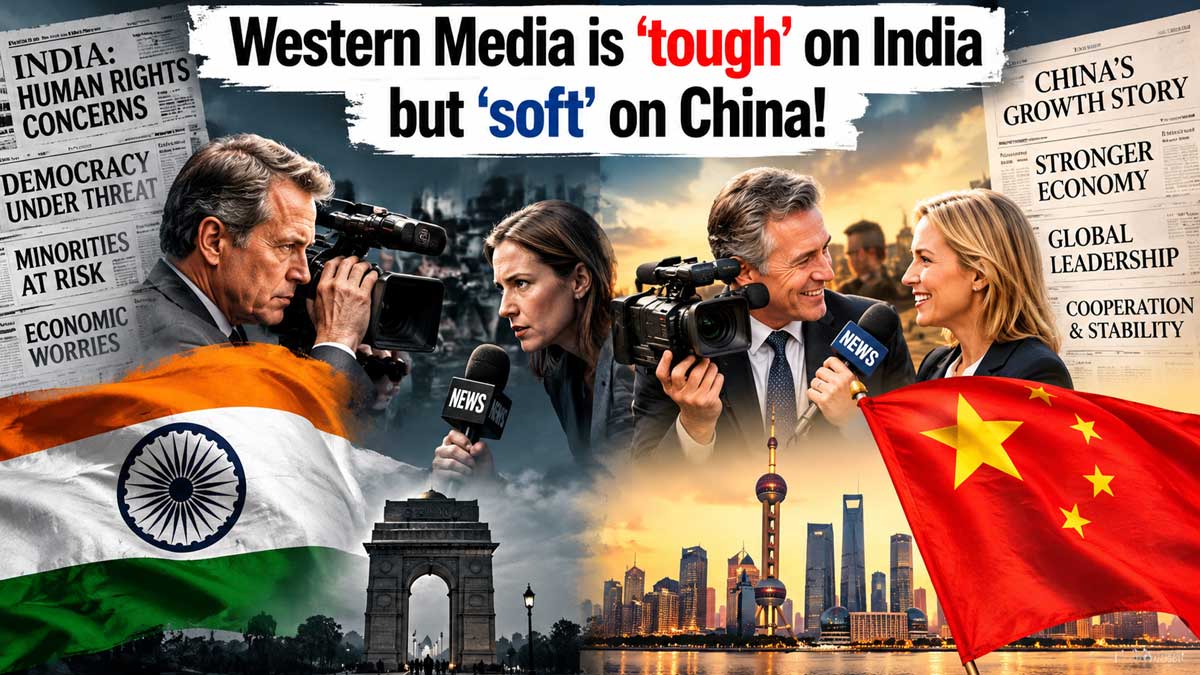
But pause for a moment. When was the last time a Western journalist publicly created a similar spectacle over China’s press freedom record?
China sits near the bottom of the same rankings. Yet criticism of China rarely turns into the kind of dramatic headlines that India receives. That is where the story of double standards begins. Western media often shines an intense spotlight on India’s flaws.
The Citizenship Amendment Act was portrayed as anti-Muslim. The farmers’ protest was described as evidence of ‘authoritarian tendencies’. The horrifying visuals from India’s second Covid wave were broadcast across the world. Election coverage repeatedly raised questions about ‘Hindu nationalism’ and majoritarian politics.
Public commentator Prof Paras Nath Chaudhary asks an important question: reporting on such issues is not wrong. Journalism must ask difficult questions. But why is the tone used for India so harsh, while the same sharpness often disappears in the case of China?
China has been accused of detaining millions of Uyghur Muslims in camps in Xinjiang. These reports do appear in Western media. Yet China is rarely subjected to the same constant narrative that ‘democracy is under threat’ or that ‘the system is collapsing’. Why? Because the world never expected democracy from China in the first place.
India is a democracy, and therefore higher ideals are expected from it. When it falls short of those ideals, criticism becomes far more severe.
The politics of language also reveals a great deal. Media shapes perceptions not only through facts, but through the words it chooses, says senior journalist Joseph.
For India, terms like ‘backsliding’, ‘majoritarian’, and ‘Hindu nationalism’ are frequently used. Reporting on Hindu-Muslim tensions sometimes carries echoes of an old colonial mindset — the idea that India is divided, emotional, and disorderly.
For China, on the other hand, words such as ‘stability’, ‘efficient governance’, and ‘development’ are more common. Harsh state actions are sometimes framed as examples of ‘strong governance’. Economic success is praised, while human rights concerns often move to the background. This is not just media bias. It is also the shadow of history.
During British colonial rule, India was often portrayed as superstitious, chaotic, and in need of ‘Western guidance’ to justify imperial control. Today, traces of that thinking can still be seen in more polished and sophisticated forms.
Openness is another reason behind this imbalance. India’s press remains relatively open. Foreign journalists can travel freely, meet people, and report on controversial issues. Naturally, India’s shortcomings become more visible to the outside world.
China tightly controls foreign media access. Reporting from there is far more difficult. As a result, fewer stories emerge.
That does not necessarily mean India is worse. Sometimes it simply means India is a more open society.
Western countries also have major business and strategic ties with China. That reality influences the media environment too, whether directly or indirectly.
Excessively aggressive criticism of China can create diplomatic and economic tensions.
Questioning India is comparatively easier because India is viewed as a democratic partner where criticism is still tolerated.
Why does this difference matter? Because media perception does not remain confined to newspapers and television screens. It influences investors, policymakers, and ordinary people. It affects trade, foreign policy, and global public opinion.
A country of 1.4 billion people, lifting millions out of poverty, running the world’s largest electoral exercise, and rapidly emerging as a technological power cannot be understood only through a negative lens. That creates an incomplete picture.
If Western media spends all its moral outrage only on open democracies, then closed and authoritarian systems may face less pressure for accountability.
Newsrooms in the West should create more space for Indian and Global South voices. India should not be judged only against Western models, but also against countries facing similar social and economic challenges.
India has problems. Questions about press freedom, communal tensions, and political polarisation must absolutely be asked. But the same standards should apply equally to every country, including China.
At the moment, that balance does not appear to exist. And that contrast in the coverage of India and China says as much about the worldview of Western media as it does about the two nations themselves.
Related Items
An Indian traveller’s eye-opening lessons in the ‘Art of Living’
From 'Beacons' to 'Landmarks', India’s changing ‘Lighthouse’ story…
Are Indian borders just lines on a map!