
 Brij Khandelwal
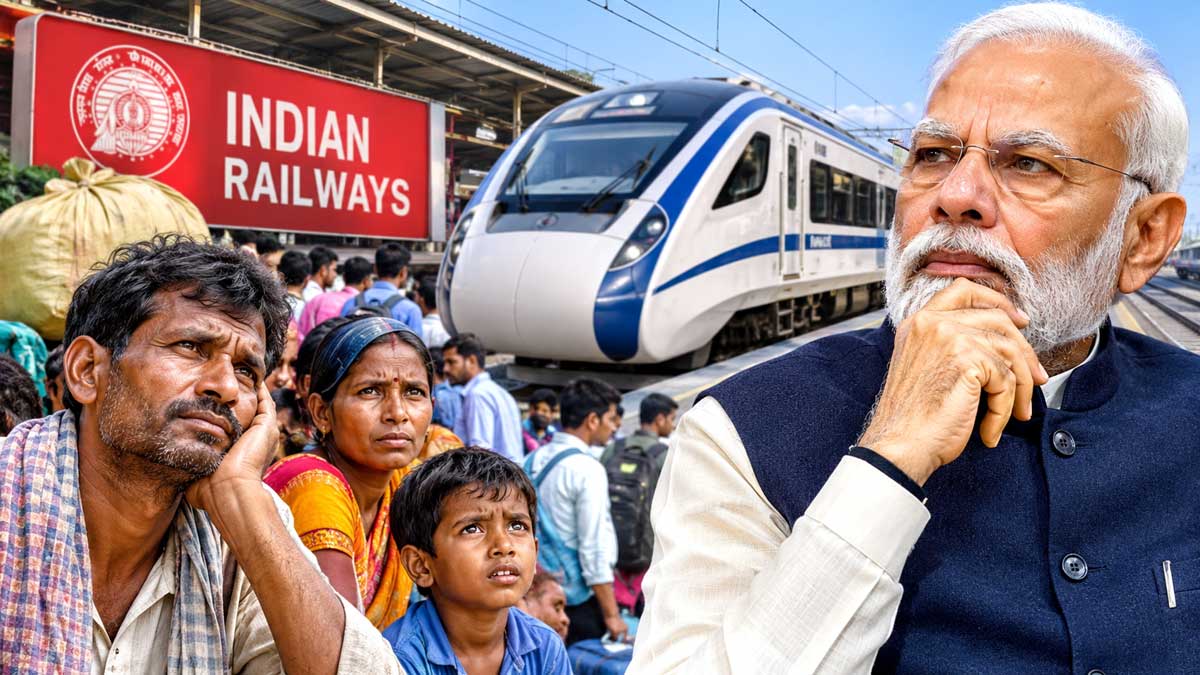
Madhu Dandavate worried about second-class passengers. Lalu Prasad Yadav brought AC comfort within reach of ordinary families. Mamata Banerjee thought of unemployed youngsters. Today, bullet trains, Vande Bharat and glittering stations dominate the headlines. But who cares about the millions squeezed into overcrowded general compartments?
A railway minister once asked a simple question: Why should air-conditioned travel remain the privilege of the rich? Another wanted unemployed youngsters to travel cheaply. Someone else worried about the miserable conditions of second-class passengers.
Today the big dream is a bullet train racing at 300 kilometres per hour. But here is an uncomfortable question: What about the millions who cannot even find a seat in an ordinary train?
Welcome to two different worlds of Indian Railways. One enjoys automatic doors, plush seats, modern interiors and premium services. The other fights for a foothold, squeezes into overcrowded compartments and struggles to reach home during festivals.
Both are citizens. Both contribute to the nation’s economy. But does the government care equally about their journeys?
Indian Railways was once proudly called the lifeline of the common man. Railway ministers were judged by their ability to connect villages, towns and distant cities. Affordable travel, passenger comfort and wider connectivity mattered politically.
Look at the priorities of earlier railway ministers. Their styles differed, but several initiatives reflected one common idea: railways must serve ordinary people.
Madhu Dandavate, Railway Minister from 1977 to 1979, believed in putting passengers first. He consulted railway unions, passenger associations and economists. His 1977-78 Railway Budget avoided increases in passenger fares and freight rates. He emphasised better facilities for second-class passengers, famously adding two inches of foam to hard wooden berths so that the poor could travel with a measure of dignity. His philosophy was straightforward: railway development must begin with those who need public transport most.
Then came Lalu Prasad Yadav (2004-09), with an idea that caught the public imagination: Garib Rath. Why should the poor remain condemned to uncomfortable journeys? Why should AC travel be reserved for people with fat wallets? Introduced in October 2006, Garib Rath offered AC three-tier travel at fares roughly 25 per cent below conventional AC three-tier fares, sometimes even lower in practice through higher capacity. It was not a perfect experiment, but its social message was powerful. Poor families deserved comfort too. They should not have to choose between affordable travel and basic dignity.
Mamata Banerjee (2009-11) brought another dimension. Her Yuva Express targeted unemployed youngsters and low-income travellers. Fares were capped at Rs.299 for journeys up to 1,500 kilometres and Rs.399 for journeys up to 2,500 kilometres. She also introduced Duronto services. Not every initiative was designed exclusively for the poor, but affordable mobility for young people found a place in her programme.
These ministers were no saints. Their policies had limitations, and some promises remained unfulfilled. But the common passenger was part of their political imagination.
The railway development story has changed dramatically under Narendra Modi. Vande Bharat has become the flagship. Sleek coaches, modern interiors, faster acceleration and impressive publicity have turned it into the face of railway modernisation. The Mumbai-Ahmedabad bullet train project promises another technological leap. Metro networks are expanding. Railway stations are receiving expensive makeovers. Premium services attract considerable political attention.
According to Railway Ministry figures, by early 2026 India had around 162-164 Vande Bharat Chair Car services, a handful of Vande Bharat Sleeper services, and a growing number of Amrit Bharat services. These achievements deserve recognition. India needs modern technology, faster trains and better infrastructure. Nobody wants the railways frozen in the past.
But modernisation cannot become an excuse for neglecting ordinary passengers. The bullet train remains a project under construction, yet it has become a powerful symbol of national ambition. Vande Bharat launches generate headlines, speeches and photographs. Beautifully renovated stations provide excellent inauguration opportunities.
But who celebrates the addition of ordinary coaches? Who inaugurates a clean public toilet? Who takes political credit when a poor worker gets a confirmed ticket?
The problem is not premium trains. It is the imbalance between political glamour and public necessity.
Millions depend on general and sleeper compartments. Workers travel from Bihar and eastern Uttar Pradesh to Delhi, Mumbai and industrial centres. Students visit their hometowns. Small traders, farmers and families depend on affordable rail travel. Their everyday experience is often miserable. Overcrowding, waiting lists, dirty toilets, water shortages and passengers spilling into reserved coaches remain familiar complaints. For them, a railway journey is not a luxury holiday. It is a lifeline.
There is another painful example of changing priorities: the withdrawal of senior citizen concessions. Before March 2020, women aged 58 and above received a 50 per cent concession on basic fares. Men aged 60 and above received 40 per cent off. COVID-19 arrived, and the concessions disappeared. The pandemic passed. Trains resumed. Restrictions vanished. Vande Bharat expanded. New premium services arrived. But the senior citizen discount never came back.
The government has defended its decision by pointing to a large overall subsidy on passenger tickets. Yet an RTI reply showed the railways earned thousands of crores extra over five years by withdrawing the specific senior concession. The Parliamentary Standing Committee on Railways has repeatedly recommended reviewing and restoring concessions for senior citizens, particularly in Sleeper and AC Three-Tier classes. The government has not restored the benefit.
A country’s progress cannot be measured only by the speed of its trains. It must also be measured by the dignity it offers its poorest passengers.
The Railway Ministry should publish a transparent ten-year account of its investments. How much has gone into bullet trains and premium services? How much into general coaches, sleeper coaches, ordinary passenger trains, suburban services and basic amenities?
The government must answer some uncomfortable questions. Can a migrant worker travel home without risking his life? Can a student afford a ticket? Can a poor family secure a berth? Can senior citizens visit their children without emptying their savings?
A bullet train may announce India’s arrival in the future. But an overcrowded general compartment tells us how far millions still have to travel. Railway modernisation is welcome. But the common passenger must not become its forgotten casualty.
After all, Indian Railways belongs to the people, not merely to those who can afford its premium seats.
Related Items
‘Mother of All Deals’ or Modi's Masterstroke!
Indira Gandhi’s declared 'Emergency' vs Modi’s ‘Undeclared'
How far has Modi travelled from promise to delivery…