
 Brij Khandelwal
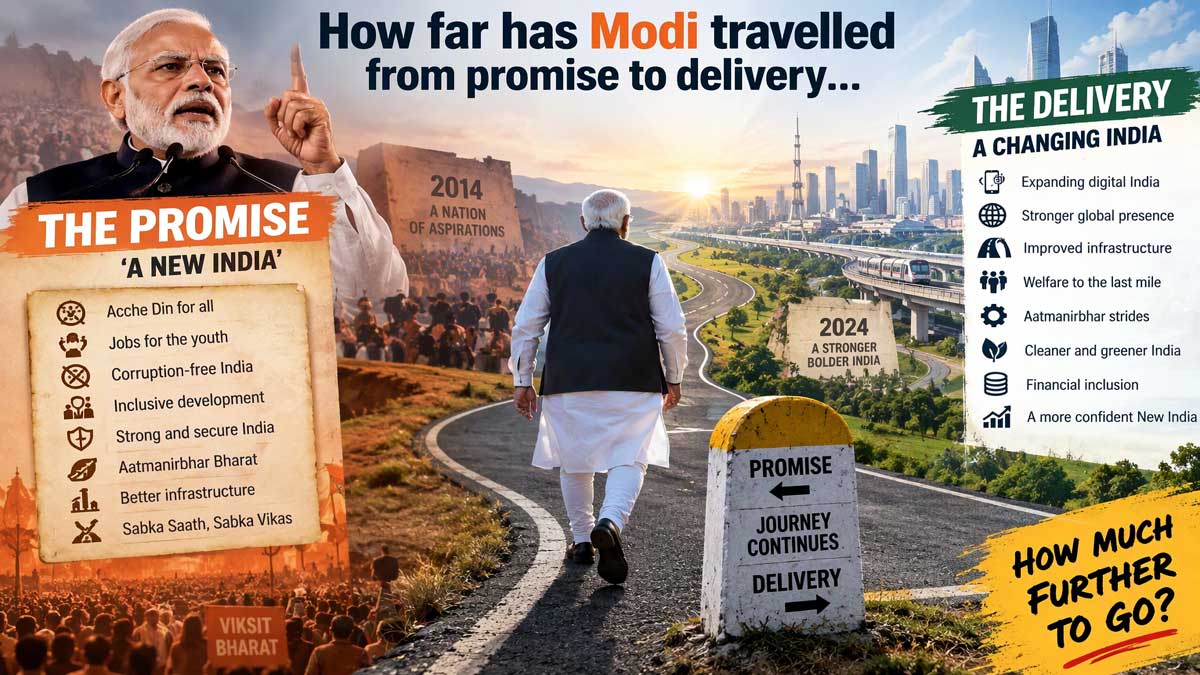
What happened to the two crore jobs a year? Are our rivers really cleaner? Are our cities smarter, or just better at putting up smart boards? Has corruption gone down, or have we simply learnt to live with it? And after twelve years, how much of the distance between promise and delivery has actually been covered? These are not academic questions. They are questions people ask over tea, at railway stations, in offices and inside their homes.
In 2014, Narendra Modi arrived with a big promise of change. Jobs. Clean governance. Better infrastructure. Faster development. A new India. Also read: बारह साल बाद भी वादों और डिलीवरी के बीच बढ़ता फासला!
There is no denying that a lot has happened since then. Highways have been built. Airports have expanded. Digital services have grown. India has become more visible and confident on the world stage. But politics is not a PowerPoint presentation. At some point, the citizen asks a very simple question: "Fine. But what changed in my life?" That is where the story becomes less comfortable.
In the Swachh Bharat campaign, toilets were built, but what happened next? Swachh Bharat was one of the government's most ambitious campaigns. Millions of toilets were built. That was a genuine achievement. But a toilet is not the same thing as sanitation. Some toilets remain locked. Some have no water. Some villages declared open-defecation free have not gone through proper verification. Sewage and waste management remain poor in many places. And then there is the uncomfortable truth that manual scavenging has not disappeared. We built toilets faster than we changed the system around them.
The same problem haunts Namami Gange. Thousands of crores have gone into cleaning the Ganga. Sewage treatment plants have been built. Projects have been inaugurated. Speeches have been delivered. Yet sewage still enters the river. A river, unfortunately, does not read government press releases. It knows only what is actually flowing into it.
Then came the Smart Cities Mission. The idea was attractive. Who doesn't want smart cities? But in many places, the ‘smart’ city became a smart neighbourhood. A few roads were beautified. Cameras appeared. Wi-Fi was promised. Command centres came up.
Meanwhile, ordinary citizens continued to deal with overflowing drains, garbage, traffic jams, broken footpaths and inadequate public transport.
There is a simple test for a smart city. Ask a pedestrian. Can she cross the road safely? Ask a cyclist. Can he ride without risking his life? Ask a commuter. Can he reach work without spending two hours in traffic? If the answer is no, the city still has some homework left.
Roads and bridges are visible. Institutional reform is not. Police reform has moved painfully slowly despite Supreme Court directions dating back to 2006. Vacancies, political interference and custodial abuses remain concerns.
Our education system continues to suffer from examination leaks and poor employment prospects for graduates.
Courts remain burdened with enormous backlogs. Public hospitals remain overstretched. These are not problems that can be solved by inaugurating a building. Institutional reform is boring politics.
And then came the jobs question. Perhaps no promise has come back to haunt the government more than jobs. The 2014 election created enormous expectations among India's young population. The much-quoted promise of two crore jobs every year became part of the political conversation. Twelve years later, unemployment and underemployment remain major concerns, particularly among educated young Indians.
And here the difference between statistics and real life becomes obvious. A graduate does not eat GDP. He needs a job. A family does not celebrate economic growth while worrying about the next LPG cylinder, school fee or grocery bill. This is why unemployment and prices keep appearing near the top of public concerns.
Farmers are still waiting. The promise to double farmers' incomes by 2022 also remains unfinished business. Farmers protested for a year against the three farm laws introduced in 2020. The government eventually withdrew them. Whatever one's view of those laws, the episode exposed a deeper problem.
Too many reforms are announced from the top and explained to people afterwards. That is not always a good way to run a democracy.
Farmers do not want sympathy speeches. They want a reliable income, fair prices, water, electricity and a market that does not punish them for producing too much.
India needs development. Nobody disputes that. But must every road come with a row of chopped trees? Must every riverfront mean concretising the river? Must every flood be called an act of nature?
Many Indian cities remain among the world's most polluted. Urban flooding has become almost seasonal. Traffic congestion is worsening. Lakes, ponds and natural drainage channels are disappearing under construction.
We keep talking about sustainable development. Sometimes it feels as if we remember the word ‘development’ and forget the word ‘sustainable’.
There was a time when corruption was one of the biggest weapons against the Congress. The BJP came promising a cleaner alternative. But somewhere along the way, corruption seems to have acquired a new political vocabulary.
The Opposition calls it the ‘washing machine’. A politician faces the CBI, ED or Income Tax Department. Then comes a political realignment. Suddenly, the same politician is on the other side of the fence.
Yesterday, someone was accused of corruption. Today, he can be a political partner. This raises an uncomfortable question. Does the allegation disappear when the politician changes sides?
Of course, this is not a new disease in Indian politics. Parties have been buying, borrowing and welcoming defectors for decades. But the BJP once promised to be different. That is why the criticism hurts more.
If yesterday's corrupt politician becomes today's respectable ally, what exactly happened to yesterday's corruption? Did it disappear? Or did the politician simply change the washing machine?
The BJP's great political appeal in 2014 was that it was supposed to be different. Less dynasty. Less corruption. Less appeasement. More governance. Today, critics say the party has absorbed some of the very habits it once condemned.
Governments have fallen. Parties have split. MLAs have crossed the floor. Political loyalties have changed overnight. The Constitution may remain the same. The political furniture keeps moving. And when investigative agencies are accused of acting more aggressively against Opposition leaders than ruling-party politicians, questions naturally arise about institutional independence. These allegations should not simply be dismissed as Opposition propaganda. Nor should every allegation be treated as proof. They deserve answers. Democracy survives not only on elections. It survives on institutions people trust.
There is another side to the story. India's global profile has certainly risen. Major international meetings, diaspora outreach and India's growing diplomatic weight have given the country a stronger presence. That matters. But global prestige cannot compensate forever for domestic failures.
A country may host a spectacular summit and still have a broken footpath outside the venue. It may speak about becoming a global power while a citizen waits months for justice. It may boast of digital India while a village struggles with basic sanitation. Both realities can exist at the same time. So, what is the report card?
Perhaps the fairest way to judge twelve years is not to ask whether Modi has achieved nothing. He clearly has. The better question is this: Has the scale of delivery matched the scale of the promise? That is where doubts remain.
India has built impressive infrastructure. But institutions remain weak. India has become more digital. But millions still struggle for decent jobs. India talks proudly about cleanliness. But rivers and cities remain polluted. India has become more powerful internationally. But basic civic discipline remains poor. India talks about eliminating corruption. But political opportunism remains alive and kicking.
And the ordinary citizen? He is still waiting for that famous ‘acche din’ to become less of a slogan and more of an everyday experience.
Twelve years is not a small period. It is long enough to build highways, airports and monuments. It is also long enough to ask whether the foundations underneath them are strong.
The Modi government deserves credit for what it has built. It also deserves scrutiny for what remains unfinished. That is not anti-Modi. That is democracy.
The real distance to be measured is not between Delhi and Mumbai, or between one highway and another. It is between promise and delivery.
And after twelve years, that road is still under construction. Modi has travelled a long way. But for millions of Indians, there are still many long miles to go.
Related Items
When rivers gave cities their soul and colour…
Modi’s Gandhian appeal, but government policies contradict him!
The law that gave the right to ask questions…