
 Dharmendra Kumar
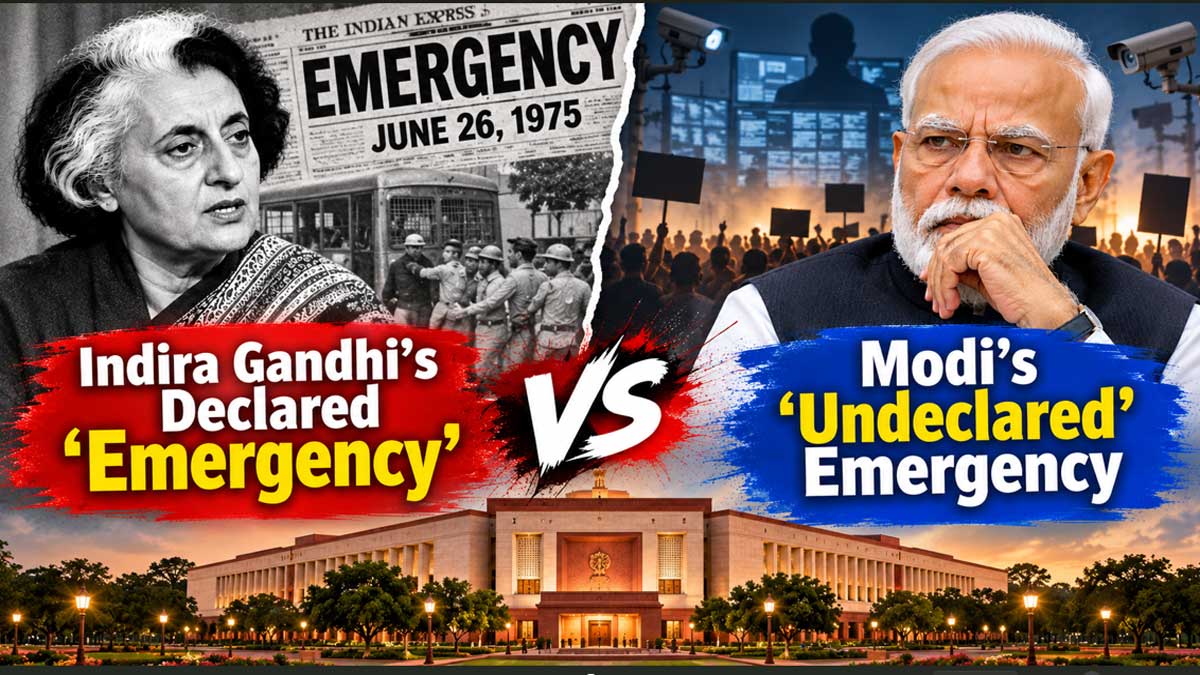
June 25, 1975, is recorded as a turning point in the history of Indian democracy. On that day, then Prime Minister Indira Gandhi declared a state of Emergency in the country. The period, which lasted until March 21, 1977, saw severe restrictions on civil liberties, the imprisonment of opposition leaders and the imposition of government censorship on newspapers.
Today, during Narendra Modi’s tenure as Prime Minister, a section of the opposition, journalists and civil rights advocates accuse the government of creating an ‘undeclared Emergency’. Comparing the two periods raises an important question: Are the circumstances really similar, or have the methods of putting pressure on political dissent changed?
Also read: इंदिरा का घोषित आपातकाल बनाम मोदी का ‘अघोषित' आपातकाल
First, it is essential to understand a fundamental difference between the two. During Indira Gandhi’s tenure, the Emergency was formally proclaimed under Article 352 of the Constitution. The government subsequently used constitutional provisions to curtail civil liberties, impose pre-censorship on the press and carry out mass arrests of political opponents. The government then possessed extraordinary legal powers to suppress dissent. Following the declaration, serious restrictions were also imposed on the judicial enforcement of citizens’ fundamental rights. From prominent opposition leaders to numerous social activists, many were detained. The Shah Commission and documents from that period highlight the gravity of these actions.
In contrast, no such formal nationwide Emergency has been declared during Narendra Modi’s tenure. Elections have continued to be held under the Constitution, opposition parties contest them, and governments face vigorous criticism in Parliament and state legislatures. Therefore, it would be factually incorrect to describe the two situations as identical from a constitutional and legal standpoint.
The comparison becomes even more significant when it comes to the media. During Indira Gandhi’s Emergency, newspapers faced government censorship before they could publish news reports and editorials. Critical content could be blocked, and journalists were arrested. Many newspapers gave in to pressure, while some adopted symbolic forms of protest. 'Indian Express', for example, famously left a blank space where an editorial would otherwise have appeared, highlighting the restrictions imposed on press freedom. The merger of news agencies and the abolition of the Press Council also weakened independent journalism.
Today, the media landscape is considerably different. Newspapers, private television channels, digital portals and independent journalists have continued to criticise the government across various social media platforms. The expansion of the internet has greatly widened the circulation of information and alternative voices.
Nevertheless, media freedom cannot be measured solely by whether critical reports are being published. It is also necessary to examine whether journalists can question those in power without fear, how diverse media ownership is, what happens after critical reporting, and whether government advertising, legal action, defamation cases or online threats influence editorial decisions. Yet, such influences are not always readily apparent. Several television channels and websites have come to be identified as either ‘anti-Modi’ or ‘pro-Modi’. Journalists themselves have even been categorised along party-political lines.
Critics of the Modi government have raised serious questions about pressure on journalists and media organisations, the alleged misuse of investigative agencies, and self-censorship in an environment perceived to favour the ruling establishment. Several international organisations have also expressed concern about civil liberties and the state of the media in India. Although their assessments and methodologies are open to debate, it would be equally inappropriate to dismiss their findings without consideration.
It is important to understand that in 1975, a system requiring government approval before the publication of news was in force. Today, many allegations of pressure concern circumstances in which there is no formal censorship, but journalists or media organisations may nevertheless choose to remain silent on certain issues through self-imposed restraint. In the first situation, control was direct and institutional; in the second, allegations of control are more dispersed, situational and contested. Both can affect democracy, but it would be inappropriate to treat them as identical systems.
Let us now turn to a question that relates directly to the experience of ordinary citizens. Can someone stand in Delhi’s Connaught Place today and publicly abuse Prime Minister Narendra Modi? Would such a thing have been possible during Indira Gandhi’s Emergency?
Today, expressing strong anger towards a prime minister, raising slogans or publicly criticising the holder of the office does not automatically constitute an act that must lead to arrest. On several occasions, Prime Minister Narendra Modi has personally come forward and forgiven people who hurled harsh verbal abuse at him. Such a response would have been virtually unthinkable during Indira Gandhi’s time.
During Indira Gandhi’s Emergency, the risks associated with openly expressing political dissent were considerably greater than they are today. Major opposition leaders were already in prison, the press was under control, and opportunities for organised opposition to the government had been severely curtailed. In such an atmosphere, anyone making an insulting public remark against the prime minister could not have assumed that they were free from the risk of arrest or other punitive action.
The impact of the two periods on society also differed in important ways. During Indira Gandhi’s Emergency, an atmosphere of fear was created primarily through the state’s direct repressive powers. The arrest of political opponents, restrictions on civil rights and censorship affected people’s public behaviour. Many became reluctant to speak openly. The centralisation of power was also evident in the implementation of government programmes and administrative targets. The family-planning campaigns associated with Sanjay Gandhi and the demolition of slums particularly affected poor and vulnerable sections of society. Excesses committed in the name of administrative discipline ultimately damaged the government’s political credibility.
In contemporary society, social media has given citizens unprecedented opportunities to express themselves. At the same time, it has facilitated abusive campaigns, organised trolling, religious and political hostility, and the spread of misinformation. Journalists, social activists and ordinary citizens who criticise those in power may sometimes be affected as much by online reactions from political supporters as by government action. This situation cannot be equated with the state-controlled censorship of 1975, but its impact on the social environment cannot be ignored.
An important similarity between the two periods emerges in the debate over the centralisation of power. During Indira Gandhi’s tenure, decision-making authority became highly concentrated in the Prime Minister’s Office and the central government. Efforts to weaken the opposition and increase control over institutions, including the judiciary, affected the democratic balance.
Critics of the Modi government have similarly alleged that decision-making power has become increasingly concentrated around the prime minister and the central government, raising questions about the independence of Parliament, investigative agencies and other institutions. However, the nature and extent of institutional pressure have not been the same in the two periods. Any conclusion should be based on the actual functioning of institutions, judicial decisions and available evidence rather than political allegations alone.
There is also a significant difference in the position of the opposition. During Indira Gandhi’s Emergency, the imprisonment of major opposition leaders made political activity extremely difficult for them. Restrictions on the press further limited their ability to communicate with the public. Elections were eventually announced in 1977, allowing the opposition to resume political activity, and the Congress suffered defeat. This became an important example of the restoration of Indian democracy.
During Modi’s tenure, opposition parties have had opportunities to contest elections, run state governments, raise questions in Parliament and hold public rallies. On the other hand, actions by central investigative agencies against some opposition leaders and controversies surrounding parliamentary proceedings have sparked debate about the fairness of political competition. These issues should be evaluated on the facts of each case and the relevant judicial findings. The mere existence of an opposition does not prove that democracy is entirely healthy, but the opposition’s present opportunities cannot be equated with the political space that was virtually shut down in 1975.
The circumstances confronting the two prime ministers in foreign policy and diplomatic relations were also considerably different. Indira Gandhi’s foreign policy involved the challenge of balancing close ties with the Soviet Union against pragmatic relations with Western countries. Following the imposition of the Emergency in 1975, India’s democratic situation attracted criticism in the United States, Britain and some other Western countries. American diplomatic documents indicate that the Emergency created tensions in India’s relations with some Western countries, while press restrictions affected international perceptions of India.
Indira Gandhi’s foreign policy during the Emergency was not merely a response to the domestic political crisis. India also sought to manage relations with neighbouring countries and explore possibilities for dialogue with China. Nevertheless, domestic restrictions on democracy significantly damaged India’s international image. The country’s reputation as a democracy was an important asset in its foreign policy, and the restrictions imposed during the Emergency seriously weakened it.
The context of Narendra Modi’s foreign policy is different. India is now a more globalised economy, and its role in international politics is linked to trade, technology, energy security, defence cooperation and strategy in the Indo-Pacific region. The Modi government has emphasised strengthening strategic and defence ties with the United States, expanding cooperation with Japan and Australia, and playing an active role in forums such as the G7, G20, Quad, BRICS and the Shanghai Cooperation Organisation. Maintaining longstanding defence and energy ties with Russia while expanding partnerships with Western countries has also been an important part of its diplomacy.
In this respect, India has sought to pursue its interests through relationships with different countries rather than relying entirely on a single power bloc. In this regard, Narendra Modi can be placed somewhat higher than Indira Gandhi.
Relations with neighbouring countries have presented both opportunities and challenges. India’s ties with Bangladesh, Nepal, Sri Lanka, the Maldives and Bhutan have experienced political fluctuations alongside cooperation. Relations with Pakistan have remained affected by terrorism and security concerns. Despite economic ties with China, border disputes and military tensions have posed serious challenges.
In comparing the foreign policies of the two prime ministers, it is important to remember that India’s priorities during Indira Gandhi’s era were shaped largely by regional security, non-alignment and Cold War power politics. Under Modi, India has sought to expand its role in global economic networks, technological partnerships, investment and a multipolar world order.
Ultimately, the most significant difference between Indira Gandhi’s declared Emergency and the allegations of an ‘undeclared Emergency’ under Narendra Modi is that the former involved direct, extensive and formal restrictions on civil liberties and political activity under a constitutional Emergency. Today’s concerns primarily relate to institutional independence, pressure on the media, the impartiality of investigative agencies, political polarisation and the practical opportunities available for dissent. These concerns deserve serious examination, but the historical facts should not be ignored by declaring the two situations identical.
Democracy is not strengthened merely because elections take place or because criticism of the prime minister is possible. Its real strength lies in whether citizens can express their views without undue fear, journalists can question those in power, the opposition can function independently, the judiciary remains impartial, and the government respects the rights of its critics. Indira Gandhi’s Emergency demonstrated how quickly the misuse of constitutional powers can weaken democracy. The same lesson remains relevant to India’s political system today: a government’s popularity or electoral success does not place it beyond criticism. The real test of India’s democratic tradition is not how powerful the government is, but how securely the rights of its citizens are protected.
Related Items
How far has Modi travelled from promise to delivery…
When women’s rights become a war between the sexes
Modi’s Gandhian appeal, but government policies contradict him!