
 Samiksha Bharti News Service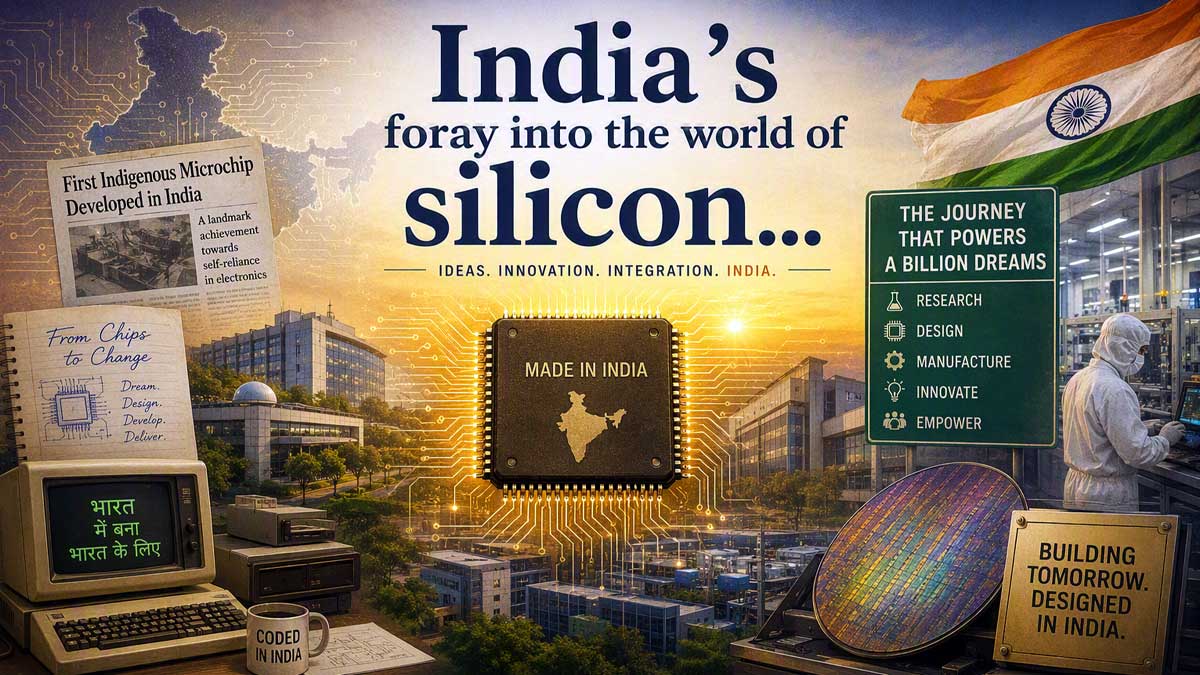
India is no longer asking whether it can make chips. It is now asking how fast it can build everything around them.
Chips are not a niche product anymore. They sit inside cars, drones, aeroplanes, MRI machines and satellites. At the moment, the global electronics industry is valued at around $4.3 trillion and growing fast. Semiconductors sit right at the base of this growing structure, forming its foundation. Every other industry, from automobiles to healthcare to defence, depends on what comes out of a chip fabrication plant. That is what makes semiconductors a foundational industry. Miss this layer, and every layer above it becomes fragile.
Also read: सिलिकॉन की दुनिया में भारत की दस्तक…
The world learned this the hard way. For example, during the COVID pandemic, car factories faced shutdowns. Not because of a lack of steel or labour, but because they could not get chips. Countries that had spent decades treating semiconductors as someone else's problem suddenly scrambled to build their own capacity. The pandemic did not create the race for chips. It simply forced everyone to run faster.
India's interest in semiconductors goes back further than most people realise: decades of quiet attempts, small starts, and lessons learned the hard way. For a long time, the ambition was there, but the ecosystem around it never quite came together. That changed with a different approach. Reforms in foreign investment, taxation and customs opened the door wide. Global electronics companies slowly began setting up manufacturing lines in India, and the results are hard to argue with.
In 2014-15, India produced about ₹1.9 lakh crore worth of electronics goods. By 2025-26, that number touched ₹13.11 lakh crore, a sevenfold jump. Electronics exports rose from around ₹38,000 crore to ₹4.24 lakh crore, an elevenfold increase.
Mobile phones tell an even sharper story. Production rose 33 times, from ₹18,000 crore to ₹6.27 lakh crore. Exports rose 165 times, from about ₹1,500 crore to ₹2.59 lakh crore. Smartphones did not even feature among India's top 100 exported goods in 2014. In FY 2025-26, smartphones became India's single largest exported commodity. Ahead of petroleum products and ahead of gems and jewellery. India now makes 99.2 per cent of the phones it uses, and has flipped from a net importer of mobiles to a net exporter. This entire manufacturing engine now supports 2.5 million jobs.
This is the moment when the picture shifts. A country once known for false starts in electronics is now the second-largest mobile phone manufacturer in the world by volume. Electronics manufacturing was the proof of concept. Semiconductors were always the next step.
That next step arrived in 2021 with the Semicon India programme. The strategy was deliberate. Build a real ecosystem, not a showpiece. Semicon 1.0 came with a ₹76,000 crore outlay. Covering the entire value chain from chip design and fabrication to packaging, testing, equipment, materials and skilled talent.
By April, 211 chips had been taped out by 75 institutions, a clear sign that design capability is spreading well beyond a handful of elite labs. Seven of those chips have been fabricated at various nodes, including advanced nodes down to 12 nanometers.
India's semiconductor push is no longer just a domestic story. On the fifth day of the India AI Impact Summit 2026, India formally joined the Pax Silica coalition. The coalition brings together the United States and other partner nations, focused on securing the global silicon supply chain. Its goal is to secure the full ‘silicon stack’, from critical minerals and fabrication to advanced AI systems and deployment infrastructure.
The mission is simple. Keep supply chains out of too few hands. Resist economic coercion. Keep the technologies that will define this century in the hands of open, democratic nations. For India, this is proof that its semiconductor ambitions now reach well beyond its own borders.
Related Items
Western Media is ‘tough’ on India but ‘soft’ on China!
From 'Beacons' to 'Landmarks', India’s changing ‘Lighthouse’ story…
“Only five minutes…” has shaken France and forced India to think…