
 Samiksha Bharti News Service
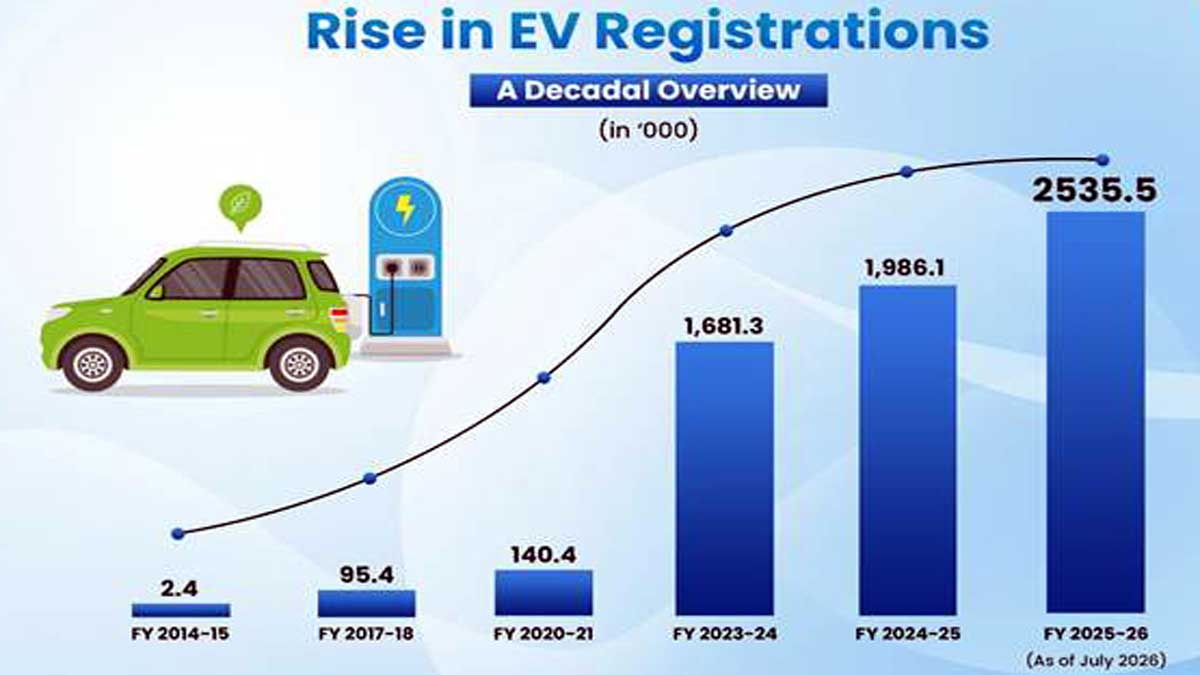
India is rapidly shifting to electric vehicles. eMobility is now turning into a key driver of economic growth, energy security, and a cleaner future. EV sales have grown ~46x since 2016, showing a strong consumer shift. Exports have surged from USD 1.2 million in 2020 to USD 84 million in 2024. This is positioning India as an emerging EV hub.
Daily commutes in crowded cities and last-mile connectivity in small towns are being fundamentally reimagined across India. At the core of this transition is electric mobility. This technological shift is becoming central to the country’s climate strategy and sustainable transportation vision.
India’s mobility transition is not just an environmental imperative but also an economic opportunity. It is reshaping one of its largest and most influential industries. This shift is emerging as a strategic lever to strengthen energy security. Further, it is reducing dependence on fossil fuel imports and driving an efficient, low-carbon growth pathway for the economy.
A decisive turning point came in the post-COVID period, in FY22. Supported by targeted policy incentives, enhanced subsidies, and improved vehicle availability, EV adoption entered a phase of accelerated growth. This period also marked a structural shift in the market. While early adoption during FY20–FY21 was dominated by e-rickshaws, electric two-wheelers soon gained significant traction. By FY25, they were a leading segment, signalling a broader transition from informal, shared mobility to mainstream private, commercial adoption.
Worldwide, consumer adoption of EVs is rising. Many competitively priced models with improved driving ranges are entering the market. Along with this, there is rapid expansion of public charging infrastructure.
In India, this momentum is mirrored by strong policy support, rising sales and registrations. It is further backed by a growing ecosystem of domestic manufacturing and charging networks, leading to an increase in EV adoption.
From a relatively small base of ~50,000 EVs sold in 2016, 2.3 million units have been sold in 2025. This reflects 46 times growth in India’s EV market. India’s growth has outpaced global trends, where EV sales increased ~20 times- from 918,000 in 2016 to 18.78 million in 2024.
In 2025, Uttar Pradesh emerged as the largest EV market. With four lakh+ units, it represented 18 per cent of national EV sales. It was followed by Maharashtra with 2.66 lakh units, 12 per cent, and Karnataka with two lakh units, nine per cent of total sales.
India’s EV penetration was merely one-fifth of the global penetration in 2020. It ramped up to over two-fifths of the global penetration in 2024. Much of this progress was driven by motorised two-wheelers, 12.8 lakh units, and three-wheelers, eight lakh units, sold in 2025.
There has been significant growth in EV registrations in the past decade, at a CAGR of over 62 per cent. This indicates rapid acceleration in EV adoption. Policy support, technological advancements, and growing consumer confidence in electric mobility are major driving forces.
After considerable domestic uptake in recent years, Indian EVs have begun making strong headway in international markets. Exports have risen from USD 1.2 million in 2020 to USD 84 million in 2024. Top export destinations included Nepal, Indonesia and Japan.
On the infrastructure side, India’s public EV charging network is expanding rapidly. According to Bharat Heavy Electricals Limited, 16,561 of the 52,718 public charging stations available as of July are equipped with fast EV charging facilities.
India is transitioning from an assembly-led market to a comprehensive EV manufacturing hub. Supported by a growing supplier ecosystem, domestic production now covers battery packs, motors, drivetrains, power electronics, wiring, and charging equipment.
Leading Original Equipment Manufacturers like Tata Motors, Mahindra, TVS, and Bajaj Auto are expanding capacity through investments in R&D, gigafactories, and dedicated EV platforms.
Simultaneously, global players like VinFast, Tesla, and major Korean and Japanese battery firms are exploring large-scale manufacturing in India. This expansion is strengthening localisation, enhancing cost competitiveness, and positioning India as an integral part of global EV supply chains.
Indian startups are witnessing the potential of EVs. They are catalysing the availability of charging infrastructure, improving battery-level innovation, promoting low-cost manufacturing and offering data-driven solutions.
With ~400 EV startups currently operating in India, they are emerging as central players in shaping India’s evolving EV ecosystem.
Besides, the advancing EV ecosystem is leveraging Artificial Intelligence to enhance the overall driving experience. Features such as voice-enabled navigation, real-time traffic insights, and intelligent route planning are central to this. AI is also contributing to safer and more inclusive mobility by enabling voice-based controls, connected features, and accessibility-focused functionalities.
Investment activity in the sector has remained strong. India’s EV ecosystem raised over USD 1.4 billion in FY 2025, ~27% higher than 2024. EV manufacturers attracted the bulk of this funding, securing around USD 1.2 billion. In this, Delhi emerged as the top city for EV investments.
Incentives like 15–25 per cent capital subsidies, preferential land allotment, stamp duty waivers, and up to 100 per cent SGST reimbursement reduce investor costs.
Leading states like Tamil Nadu, Maharashtra, Karnataka, Gujarat, Haryana, and Uttar Pradesh have become major EV hubs, anchoring robust manufacturing ecosystems. The Delhi EV Policy is one of the most progressive EV policies in India. It aims to reduce vehicular emissions and improve air quality in the city.
India’s EV market, valued at USD 3.71 billion in 2025, is projected to grow to USD 191.04 billion by 2034, at a CAGR of 54.94 per cent.
The Indian EV battery market is likely to grow from USD 2.71 billion in 2025 to USD 15.90 billion by 2034, at a CAGR of 21.70 per cent.
India aims for 30 per cent of all vehicle sales to be electric by 2030, aligning with the global EV30@30 initiative.
The EV ecosystem is strengthened with the establishment of 1.32 million charging stations across India by 2030.
With demand and production incentives, localisation policies, and early charging infrastructure, India has entered a decisive phase of scale. As global supply chains realign, India is expected to be one of the most attractive destinations for EV manufacturing investment.
As domestic capabilities strengthen, India is poised to emerge as an export hub. This applies to various variants: electric two-wheelers, compact EVs, battery packs, and key drivetrain components. This is supported by R&D investment and global partnerships.
India stands at the cusp of a defining mobility transformation. Demand is surging, manufacturing is scaling up, and technological capabilities are advancing. Consequently, the country is fast emerging as a global hub for R&D and EV manufacturing. Key drivers like better finance access, rising awareness, tech advances, reliable charging, a skilled workforce are accelerating India’s EV transition. A reform-driven policy environment further provides a compelling and durable advantage at scale.
The road ahead will be shaped by deeper supply chain integration, accelerated localisation of batteries and a robust charging infrastructure. Together, these pillars are poised to define India’s leadership in the global EV landscape.
Related Items
‘Green Crusaders’ or ‘Growth Killers’ of India!
Should India trust Musk with its digital lifeline!
Poverty retreats, Growth accelerates, but prosperity...?