
 Brij Khandelwal
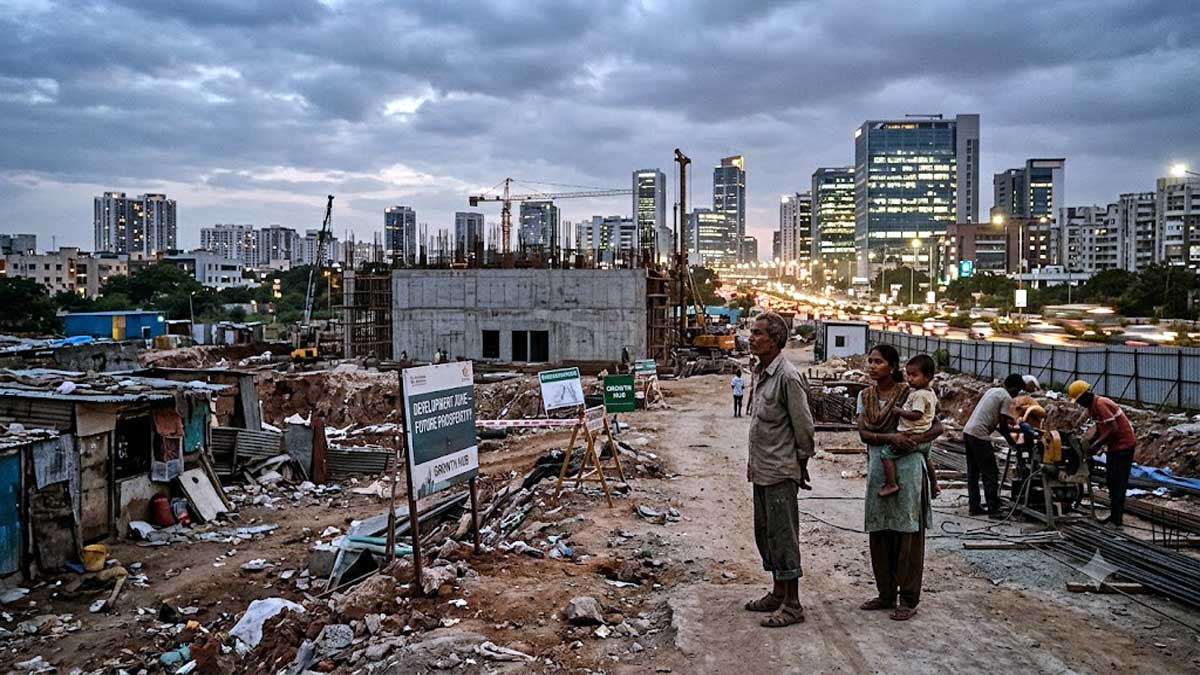
Imagine two lives separated by three generations. One belongs to a small-town schoolteacher in the 1970s. The other belongs to his grandson, an IT professional today. The difference is nothing short of a revolution.
In a small town near Agra, Uttar Pradesh, schoolteacher Raghunath Prasad woke up before sunrise. There was little certainty about electricity. Taps rarely delivered water. Children studied under kerosene lamps. Families queued outside ration shops. Bicycles and bullock carts were the main means of transport. Finding a doctor during illness was a blessing. A telephone was something you saw in an influential officer's house.
Also read: गरीबी पर चोट, विकास की रफ्तार और खुशहाली की अधूरी कहानी
Now look at his thirty-year-old grandson, Mohan Kumar. A smartphone sits in his hand, digital payments are part of his daily routine, and an air-conditioner cools his home. His kitchen has a gas connection, while a motorcycle or car waits outside. He works for an IT company, makes video calls, books tickets online and transfers money within seconds. Modern hospitals, expressways and better roads have changed his world.
For Raghunath Prasad, opening a bank account, getting electricity and building a permanent house were major achievements. For Mohan, these are ordinary facilities. He lives in a world his grandfather could hardly imagine.
This is not merely one family's story. It is the story of India's extraordinary transformation. In seven decades, the country has travelled a remarkable distance.
But can a nation of 1.4 billion people change its destiny within a generation? Can India defeat poverty, hunger and deprivation while becoming a major global economic power? The country's recent journey offers plenty of hope. Yet celebration must go hand in hand with honest introspection.
The latest World Bank figures are encouraging. In 2011, around 27.1 per cent of India's population lived in extreme poverty. By 2023, this figure had fallen to just 2.6 per cent. The picture also improved under the higher poverty threshold of $4.20 a day. Poverty declined from 57.7 per cent to 16.1 per cent.
In other words, nearly 496 million people moved above this poverty line in twelve years. The World Bank ranks India among the fastest-reducing countries in poverty.
At Independence, nearly 45 per cent of Indians lived in poverty. Government estimates placed poverty at 29.8 per cent in 2009-10. By 2011-12, it had fallen to 21.9 per cent.
When Narendra Modi took charge in 2014, the economy had enormous potential. But basic facilities remained painfully inadequate. Banking, roads, electricity, drinking water and employment needed urgent attention.
The Modi government adopted a new development strategy. It focused on infrastructure, digital technology, financial inclusion and welfare schemes. The emphasis was also on delivering government assistance directly to beneficiaries.
Earlier, welfare money passed through several official channels. Middlemen often took their share along the way. The Jan Dhan-Aadhaar-Mobile combination attempted to change this system. Millions of poor families entered the banking network. Direct Benefit Transfer began sending subsidies straight into bank accounts.
Digital payments brought another revolution. Today, vegetable sellers, rickshaw drivers and small shopkeepers accept money through mobile phones. UPI has made ordinary citizens participants in the digital economy.
During 2025-26, UPI recorded over 24,000 crore transactions, worth nearly Rs.314 lakh crore. This is more than a technological success. It has opened the doors of economic participation to millions.
Several welfare programmes have also changed everyday lives. The Ujjwala scheme has provided more than 10.5 crore LPG connections. Smoky kitchens are gradually giving way to cleaner cooking fuel. The Swachh Bharat Mission has helped build over 12 crore household toilets.
The Jal Jeevan Mission expanded tap-water connections across rural India. In 2019, barely 3.2 crore rural households had tap connections. By May this year, the number had crossed 15.8 crore.
The Pradhan Mantri Awas Yojana has given millions of families permanent homes. Many houses have been registered in women's names. Ayushman Bharat has offered health protection to poorer families. Senior citizens above 70 have also been brought under its coverage. The free foodgrain scheme continues to support nearly 81 crore people.
Infrastructure has become another major engine of growth. Roads, railways, electricity, ports and airports are essential for a modern economy. The government increased spending on these sectors.
Expressways, metro networks, railway stations, airports and freight corridors are changing India's economic landscape. Better roads connect markets and reduce travel time. Railway electrification and dedicated freight corridors strengthen transportation and trade.
Economic growth has also remained impressive. According to government estimates, India's real GDP grew by 7.6 per cent in 2025-26, compared with 7.1 per cent the previous year. Domestic demand, investment and the services sector contributed to this performance.
But hold on! The other side of the picture deserves attention too. In 2023, around 75 million Indians still lived in extreme poverty. The number below the higher $4.20 poverty line was considerably larger. From Uttar Pradesh to West Bengal, many regions continue to struggle with deprivation and inadequate opportunities.
Now look beyond India's borders. According to the World Bank, nearly 800 to 850 million people worldwide still live in extreme poverty. Since 1990, around 1.5 billion people have escaped poverty. But the COVID pandemic, wars, inflation and expensive energy have slowed global progress.
India has certainly made a giant leap. Yet becoming a developed nation will require much more than highways and government schemes.
The country needs educated citizens, healthy families, stronger industries and decent jobs. Infrastructure matters, but human development matters even more. Economic growth must create opportunities for everyone, not merely increase the wealth of those already doing well. The real measure of development is not how rich the rich become, but how quickly poverty disappears.
India has travelled a long road. The journey deserves appreciation, but complacency would be dangerous. Freedom from poverty is only the first milestone. Dignity, equal opportunities and prosperity for all remain the real destination.
The leap has been impressive. The journey, however, is far from over.
Related Items
How far has Modi travelled from promise to delivery…
Building the infrastructure for growth in Jammu and Kashmir…
Small families, Fractured bonds! Blame it on family planning!