
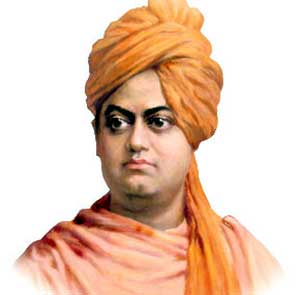
Swami Vivekananda once said, “Whatever you think, that you will be. If you think yourselves weak, weak you will be; if you think yourselves strong, strong you will be.”
He also said, “See for the highest, aim at that highest, and you shall reach the highest.”
His message was simple yet powerful. Vivekananda conveyed his ideas directly to the people, especially to the youth. His message broke through the shackles of caste and creed and spoke of a language of universal brotherhood. What he said captures the great importance of his ideas and ideals among the youth in our country today. He personified the eternal energy of the youth and their restless quest for truth. It is entirely fitting that 12th January, the birth anniversary of Swami Vivekananda, is observed as National Youth Day to rekindle the eternal message of this great patriot and son of India.
But how to make youth realise the relevance of Swami Vivekananda in these exciting and challenging times, when on the one hand people and nations are engaged in the noble task of developing the personality and leadership qualities of the youth by involving them in various nation-building activities, while on the other hand there are challenges of hunger, poverty, unemployment, corruption and terrorism.
Among the various ways which Swami Vivekananda suggested to rebuild the Indian society, Education was the primary means for empowering the people. He once said, “The education which does not help the common mass of people to equip themselves for the struggle for life, which does not bring out strength of character, a spirit of philanthropy, and the courage of a lion – is it worth the name? Real education is that which enables one to stand on one’s own legs.” For him, education meant secular learning that built character and instilled human values in students.
The Government of India while commemorating the 150th Birth Anniversary of Swami Vivekananda sanctioned a “Value Education Project” of the Ramakrishna Mission (an organisation established by Swami Vivekananda which is widely recognized for its commendable work in the areas of value based education, culture, health, women’s empowerment, youth and tribal welfare and relief and rehabilitation), to help to inculcate in children a moral compass and a value system against the tide of commercialism and consumerism that is sweeping our societies.
It also gave an endowment of US$1.5 million to the University of Chicago, for establishing the Swami Vivekananda Chair to focus on Vivekananda, through lectures, seminars and suitable related academic activities on Indian Culture and Indian Studies. The Chair will be held by each scholar for a period of two years. The University of Chicago will also facilitate exchange of research scholars between the University of Chicago and the Government of India. This permanent endowment will help spread the message of harmony of religions, understanding between nations and the spiritual oneness of humanity, which Swami Vivekananda worked for.
According to Swami Vivekananda, “Teach yourselves, teach everyone his real nature, call upon the sleeping soul and see how it awakes. Power will come, glory will come, goodness will come, purity will come, and everything that is excellent will come when this sleeping soul is roused to self-conscious activity.”
The Government is also making efforts to convert teachings of Swami Vivekananda into practice in the current context. To meet the need and aspirations of more than a billion people is not an easy task unless some integrated action is taken in areas where the country has a core competence. Agriculture, Education, Healthcare, Reliable and Quality Electric power, Surface transport and Infrastructure for all parts of the country, Information and Communication Technology and Strategic sector are the areas closely inter-related and if the work on these areas for an integrated action start in the right earnest it will lead to food, economic and national security of India.
The Government has embarked on the mission of building a united, strong and modern India to fulfil the vision of the great thinkers like Vivekananda. “Ek Bharat, Shreshtha Bharat”, following the principle of “Sabka Saath, Sabka Vikas”. These are not merely slogans but a commitment to the people particularly to youth to take the nation to new heights. A number of path-breaking initiatives have been introduced recently. ‘Make in India’ campaign has been launched to develop India as a global manufacturing hub. ‘Digital India’ initiative seeks to transform India into a digitally empowered society and knowledge economy. ‘Skill India’ is being launched to impart necessary skills to prepare Indians for the opportunities in Indian Economy as also the opportunities abroad. A number of initiatives, including Smart Cities Project, have been launched for developing infrastructure. In all these ‘Swachh Bharat Mission’ and ‘Clean Ganga’ Mission have been launched for building a clean and green India.
All these initiatives of the Government require active involvement and support of youth as they are the major stakeholders of future of this country. Skill development and Entrepreneurship is the flagship programme to put India on the road to become developed nation. Government is making all efforts to invest hugely in youth of the country because it is necessary in the ambitious task of building a modern and prosperous India. And as Swami Vivekananda once exhorted, “Arise! Awake! And stop not till the goal is reached”, let us all unite and work for the country with Purity, patience, and perseverance as the Swami felt long ago that these three are essentials to success.
Related Items
Indian Ayurveda ensures a healthy future…
Stop judging India's youth by its Instagram reels!
Why India’s youth are turning to religion…!