
 Samiksha Bharti News Service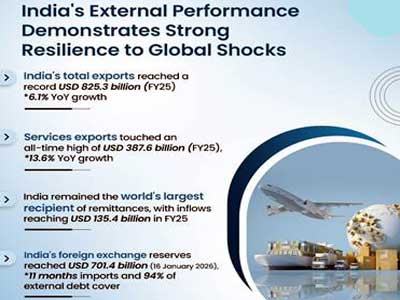
India enters FY26 with strong economic momentum supported by stable macroeconomic fundamentals, sustained policy support, and broad-based sectoral performance. Despite a challenging global environment, the economy has remained resilient, with robust growth, historically low inflation, improving labour market indicators, and strengthening external and financial buffers. Coordinated fiscal, monetary, and structural policies have reinforced macroeconomic stability while supporting investment, consumption, and inclusion.
The emerging macroeconomic environment reflects an economy that is consolidating its gains while strengthening the foundations for sustained and inclusive growth. India’s growth outlook remains robust, underpinned by strong macroeconomic fundamentals and broad-based demand momentum. As per the First Advance Estimates, real GDP and Gross Value Added are projected to grow by 7.4 per cent and 7.3 per cent, respectively, in FY26.
A strong agricultural performance has bolstered rural incomes and consumption, while improvements in urban demand- supported by tax rationalisation measures indicate a broadening of the consumption base. India’s potential growth is estimated at around seven per cent, with real GDP growth for FY27 projected in the range of 6.8-7.2 per cent, reflecting sustained medium-term growth capacity amid a challenging global environment.
India recorded the lowest inflation rate since the beginning of the CPI series, with April-December 2025 average headline inflation coming in at 1.7 per cent, contributing to a general disinflationary trend in food and fuel prices.
Among major Emerging Markets & Developing Economies, India has recorded one of the sharpest declines in headline inflation in 2025 over 2024, amounting to about 1.8 percentage points.
In December 2025, the RBI lowered its inflation forecast for FY26 from 2.6 per cent to two per cent, supported by a good kharif harvest and healthy rabi sowing. The IMF projects inflation at 2.8 per cent in FY26 and four per cent in FY27. The RBI’s forecast for headline Inflation for Q1 and Q2 of FY27 currently stands at 3.9 and four per cent.
Looking ahead, the inflation outlook remains benign, supported by favourable supply-side conditions and the gradual pass-through of GST rate rationalisation. Agriculture and allied activities continue to play a stabilising role in India’s growth cycle by supporting rural demand and income security. The sector is estimated to grow by 3.1 per cent in FY26, supported by a favourable monsoon during H1 FY26. Agricultural GVA expanded by 3.6 per cent in H1 FY26, higher than the 2.7 per cent growth recorded in H1 FY25, reflecting improved crop performance.
Allied activities, particularly livestock and fisheries, have exhibited stable growth of around 5–6 per cent, providing resilience and diversification reflecting a relatively stable expansion in allied sectors.
Industrial activity is expected to gain momentum in FY26, with the industrial sector projected to grow by 6.2 per cent, up from 5.9 per cent in FY25. The sector recorded growth of seven per cent in the first half of FY26, exceeding the growth of 6.1 per cent in H1 of FY25 and the pre-COVID trend of 5.2 per cent.
Manufacturing has emerged as a key growth engine, with GVA growth accelerating to 7.72 per cent in Q1 and 9.13 per cent in Q2 of FY26, signalling a structural recovery. Government-led initiatives, particularly the Production Linked Incentive schemes across 14 sectors, have played a catalytic role, attracting over ₹2 lakh crore of actual investment, generating incremental production/sales exceeding ₹18.7 lakh crore, and creating over 12.6 lakh jobs as of September 2025.
India’s innovation ecosystem has also strengthened, with the country’s Global Innovation Index rank improving to 38th in 2025, up from 66th in 2019, reinforcing the role of manufacturing-led innovation in long-term growth.
The services sector is estimated to have grown by 9.1 per cent in FY26, up from 7.2 per cent in FY25, indicating a further acceleration in services-led expansion. Services’ share in GDP rose to 53.6 per cent in H1 FY26, while its share in GVA reached a historic high of 56.4 per cent as per the FY26 First Advance Estimates, reflecting the rising importance of modern, tradable, and digitally delivered services.
India is now the world’s seventh-largest exporter of services, with its share in global services trade more than doubling from two per cent in 2005 to 4.3 per cent in 2024. And the sector remains the largest recipient of foreign direct investment. Implicit estimate for H2 suggests a continuation of the services sector's momentum, supported by resilient domestic demand and steady export activity.
India’s labour market continues to demonstrate resilience alongside economic expansion. In Q2, July to September 2025, FY26, total employment stood at 56.2 crore persons, aged 15 years and above, reflecting the creation of approximately 8.7 lakh new jobs compared to Q1, April to June 2025, FY26.
According to the Periodic Labour Force Survey, key labour indicators point to strengthening employment conditions. The Labour Force Participation Rate for persons aged 15 years and above increased to 56.1 per cent in December 2025.
Female LFPR rose to 35.3 per cent, indicating rising participation and improving inclusion. The Worker Population Ratio increased to 53.4 per cent, reflecting steady employment absorption.
The unemployment rate declined to 4.8% in December 2025, continuing its downward trajectory. The Annual Survey of Industries FY24 highlights the strength of organised manufacturing, with employment rising by six per cent year-on-year, translating into an addition of over 10 lakh jobs compared to FY23.
As of January 2026, the e-Shram portal has registered over 31 crore unorganised workers, with women accounting for more than 54 per cent of total registrants, significantly strengthening the outreach of gender-focused welfare initiatives. The National Career Service platform has emerged as a key labour market intermediary, with over 5.9 crore registered job seekers and 53 lakh job providers, and mobilisation of approximately eight crore vacancies across sectors. It recorded over a 200 per cent increase in job vacancies in FY24 compared to FY23.
On the trade front, India’s total exports reached record levels of USD 825.3 billion in FY25 and USD 418.5 billion in H1 FY26, driven by strong growth in services exports and sustained momentum in non-petroleum, non-gems, and jewellery exports.
India’s integration into global trade continues to deepen, marked by diversification and strong services-led growth. India’s share in global merchandise exports increased from one per cent in 2005 to 1.8 per cent in 2024.
According to UNCTAD’s Trade and Development Report 2025, India ranks third among countries in the Global South in terms of the diversity index of trade partnerships, following China and the UAE. India’s index score of 3.2 exceeds that of all countries in the Global North, underscoring its resilience in the face of tariff uncertainties and other emerging challenges.
Services exports emerged as a key growth engine, reaching an all-time high of USD 387.5 billion in FY25, registering a robust 13.6 per cent year-on-year growth. This performance reinforced India’s position as a global hub for technology, business, and professional services, with rising demand across IT, financial, and knowledge-intensive segments.
External buffers remained strong. Foreign exchange reserves stood at USD 701.4 billion as of 16 January 2026, providing an import cover of around 11 months and covering over 94 per cent of external debt, thereby strengthening India’s capacity to withstand external shocks.
India also remained the world’s largest recipient of remittances, with inflows reaching USD 135.4 billion in FY25, offering critical support to the current account. Notably, the share of remittances from advanced economies increased, reflecting the growing contribution of skilled and professional Indian workers in global labour markets.
Industrial activity gathered further momentum in December 2025, with broad-based improvement reflected across both the Index of Industrial Production and the Index of Eight Core Industries.
The combined Index of Eight Core Industries measures both the individual and aggregate performance of production across eight key sectors, viz., coal, crude oil, natural gas, refinery products, fertilisers, steel, cement, and electricity. It serves as a leading indicator of industrial performance and accounts for 40.27 per cent of the total weight of the IIP.
The IIP rose by 7.8 per cent in December 2025, marking its highest level in over two years, following robust growth of 7.2 per cent in November 2025. Sector-wise, Manufacturing remained the primary growth driver, expanding by 8.1 per cent, while Mining and Electricity recorded growth of 6.8 per cent and 6.3 per cent, respectively.
Within manufacturing, strong performance was observed in technology- and mobility-linked segments, with notable growth in Computer, electronic and optical products- 34.9 per cent; Motor vehicles, trailers and semi-trailers- 33.5 per cent; and other transport equipment- 25.1 per cent.
On the core sector front, Cement production surged by 13.5 per cent year-on-year, followed by Steel at 6.9 per cent, reflecting sustained demand from construction and infrastructure-related activities. Other core sectors also posted positive growth, including Electricity (5.3 per cent), Fertilisers (4.1 per cent), and Coal (3.6 per cent), reinforcing the recovery across energy and input-intensive industries.
Overall, the synchronised improvement in IIP and ICI points to strengthening industrial fundamentals, supported by infrastructure spending, resilient domestic demand, and steady expansion across core and manufacturing sectors.
Prudent fiscal management by the government has enhanced credibility and strengthened confidence in India’s macroeconomic and fiscal framework, resulting in three sovereign credit rating upgrades in 2025 by Morningstar DBRS, S&P Global Ratings, and Rating and Investment Information, Inc.
The Centre’s revenue receipts improved from an average of about 8.5 per cent of GDP in FY16–FY20 to 9.2 per cent of GDP in FY25, mainly supported by buoyant non-corporate tax collections that increased from about 2.4 per cent of GDP pre-pandemic to around 3.3 per cent post-pandemic.
The share of direct taxes in total taxes rose from 51.9 per cent pre-pandemic to 55.5 per cent post-pandemic, reaching 58.8 per cent in FY25. Meanwhile, the direct tax base expanded steadily, with income tax return filings rising from 6.9 crore in FY22 to 9.2 crore in FY25, indicating better compliance, wider use of technology in tax administration, and more individuals entering the tax net as incomes increased.
Gross GST collections during April–December 2025 amounted to ₹17.4 lakh crore, reflecting year-on-year growth of 6.7 per cent and broadly tracking nominal GDP growth conditions. High-frequency indicators point to strong transaction activity, with cumulative e-way bill volumes during the same period increasing by 21 per cent YoY.
The government’s effective capital expenditure increased from an average of 2.7 per cent of GDP in the pre-pandemic period to about 3.9 per cent post-pandemic, and further to four per cent of GDP in FY25.
Under the Special Assistance to States for Capital Expenditure, the Centre has incentivised States to maintain capital spending at around 2.4 per cent of GDP in FY25. The combined fiscal deficit of State Governments remained broadly stable at around 2.8 per cent of GDP in the post-pandemic period, similar to pre-pandemic levels, but rose in recent years to 3.2 per cent in FY25, reflecting emerging pressures on State finances.
India lowered its general government debt-to-GDP ratio by about 7.1 percentage points since 2020 while continuing to maintain high levels of public investment. India's monetary and financial sectors have strong performance during FY26, April-December 2025, amidst elevated uncertainty in the global financial markets. In an increasingly fragmented global financial environment, India’s regulatory framework, institutional resilience, and growing reliance on domestic financial channels have played a stabilising role. With the support of strong monetary management and financial intermediation across channels, India has remained stable and safeguarded against economic shocks.
In response to the evolving macroeconomic and financial developments, the Reserve Bank of India’s Monetary Policy Committee cumulatively reduced the repo rate by 100 basis points between April and December 2025, currently at 5.25 per cent. The reductions have been aimed at boosting credit flow, investment, and overall economic activity. Complementing policy rate cuts, the RBI reduced the cash reserve ratio by 100 basis points to three per cent during September-November 2025.
In addition, the RBI injected durable liquidity of ₹2.39 lakh crore through open market operations during April-May 2025, followed by further OMO purchases of ₹1 lakh crore and a 3-year USD/ INR buy-sell swap of USD 5 billion in December 2025. As a result, system liquidity remained in surplus, averaging ₹1.89 lakh crore in FY26, up to 8 January 2026, compared to ₹1,605 crore in FY25.
While reserve-money growth moderated to 2.9 per cent by December 2025, compared to 4.9 per cent as of December 2024, the CRR-adjusted growth stood at 9.4 per cent as compared to 6.2 per cent a year ago. The trend reflects the expansionary stance of monetary policy.
During the same period, broad-money growth rose to 12.1 per cent as compared with nine per cent a year ago, indicating that banks effectively leveraged the liquidity released by the CRR cut. The trend is driven primarily by rising aggregate deposits with banks, which are the largest component of broad money.
The money multiplier increased to 6.21 in December 2025 from 5.70 a year earlier, signalling improved financial intermediation by the banking system, thereby ensuring adequate systemic liquidity.
The banking sector strengthened further in FY26, with Gross non-performing asset ratios declining to multi-decadal lows and net NPAs reaching record low levels. The capital-to-risk-weighted assets ratio of scheduled commercial banks remained strong at 17.2 per cent as of September 2025.
Profitability also improved; Profit after tax of SCBs rose by 16.9 per cent in FY25 and by 3.8 per cent year-on-year as of September 2025. Return on equity stood at 12.5 per cent while return on assets stood at 1.3 per cent in September 2025.
Credit growth, after moderating earlier in FY26, picked up momentum. Outstanding credit by SCBs increased to 14.5 per cent YoY in December 2025, compared to 11.2 per cent in December 2024. December 2025 marked the highest YoY growth rates for both bank credit and non-food credit in FY26.
Credit growth for MSMEs continued to show momentum and remained robust, with MSME credit expanding by 21.8 per cent in November 2025. Within this sector, micro and small enterprises recorded an increase of 24.6 per cent YoY in November 2025, up from 10.2 per cent in November 2024.
RBI’s Financial Inclusion Index measures the country's progress in achieving financial inclusion. It captures data on 97 indicators related to banking, investments, insurance, postal, and pension sectors across three dimensions: access, usage, and quality. These dimensions are represented through three sub-indices, viz., FI-access, FI-usage, and FI-quality. India’s Financial Inclusion Index rose from 64.2 in March 2024 to 67.0 in March 2025.
Capital markets played an increasingly prominent role in capital formation. During FY26, up to December 2025, total resource mobilisation from primary markets stood at ₹10.7 lakh crore. Over the past five years, from FY22 to FY 26, till December 2025, primary markets mobilised a total of ₹53 lakh crore through equity and debt issuances.
Household financial savings continued to shift towards market-linked instruments. Individual investors’ share in equity ownership increased to 18.8 per cent by September 2025, with household equity wealth increasing by about ₹53 lakh crore between April 2020 and September 2025. The share of equity and mutual funds in annual household financial savings rose from around two per cent in FY12 to over 15.2 per cent in FY25.
The macroeconomic trends in FY26 point to an economy characterised by stability alongside momentum. Growth remains broad-based across agriculture, industry, and services, while inflation has moderated and labour market indicators have strengthened. External sector performance, rising services exports, and comfortable foreign exchange reserves provide resilience against global shocks. Fiscal consolidation has advanced in parallel with sustained capital expenditure, and the financial system remains well-capitalised and supportive of credit expansion and financial inclusion.
Together, these developments indicate strengthening economic fundamentals and an improved capacity to sustain growth while maintaining macroeconomic stability.
Related Items
Western Media is ‘tough’ on India but ‘soft’ on China!
Building the infrastructure for growth in Jammu and Kashmir…
From 'Beacons' to 'Landmarks', India’s changing ‘Lighthouse’ story…