Latest News: Union Budget 2026–27 Highlights: New Income Tax Act, 2025 to be effective from April 2026; simplified tax rules and forms will be notified soon * Safe harbor limit for IT services raised from ₹300 crore to ₹2000 crore * Foreign cloud service providers granted a tax holiday until 2047 * All non-residents paying tax on an estimated basis exempted from Minimum Alternate Tax * Securities Transaction Tax on futures trading increased from 0.02% to 0.05% * Customs duty exemption extended for capital goods used in lithium-ion battery cell manufacturing * Customs duty exemption granted for capital goods required in processing critical minerals * Tariff rate on goods imported for personal use reduced from 20% to 10% * Basic customs duty exemption extended to 17 medicines and drugs * BioPharma Shakti program with an outlay of ₹10,000 crore to build an ecosystem for domestic production of biologics and biosimilars * Proposal for a ₹10,000 crore SME Development Fund to support MSMEs * Public capital expenditure increased from ₹11.2 lakh crore to ₹12.2 lakh crore in FY 2026–27 * Seven high-speed rail corridors to be developed as Growth Transport Links for sustainable passenger systems * Indian Institute of Design Technology, Mumbai to set up AVGC content creation labs in 15,000 high schools and 500 colleges * A girls’ hostel to be built in every district to address challenges faced by female students in higher education and STEM institutions * In partnership with IIMs, a 12-week hybrid training program will upgrade skills of 10,000 guides across 20 tourist destinations * ICAR packages on agricultural portals and practices to be integrated with AI systems as a multilingual AI tool * Tax on foreign travel packages reduced from current five per cent and 20% to two per cent * Customs bonded warehouse framework revamped into an operator-centric system with self-declaration, electronic monitoring, and risk-based accounting * Indian share markets will be open for trading on Sunday, February 01, as the Union Budget is being presented on that day * Key Highlights of Economic Survey 2025–26: GDP & GVA Growth Estimates for FY 2026: First advance estimates at 7.4% and 7.3% respectively * India’s Core Growth Projection: Around 7%, with real GDP growth for FY 2027 expected between 6.8% and 7.2% * Central Government Revenue: Rose to 11.6% of GDP in FY 2025 * Non-Performing Assets: Declined to a multi-decade low of 2.2% * PMJDY Accounts: Over 552 million bank accounts opened by March 2025; 366 million in rural and semi-urban areas * Investor Base: Surpassed 120 million by September 2025, with women comprising ~25% * Global Trade Share: India’s export share doubled from 1% in 2005 to 1.8% in 2024 * Services Export: Reached an all-time high of $387.6 billion in FY 2025, up 13.6% * Global Deposits: India became the largest recipient in FY 2025 with $135.4 billion * Foreign Exchange Reserves: Hit $701.4 billion on January 16, 2026—covering 11 months of imports and 94% of external debt * Inflation: Averaged 1.7% from April to December 2025 * Foodgrain Production: Reached 357.73 million metric tons in 2024–25, up 25.43 MMT from the previous year * PM-Kisan Scheme: Over ₹4.09 lakh crore disbursed to eligible farmers since inception * Rural Employment Alignment: “Viksit Bharat – Jee Ram Ji” initiative launched to replace MGNREGA in the vision for a developed India by 2047 * Manufacturing Growth: 7.72% in Q1 and 9.13% in Q2 of FY 2026 * PLI Scheme Impact: ₹2 lakh crore in actual investment across 14 sectors; production and sales exceeded ₹18.7 lakh crore; over 1.26 million jobs created by September 2025 * Semiconductor Mission: Domestic capacity boosted with ₹1.6 lakh crore invested across 10 projects * Railway High-Speed Corridor: Expanded from 550 km in FY 2014 to 5,364 km; 3,500 km added in FY 2026 * Civil Aviation: India became the third-largest domestic air travel market; airports increased from 74 in 2014 to 164 in 2025 * DISCOMs Turnaround: Recorded first-ever positive PAT of ₹20,701 crore in FY 2025 * Renewable Energy: India ranked third globally in total renewable and installed solar capacity * Satellite Docking: India became the fourth country to achieve autonomous satellite docking capability * School Enrollment Ratios: Primary – 90.9%, Upper Primary – 90.3%, Secondary – 78.7% * Higher Education Expansion: India now has 23 IITs, 21 IIMs, and 20 AIIMS; international IIT campuses established in Zanzibar and Abu Dhabi * Maternal & Infant Mortality: Declined since 1990, now below global average

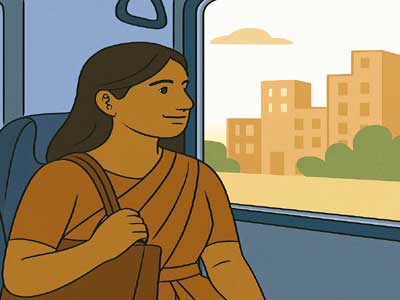
When Lakshmi got a free ticket, her world began to move…


At 6.30 every morning, Lakshmi steps out of her small tiled house in a sleepy suburb of Mysuru. One hand clutches her tiffin, the other her faded handbag. Until two years ago, her biggest daily worry was not the workload at the private school where she works as an assistant, but the bus fare. Some days she walked. Some days she borrowed. Some days she simply skipped work. Then came Shakti and Lakshmi’s world quietly shifted gears.

Launched on June 11, 2023, the Karnataka government’s Shakti scheme did something radical in its simplicity: it made bus travel free for women and transgender persons on non-premium state buses. No smart cards, no forms, no queues. Just show an Aadhaar or ID, get a zero-fare ticket, and move. For Lakshmi, that small piece of paper was not a ticket; it was permission to breathe.

From villages to cities, from factory gates to college campuses, Shakti has redrawn Karnataka’s mobility map. In just over two years, more than 500 crore free tickets have been issued. That number is not just a statistic; it is a rolling census of freedom.

In the first six months alone, over 62 lakh women boarded buses they once hesitated to take. By 2025, women made up nearly 60 per cent of passengers on key Bengaluru routes, changing the very character of public transport. Buses, once male-dominated spaces of elbows and impatience, now hum with chatter, laughter, sarees, backpacks, and confidence.

For daily wage earners like Lakshmi, the math is simple and life-changing. She saves around ₹700 a week, money that earlier vanished into conductors’ hands. That saving now pays for her daughter’s notebooks, a doctor’s visit, or an extra vegetable in the curry. Surveys show 80 per cent of beneficiaries save between ₹500 and ₹1,000 every week. In poor households, that is not “extra income”; that is survival with dignity.

Independent studies back what women already know. A large survey across 15 districts found Shakti had a 96 per cent reach, the highest among Karnataka’s welfare schemes. Over 91 per cent of women reported improved financial conditions, and nearly one in five found new or better jobs. In districts like Chikkamagaluru and Bengaluru Urban, the impact on employment was dramatic.

Another study tracking nearly three crore BMTC trips showed what mobility really unlocks: access. More women reached workplaces, colleges, hospitals, courts, and markets. Healthcare access improved for over 80 per cent. For many, it was the first time they travelled alone, without asking a husband, brother, or son for money.

In smaller towns, the ripple effects are even more visible. Women farmers in Hassan save ₹200 a day. Vendors in Mandya now travel farther to better markets in Mysuru. Garment workers, students, and elderly women visiting children have become the most regular riders. A conductor in Tumakuru summed it up simply: “Earlier buses were half-empty. Now they are full of women and stories.”

Shakti has also quietly rewritten social rules. When women travel in groups, public spaces feel safer. When buses fill with women, streets change tone. Parents are more willing to send daughters to colleges farther away. Families meet more often. Over 80 per cent of women say they now visit relatives more frequently, strengthening bonds and independence alike.

Yes, problems remain. Buses are crowded. Bus stops are far. Conductors are overworked. About 85 per cent of women complain of rush and distance. These are real issues, but they are problems of success, not failure. They demand more buses, better planning, and sustained investment.

For Lakshmi, policy debates are distant. What she knows is this: she no longer calculates her life in rupees per ride. She dreams differently now, maybe a better job, maybe evening classes, maybe just the confidence to say yes to opportunity.

Shakti proves an old truth: when women move freely, society moves forward. Sometimes, empowerment does not need a slogan. It just needs a free seat on a bus, and the courage to climb aboard.