
 Brij Khandelwal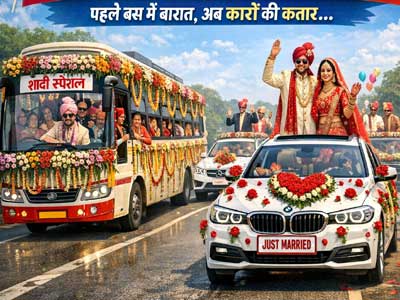
There was a time when love itself was rebellion. Falling in love meant defying the family. Challenging society. Whispered meetings, secret letters, stolen glances. The whole affair had the flavour of a Bollywood drama. As the old dialogue goes: “Pyar kiya to darna kya.”
Boy meets girl. Parents oppose. Society frowns. And one fine morning, the two disappear. A hurried court marriage. Two witnesses. Or a quiet ceremony at an Arya Samaj temple. Seven sacred rounds around the fire. No band, no fireworks, no dancing relatives. Just two stubborn hearts and a lifetime promise.
Read in Hindi: प्यार का परचम या पैकेज की परेड! पहले बस में बारात, अब कारों की कतार…
The parents stayed angry for years. The neighbourhood gossip machine ran nonstop. But the love had fire in it. Madness. A raw courage.
Today, the picture has changed. Completely. The modern love story begins in offices and college campuses. Coffee shops replace secret gardens. Weekend trips replace hidden letters. Instagram stories narrate the romance in real time.
Both are educated. Both earn well. The lifestyle is smart. The language is global. Caste barriers blur. Language barriers weaken. The old social walls appear to be cracking.
At first glance, it looks like love has finally defeated society. But the real twist arrives on the wedding day. Suddenly, the same old script reappears. Band, baaja, baraat. Destination wedding. Designer outfits. DJ nights. Drone cameras hovering in the sky.
“No dowry”, everyone proudly announces. But “gifts” are welcome. “No transaction”, they say politely. But “tradition” must be respected. Jewellery, luxury venues, endless rituals, elaborate décor.
Those who once rebelled against society now perform its rituals with perfect obedience. The revolution of love quietly bows before the wedding mandap. What is called a love marriage often begins to look like something else, a marriage of convenience.
Earlier, the parents decided, and the children obeyed. Now the children decide, and the parents applaud. The script has changed. The stage remains the same.
Perhaps the only difference is this: Earlier love had fire. Today, love has event management. Sometimes love itself feels like a beautifully packaged excuse.
In India, marriage was never just a union of two people. It was a festival of families. A fair of relationships. A carnival of emotions. Villages, neighbourhoods, cousins, uncles, distant relatives — everyone had a role in the drama. That fair still exists today. But the colours have changed. The drum is the same. Only the rhythm has shifted.
Ask anyone from the older generation about weddings of the past, and a smile appears immediately. Back then, a single bus was enough for the entire wedding procession. Yes, just one bus.
A moving house with relatives. People packed on seats, standing in the aisle, sometimes even sitting on the roof. Someone would inevitably crack the joke: “Brother, whoever fits in this bus, those are the real relatives!”
The journey itself was half the celebration. Snacks were passed around. Antakshari competitions. Loud laughter. Children running up and down the aisle. Sometimes the family priest would arrive late. Sometimes, a dramatic sulking episode by an offended Fufaji.
There was usually one special car reserved for the groom. That was the ultimate symbol of pride. The rest of the bus represented something far more important: family, friendship, shared chaos.
It felt like a Bollywood chorus line humming: “Yeh dosti hum nahi todenge…”. The baraat would reach a dharamshala or garden. The welcoming party would be waiting with garlands and jokes. Women sang traditional songs. Playful taunts filled the air.
Somewhere, a game of cards had started. Somewhere, someone was preparing bhang-thandai. Stories from those weddings were retold for decades.
Now look at the modern wedding. The bus has vanished. In its place stands a long, polished convoy of cars. Often all identical. Same colour. Same model. The groom’s car shines the brightest. Sometimes the groom doesn’t arrive by road at all. He descends from the sky, a dramatic helicopter entry.
Photographers run everywhere. Videographers shout instructions. Drones buzz overhead like mechanical birds. Every moment must be captured. Every smile archived. It begins to feel less like a wedding and more like a live film shoot. Even decoration has turned into a competitive sport.
Earlier, very little money was spent on vehicles. Now, sometimes more is spent decorating the car than on the car itself. Flowers everywhere. Lights everywhere. Ribbons, themes, colour coordination. The vehicle looks less like transportation and more like a travelling flower shop. Someone joked recently: “Weddings today run less on relationships and more on event management companies.”
Romance has also changed its style. Earlier, the groom often saw the bride properly for the first time on the wedding night. The atmosphere felt like the old song: “Parda hai parda.” Today, the love story begins long before the wedding. First meeting. Then dates. Then a pre-wedding photoshoot.
Mountains in the background. A lake nearby. Slow-motion walks. Drone shots from the sky. Background music: “Tum hi ho…”. Lakhs of rupees are spent on photography alone. Sometimes people laugh and say, “The film is completed first, the wedding comes later.”
Food has also undergone a revolution. Earlier, the wedding tent was simple. Four bamboo poles, one cloth canopy. One hardworking halwai. The menu was modest: Puri. Aloo sabzi. Raita. Jalebi. Laddoo. Barfi. Guests licked their fingers and declared happily, “What a feast!”
Today, weddings resemble international food festivals. Chinese counters. Italian pasta stations. Live pizza ovens. Ten varieties of chaat. Fifty types of pickles. Forty kinds of papad. Guests wander around holding plates, often confused about what to eat and what to leave.
After all these transformations, one question quietly remains. Have marriages really become happier? Or simply more expensive? Older people often sigh and say, “Earlier weddings had more warmth and less show-off.” Today, the show-off has grown enormously.
Money flows like water. Sometimes wedding expenses nearly break a father’s back. Society’s expectations only increase the pressure. But the real question is different. Is there peace in the heart, too? Time changes everything. Customs change as well. But one thing should never change: the honesty of relationships. Because at its core, marriage is still the meeting of two hearts.
A wedding should create memories, not debts. And love, if it truly exists, should never need such a grand stage to prove itself.
Related Items
Two voices of love, bridging the 'past' and 'present'...
‘In Haseen...’ captures melody of love amid beautiful valleys
Small families, Fractured bonds! Blame it on family planning!