
 Samiksha Bharti News Service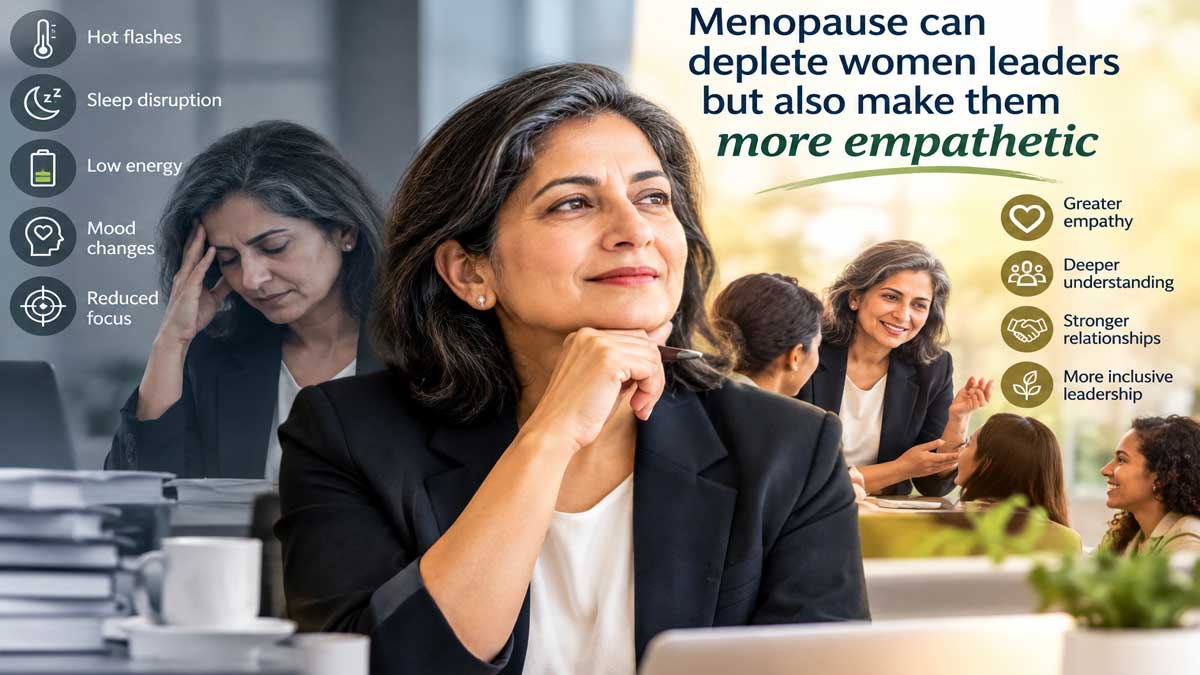
Women leaders going through menopause become depleted and more nostalgic, leading to an increase in their levels of empathy, according to new research from Durham University Business School.
The research, conducted by Prof Olga Epitropaki and Prof Maria Kakarika, found that the experiences of menopausal women leaders challenge many of the stereotypes and deficit-based assumptions typically associated with menopause. Although severe symptoms depleted psychological resources, the nostalgia this triggered had bittersweet effects for women leaders, making them more empathetic towards their employees on the one hand, but also more psychologically withdrawn on the other.
The researchers say that because menopause is seen as a taboo topic to discuss, it largely remains absent from staff wellbeing and leadership development discussions, despite women’s high participation in the workforce.
“As this stage in life often coincides with a career advancement into senior roles, menopause is a particularly important consideration for women and for employers,” says Prof Epitropaki.
“Leadership involves considerable cognitive and emotional demands, which may be exacerbated by menopausal symptoms. Understanding how menopause intersects with leadership experiences is therefore essential for informing organisational policies that support women’s well-being and career progression,” Prof Epitropaki emphasises.
To understand how menopause might impact work life, the researchers conducted a critical incident study and a 3-part causal-chain experiment. In the first study, they surveyed 341 full-time women in leadership positions who were experiencing menopausal symptoms. They were asked to recall a specific menopause-related incident from the previous month and describe what happened.
All the women surveyed reported having vivid menopausal experiences, with 66 per cent experiencing hot flushes, 57 per cent suffering from sleep disturbances, 44 per cent reporting psychological changes, 29 per cent reporting cognitive difficulties, 28 per cent experiencing physical pain, and 10 per cent recording menstrual changes. Many participants regularly experienced more than one symptom, and often more than one at a time. Some recalled having severe hot flushes during meetings, or battling extreme fatigue, making it hard to function while at work.
Women who experienced more severe symptoms reported feeling more depleted afterwards. The more depleted they felt, the more likely they were to experience nostalgia for their premenopausal selves. Higher nostalgia was then associated with greater psychological withdrawal but also linked to greater empathy towards employees.
Researchers further conducted three experiments involving a total of 450 women leaders. The experimental results showed that (a) more severe menopausal experiences increased feelings of depletion; (b) greater depletion increased nostalgia for the premenopausal self; and (c) nostalgia, in turn, increased empathy towards employees. However, experimentally induced nostalgia did not significantly increase psychological withdrawal.
Nostalgia, the researchers suggest, can have bittersweet effects. On the one hand, it can replenish inner strength by restoring psychological continuity and reinforcing positive self-value. This can help women to feel more connected to and empathic toward colleagues and subordinates.
On the other hand, nostalgia for the premenopausal self can also draw attention to what women feel they have lost. Reflecting on a time when they may have felt more energetic, capable or in control was associated with greater psychological withdrawal in the critical-incident study.
This perceived loss, the researchers noted, may heighten women leaders’ concerns about their ageing, potentially declining abilities, low energy and personal control, and thus creating an additional psychological challenge for women leaders. The researchers therefore warn that menopause can create unnecessary hurdles for women professionally, particularly when symptoms and their psychological consequences go unrecognised and unsupported by employers.
The researchers state their findings highlight a vital need for organisations to provide better dialogue and support for staff navigating menopause. Their study, Prof Kakarika states, provides a necessary first step in doing so.
“Rather than treating menopause solely as a medical or personal issue, we conceptualise it as a self-regulatory challenge that intersects with the cognitive and emotional demands of leadership,” says Prof Kakarika.
By offering additional help and providing interventions, women leaders will be more empowered in the workplace to pursue their professional development without sacrificing their physical or mental health.
Related Items
Income disparity between partners at home stalls women’s careers
How Shekhawati’s Marwaris helped build India’s business empires…
RTI law or a new business of extortion…!