
 Brij Khandelwal
“Ek kachori, doh samosas, in mardon ka kya bharosa? “Ek cigarette, doh cup chaay, mard jaat haay haay!”
What a revolution! Kachoris, samosas and cigarettes have become weapons of women’s liberation. Add a plate of biryani, and this revolution might qualify for a royal banquet!
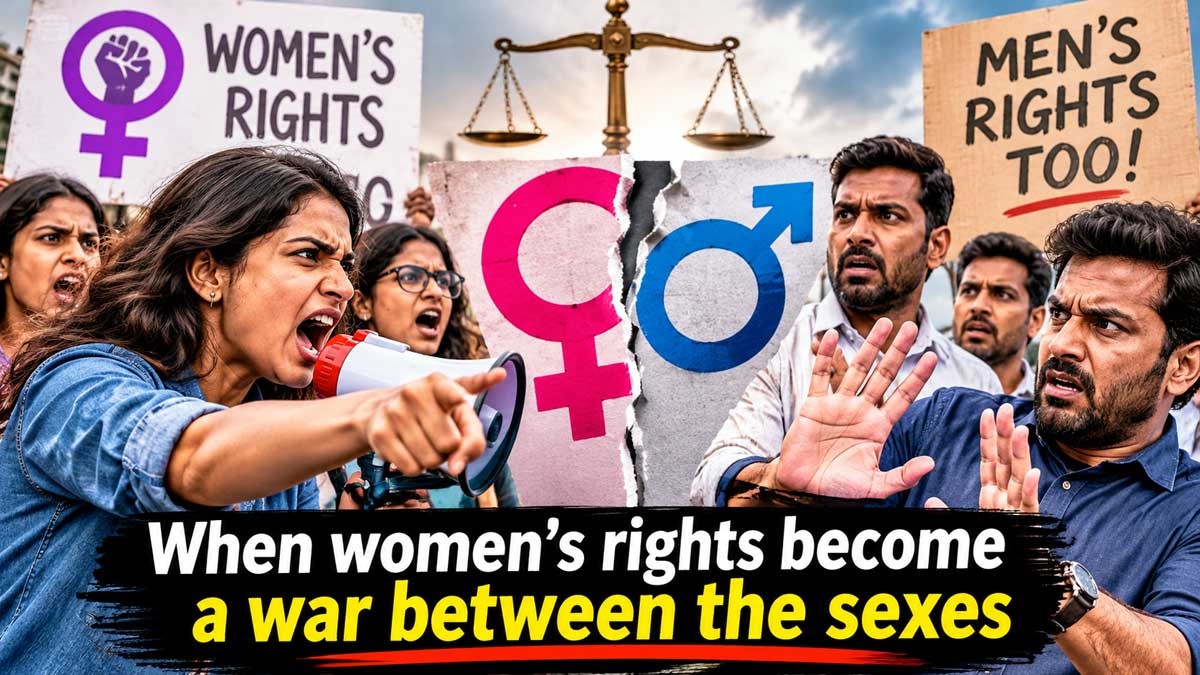
Jokes apart, what are we celebrating? A fight for equality or another battle of the sexes? Feminism deserves respect. But when a serious struggle descends into blanket insults against men, its message gets lost in the masala.
Picture this. It is three in the morning. Someone bangs on the door. A seventy-year-old father-in-law, already battling heart disease, struggles to understand what is happening. His wife trembles with fear. Then comes another shock: a married sister-in-law discovers that she, too, has been named in a complaint.
A family’s reputation lies in tatters. Neighbours whisper, relatives keep their distance, and lawyers send bills. Savings disappear, peace vanishes, and court dates dominate the family calendar.
This is not a Bollywood thriller. Such situations can arise in matrimonial disputes, though every case has different facts. The point is not to dismiss genuine complaints. It is to ask whether justice survives when allegations become verdicts before evidence is examined.
Domestic violence and dowry harassment remain serious problems. Women facing abuse deserve protection, support and justice. No decent society should turn away from their suffering. But the possibility of misuse also deserves attention.
Section 498A of the Indian Penal Code dealt with cruelty by husbands and their relatives. Sections 85 and 86 of the Bharatiya Nyaya Sanhita now address this subject. In Arnesh Kumar vs State of Bihar, the Supreme Court laid down safeguards against unnecessary arrests. Arrests should not be automatic; prescribed legal procedures must be followed.
Sometimes, a marital dispute becomes a family-wide operation. The husband is accused, elderly parents are named, and siblings living hundreds of kilometres away get dragged into the mess. Courts have repeatedly expressed concern about unnecessarily implicating relatives.
The law must protect genuine victims without becoming an instrument of revenge. That is easier said than done, but justice demands nothing less.
Social media has turned matrimonial quarrels into a travelling circus. A video appears from a road, metro station or college campus. Someone slaps, someone shouts, and someone swings a sandal. Within minutes, the internet becomes a courtroom.
The verdict arrives before the evidence. One person becomes a hero, the other a villain. Nobody asks what happened before the camera started rolling.
If a man slaps a woman, we rightly condemn violence. But if a woman slaps a man, should we distribute medals? Does a flying sandal become a symbol of empowerment simply because a woman throws it?
Come on! Violence does not become noble when the person delivering the blow changes gender. A society that condemns male aggression must also reject female aggression. Otherwise, we are not changing the rules. We are merely changing the players.
Divorce raises another bitter question: who pays, how much, and for how long? A husband may fear losing his lifetime savings. A wife may worry about rent, food, education and security. Both concerns can be genuine. Neither deserves automatic dismissal.
Courts must consider income, assets, financial needs, responsibilities and the ability to pay. Maintenance should neither become a weapon of revenge nor an excuse to abandon someone who genuinely needs support. Fairness must guide every decision.
And what about the children? They never signed the marriage certificate, yet often pay the heaviest price for its collapse. Some are forced to choose between parents. Others become bargaining chips in bitter disputes. Adults may call this victory. But what kind of victory leaves a child emotionally wounded?
The #MeToo movement gave many women the courage to speak about sexual harassment. Fear, pressure and social stigma had silenced victims for years. The movement broke that silence and forced institutions to confront uncomfortable truths. That achievement deserves recognition. But an accusation should not automatically become a conviction on social media.
Serious complaints require serious investigations. Proven wrongdoing demands appropriate action. Where allegations are deliberately false, the law must provide appropriate remedies. Every person deserves a fair process.
Social media has no shortage of judges. Every phone is a courtroom, every comment a verdict, and every viral post a public hanging. But where are the complete facts? Where is the opportunity to respond?
Reputations can be destroyed within minutes. Restoring them may take years. Justice cannot depend on the speed of a hashtag.
Modern women want education, employment, financial independence and freedom of choice. These are legitimate rights, not favours granted by society.
Tradition cannot become a prison. Women's clothes, careers, food choices and marriages should not invite endless public policing. A woman does not lose her values because she marries outside her religion or community.
Social worker Padmini Iyer makes an important point: women's freedom goes far beyond what they wear or whom they marry. Their right to study, earn, think independently and live with dignity matters just as much.
Yet freedom does not require turning every relationship into a battlefield. Healthy relationships need communication, cooperation and mutual respect. Suspicion, threats and score-settling can destroy even the strongest bonds.
Retired school principal Shobha from Karnataka offers another important reminder. Genuine domestic violence complaints must never be brushed aside. Women's commissions and courts must investigate fairly, protecting victims without blindly favouring either side.
Public commentator Prof Paras Nath Chaudhary puts it plainly: feminism is not the problem. The problem begins when anyone invokes its name to justify violence, humiliation, false accusations or irresponsibility. Equally unacceptable is crushing women's freedom in the name of tradition.
Social activist Mukta believes society needs neither blind feminism nor male domination. It needs equal rights, mutual respect and shared responsibility. That sounds like common sense. Unfortunately, common sense often becomes the first casualty when tempers rise.
Let us get one thing straight. Not every man is an oppressor. Not every woman is a victim. Neither gender deserves a blanket certificate of innocence or guilt.
Feminism is not about hating men. It challenges a system that treats women as inferior. Men must understand that being male does not give them ownership over women's lives. Equally, defending women's rights does not require treating every man as an enemy.
A fair society listens to complaints, examines evidence and holds offenders accountable, regardless of gender. Justice must not tilt because someone shouts louder. Nor should prejudice silence those who suffer genuine abuse.
Kachoris, samosas and biryani may spice up a protest. They might even make a catchy social media reel. But slogans cannot replace meaningful reforms, effective protection, impartial investigations and responsible behaviour.
So, what do we really want: freedom for half the population or a permanent war against the other half? Male domination or female retaliation?
The answer is neither. Society needs equality without arrogance, freedom without fear, and justice without prejudice.
Related Items
Fight is for ‘Justice’, not ‘Samosas’ and ‘Kachoris’
Income disparity between partners at home stalls women’s careers
Menopause can drain women leaders yet deepen their empathy