
 Brij Khandelwal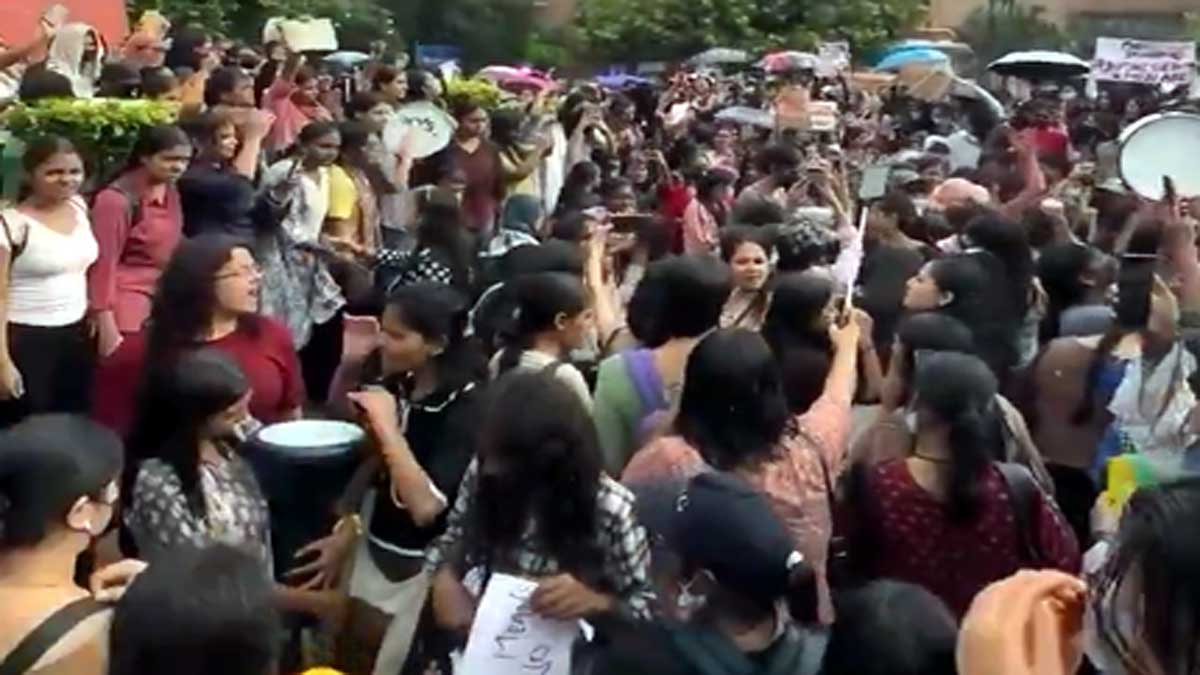
What happens when an alleged gang rape of a minor girl in a park turns, within minutes, from a demand for justice into a competition of rhymes?
Police accountability must be demanded. Officers must be held responsible. The safety of daughters must be secured. Yet after a serious crime in Delhi, social media was filled with slogans that made the fight for justice sound less like a movement and more like a comedy poetry session.
Also read: लड़ाई 'समोसा' और 'कचौड़ी' की नहीं, 'न्याय' की है…!
The question is simple: Do the slogans echoing through Delhi’s elite colleges represent the real voice of half of India’s population, or are they the anger of a few privileged young women that social media has elevated to centre stage?
On the evening of 21 September, a 17-year-old girl was celebrating her birthday with a male friend in Aastha Kunj Park near Kalkaji Temple in Delhi. Three men allegedly posed as policemen and gang-raped her. Delhi Police arrested the accused within 12 hours.
The park’s poor management was also exposed. Several entrances had no CCTV cameras. It was dark, and security guards were inadequate. Lieutenant Governor Tarunjit Singh Sandhu ordered a security audit of Delhi’s parks. The Delhi Development Authority restricted entry after sunset and promised better surveillance.
Still, the deeper questions remain: Why did a girl’s birthday turn into a nightmare? Why must daughters pay for their freedom with fear and restrictions?
After the incident, students from Lady Shri Ram College, Miranda House, Gargi and Kamala Nehru College took to the streets under the banner “We Women Are Free.”
Some slogans were powerful. Others reduced a serious movement to canteen chatter: “ek kachori, do samosa, in mardon ka Nahin bharosa!” “ek cigarette, do chay, mard jaat haay haay!” “mere sir mein dard hai, iska karan mard hai!” And then: “humari skirt Nahin hai chhoti, in mardon ki soch hai chhoti!” Impressive rhymes, perfect for Instagram reels. Anger expressed, entertainment delivered.
But pause. Will these slogans switch on park lights? Will missing CCTV cameras install themselves? Will police patrols increase? Will years-old court cases suddenly move faster? Slogans can grab attention. They cannot deliver security.
The students did raise some essential points. “Lock up the rapists, not the girls” challenged the old reflex of restricting women instead of catching criminals. Another message was clear: instead of tracking daughters’ locations, examine sons’ intentions.
Exactly right. Families that keep long lists of questions about where a daughter went, what she wore and whom she met should also scrutinise their sons’ behaviour. Unfortunately, serious messages often get drowned in the noise of spicy rhymes.
Now the real question. Do students from Delhi’s prestigious colleges represent the hundreds of millions of Indian women? A woman labouring in a field, a domestic worker scrubbing utensils in Mumbai homes, a daughter-in-law in an Uttar Pradesh village and a student at a big Delhi college all need safety and dignity. Their struggles, however, are not the same.
For one girl, freedom may mean wearing the clothes she chooses. For another, it means finishing school. For one woman, freedom is getting a job; for another, it is escape from domestic violence.
A poor woman’s immediate concerns are often food, work and a roof. Her freedom is tied to her family’s economic condition. For many women, the family itself is the only support in hard times.
Public commentator Prof Paras Nath Chaudhary notes, “This does not mean traditional practices should never be questioned. But not every family, every man and every social relationship is the enemy.
The Indian women’s movement has fought long battles for education, property rights, protection from domestic violence and equal employment opportunities. Progress has come not only through slogans but through law, social reform and sustained effort. Women’s participation in the workforce has risen, yet the road remains long. Large gaps persist between villages and cities, rich and poor.”
Are the voices of these women less important simply because they do not go viral on social media? Social activist Padmini Iyer says, “Students have every right to protest. Their anger is justified. Satire and humour can strike at social evils. But the real test of a movement comes the next day, when the cameras leave, and the crowd goes home.
Who will ensure lights in the parks? Who will monitor the CCTV cameras? Who will watch police patrolling? Who will provide legal aid to survivors? Who will push for faster hearings in the courts?”
Young advocate Ankur points out, “Conviction rates in rape cases remain a serious concern, though figures vary by state, court and period. Arrest is the first step toward justice, not the last. Fair investigation, strong evidence and timely trials are equally essential.”
Governments cannot discharge their duty with announcements alone. Activists cannot claim they have done theirs merely by raising slogans.
Social worker Mukta Gupta observes, “Remember one thing. Treating all men as the same is not justice either. The fight is not against men but against criminal mindsets, sexual violence, impunity and the systems that protect the guilty. Men must also be made partners in this struggle.”
India needs movements, but movements that step outside college walls and connect with the lives of ordinary women.
Students should campaign for safer parks, better policing, faster trials and support for survivors. They should work with labouring women, rural organisations, lawyers, teachers and social workers. Social media can be used, but viral videos must not become the destination of the movement.
The Aastha Kunj incident raises legitimate questions about administrative failure. The answer cannot be that girls stay indoors after dark while dangerous places remain poorly managed.
In the end, the success of a movement is not measured in likes, shares and applause. It is measured by the change it brings to real lives.
A slogan can shake a college. Real revolution arrives only when its impact reaches the street, the village, the office and the home. When an ordinary woman can live without fear, only then will the slogans have found the path to justice.
Related Items
Shining expressways, Crumbling justice…
‘Dancing Girl’ from Mohenjo‑daro: Are we ashamed of our history…!
Why this West Asia war is not ours to fight…!