Latest News: Indian share markets will be open for trading on Sunday, February 01, as the Union Budget is being presented on that day * Key Highlights of Economic Survey 2025–26: GDP & GVA Growth Estimates for FY 2026: First advance estimates at 7.4% and 7.3% respectively * India’s Core Growth Projection: Around 7%, with real GDP growth for FY 2027 expected between 6.8% and 7.2% * Central Government Revenue: Rose to 11.6% of GDP in FY 2025 * Non-Performing Assets: Declined to a multi-decade low of 2.2% * PMJDY Accounts: Over 552 million bank accounts opened by March 2025; 366 million in rural and semi-urban areas * Investor Base: Surpassed 120 million by September 2025, with women comprising ~25% * Global Trade Share: India’s export share doubled from 1% in 2005 to 1.8% in 2024 * Services Export: Reached an all-time high of $387.6 billion in FY 2025, up 13.6% * Global Deposits: India became the largest recipient in FY 2025 with $135.4 billion * Foreign Exchange Reserves: Hit $701.4 billion on January 16, 2026—covering 11 months of imports and 94% of external debt * Inflation: Averaged 1.7% from April to December 2025 * Foodgrain Production: Reached 357.73 million metric tons in 2024–25, up 25.43 MMT from the previous year * PM-Kisan Scheme: Over ₹4.09 lakh crore disbursed to eligible farmers since inception * Rural Employment Alignment: “Viksit Bharat – Jee Ram Ji” initiative launched to replace MGNREGA in the vision for a developed India by 2047 * Manufacturing Growth: 7.72% in Q1 and 9.13% in Q2 of FY 2026 * PLI Scheme Impact: ₹2 lakh crore in actual investment across 14 sectors; production and sales exceeded ₹18.7 lakh crore; over 1.26 million jobs created by September 2025 * Semiconductor Mission: Domestic capacity boosted with ₹1.6 lakh crore invested across 10 projects * Railway High-Speed Corridor: Expanded from 550 km in FY 2014 to 5,364 km; 3,500 km added in FY 2026 * Civil Aviation: India became the third-largest domestic air travel market; airports increased from 74 in 2014 to 164 in 2025 * DISCOMs Turnaround: Recorded first-ever positive PAT of ₹20,701 crore in FY 2025 * Renewable Energy: India ranked third globally in total renewable and installed solar capacity * Satellite Docking: India became the fourth country to achieve autonomous satellite docking capability * School Enrollment Ratios: Primary – 90.9%, Upper Primary – 90.3%, Secondary – 78.7% * Higher Education Expansion: India now has 23 IITs, 21 IIMs, and 20 AIIMS; international IIT campuses established in Zanzibar and Abu Dhabi * Maternal & Infant Mortality: Declined since 1990, now below global average * E-Shram Portal: Over 310 million unorganised workers registered by January 2026; 54% are women * National Career Service Portal: Job vacancies exceeded 28 million in FY 2025 and crossed 23 million by September 2026

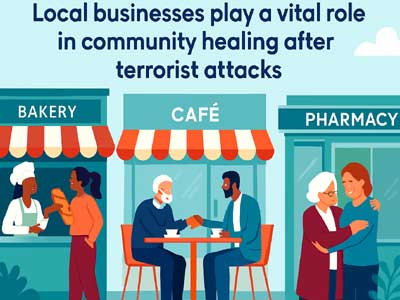
Local businesses aid community healing after terrorist attacks


Everyday consumption habits play a vital role in community healing following terrorist attacks, finds new research from NEOMA Business School.

Researchers Amy Greiner Fehl and Mariann Györke conducted a seven-year-long ethnographic study in the neighbourhoods affected by the 13 November 2015 Paris terrorist attacks, highlighting the role of cafes and restaurants in particular.

They find that local businesses provide a literal and figurative space for community members to come together and rediscover a sense of belonging through their shared consumption habits based on the cultural significance of these activities.

The researchers also analysed the Paris city archives of the objects left at the memorials for the attacks to deepen their understanding of the symbolic significance of public spaces. This extended follow-up enabled the researchers to capture the subtle evolution of the dynamics between restoring social bonds, commemorative practices, and communal spaces.

Fehl and Györke identify two stages in the return to public places. The first is characterised by a spontaneous desire to be together and recreate connections; the second is a more integrative phase where consumption acquires new meaning.

Going to ‘your’ café becomes an affirmation of belonging to a community, and ordering a drink becomes a way of contributing to the shared memory of the neighbourhood. This type of consumption solidarity supports healing and overcoming shared trauma.

The study highlights, moreover, that solidarity is not the sole province of the state or institutions; it also emerges in everyday gestures.

The findings could prompt local and national governments to rethink community support efforts in the wake of terrorist attacks, suggesting that the restoration of community spaces where people can gather and rebuild connections should be a central policy concern.