
 Samiksha Bharti News Service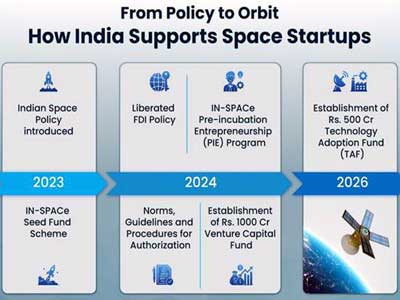
India’s space sector is undergoing a historic transformation. Indian space industry is now participating in satellite manufacturing, launch services, space applications and downstream services.
India’s space startup ecosystem has grown from just one startup in 2014 to over 400 in 2026, reflecting the rapid expansion of private participation and innovation across the space sector.
Read in Hindi: विक्रम-1 लॉन्च के बाद अब ग्लोबल स्पेस हब के रूप में उभर रहा है भारत
Valued at approximately USD 8.4 billion today, the sector is projected to grow fivefold to USD 40–45 billion by 2030. It is further aimed to reach USD 100 billion by 2040. Strong public-private partnerships continue to drive this growth, positioning India as a global hub for space technology, manufacturing, innovation and commercial space activities.
Vikram-1, developed by Skyroot Aerospace, is India's first privately developed orbital launch vehicle, capable of placing 350 kg into Low Earth Orbit. Orbital launch vehicles deploy satellites into stable Earth orbits, supporting communication, navigation, Earth observation and scientific research.
It is built with an all-carbon composite structure, reliable solid-fuel boosters and a 3D-printed liquid engine, Vikram-1 showcases India's growing private-sector launch capabilities.
A successful mission will validate the country's indigenous commercial launch capability and the success of the Government of India's space sector reforms.
The mission will deploy multiple customer payloads into LEO at an altitude of 450 kilometres. These include Skyroot's SCOPE satellite, DCUBED's technology demonstration payload, Grahaa Space's SOLARAS S3 satellite, and Cosmoserve Space's Embrace, a robotic arm designed to capture orbital debris.
The maiden flight will also carry two symbolic payloads— 'Cosmic Bloom’, a floral-shaped artwork, and an 18-karat gold micro-rocket. The micro-rocket features microscopic sculptures of CV Raman, Vikram Sarabhai and APJ Abdul Kalam, each smaller than a grain of rice, paying tribute to India's pioneering scientists.
Remember, the Indian Space Policy 2023 defined the role of NewSpace India Limited as ISRO's commercial arm. NSIL manufactures and procures space systems on commercial principles. It also delivers end-to-end space solutions to both Government entities and NGEs. NSIL further expands private participation through PSLV productionisation and small satellite technology transfer. It also supports satellite services while marketing space products and spin-off technologies.
Over the years, NSIL has witnessed a tenfold increase in revenue, reflecting its expanding commercial footprint in the global space sector. As of December 2025, over 70 Technology Transfer Agreements had enabled the transfer of ISRO-developed technologies to industry, accelerating their commercialisation. As of July 2026, NSIL has launched a total of 141 satellites, including 138 international/customer satellites and three Indian satellites, reinforcing India's position as a trusted global launch service provider.
The Foreign Direct Investment policy for the space sector was liberalised to make it more investor-friendly. The revised policy permits up to 74 per cent automatic FDI in satellite manufacturing and operations, 49 per cent automatic FDI in launch vehicles and spaceports, and 100 per cent automatic FDI in the manufacturing of satellite components and subsystems. The reform is expected to accelerate investments, promote technology transfer and collaborative research, and further improve the ease of doing business in India's space sector.
NSIL strengthened India’s commercial launch capabilities by executing India’s first dedicated commercial LVM3 mission in October 2022, launching 36 OneWeb satellites into Low Earth Orbit and reinforcing India’s position in the global launch services market.
Vikram-S was launched under Mission Prarambh in November 2022. Vikram-S was India's first privately developed rocket and the country's first private launch authorised by IN-SPACe. The technology demonstration mission carried three customer payloads equipped with sensors to validate critical launch technologies for future orbital missions.
Agnikul Cosmos became the first NGE to launch a rocket from India’s first private launch pad ‘Dhanush’ at Sriharikota in May 2024. The mission also demonstrated the world’s first single-piece 3D-printed semi-cryogenic rocket engine.
IN-SPACe approved a Public-Private Partnership for an Earth Observation satellite constellation, led by Pixxel with Dhruva Space, SatSure Analytics India and Piersight Space, to strengthen applications such as agriculture, disaster management, climate monitoring and urban planning.
Technology commercialisation has also accelerated. In February 2026, IN-SPACe facilitated the ₹511 crore, 10-year transfer of SSLV technology to Hindustan Aeronautics Limited, enabling industry-led production and launch services. Bellatrix Aerospace also successfully demonstrated an indigenous Green Propulsion System under DRDO’s Technology Development Fund, strengthening indigenous capabilities through cleaner propulsion technologies. This collaborative ecosystem is shaping India's emergence as a global space technology hub.
India's space sector stands at the threshold of a new era. The Indian Space Policy 2023, liberalised FDI norms, and dedicated funding initiatives have opened the entire space value chain to any potential players. These reforms have fostered a dynamic ecosystem marked by growing startups, indigenous innovation, and expanding commercial activities.
Moreover, as Vikram-1 prepares for liftoff under Mission Aagaman, it would represent more than a technological milestone. It reflects the growing confidence and capabilities of India's private space industry.
Related Items
From 'Beacons' to 'Landmarks', India’s changing ‘Lighthouse’ story…
Are Indian borders just lines on a map!
How the 'Indian Solar Revolution' is transforming rural lives…