
 Samiksha Bharti News Service
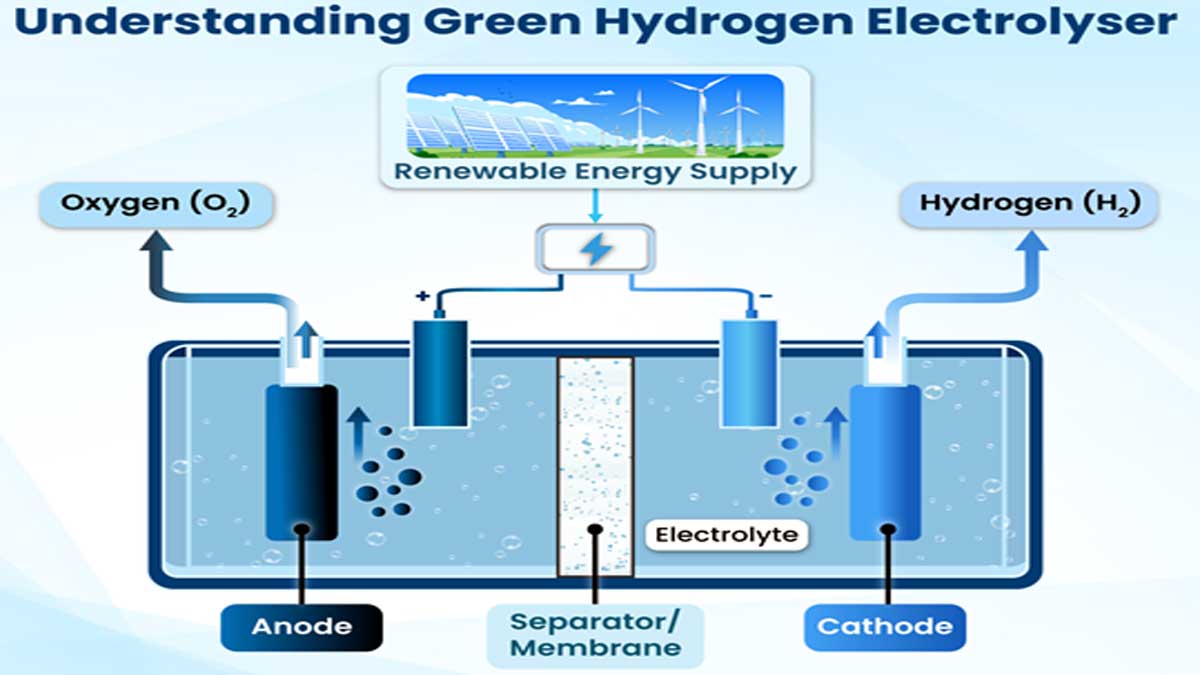
Green hydrogen is emerging as a pillar of India’s clean energy transition. It is produced by splitting water using renewable electricity. It can help reduce emissions in sectors such as fertiliser production, petroleum refining, iron and steel manufacturing, heavy-duty road transport and shipping.
Hydrogen is an energy carrier that stores energy and delivers it for varied uses. In a fuel cell, it reacts with oxygen to produce electricity, leaving only water and heat as by-products, and no polluting compounds or greenhouse gases. Although pure hydrogen is not found in large quantities in nature, it can be extracted from compounds such as water or natural gas. Its environmental impact therefore depends on how it is made. Conventional methods rely on fossil fuels and release carbon emissions.
Also read: स्वच्छ ऊर्जा परिवर्तन के रूप में तेजी से उभर रहा है हरित हाइड्रोजन
Production using renewable electricity from solar and wind power can cut this footprint substantially. Hydrogen made by splitting water using renewable power is called green hydrogen. Unlike fossil-based routes, this process emits far less carbon. India’s abundant solar and wind resources make domestic production feasible. This diversifies the country’s energy sources and strengthens energy security. It also supports India’s goal of net-zero emissions by 2070.
Green hydrogen matters most in sectors where cutting emissions is difficult. Reasons include high-temperature heat needs, chemical processes and few alternatives to fossil fuels. These hard-to-abate sectors include fertiliser, petroleum refining, iron and steel, heavy-duty road transport and shipping. Fertiliser and refining plants already use hydrogen, so green hydrogen can replace the fossil-based supply. It can also support lower-emission steelmaking, selected transport uses and energy storage. It is especially useful where direct electrification is difficult or less practical.
For India, wider adoption could reduce dependence on imported fossil fuels. It would also lessen exposure to global fuel price swings. The sector could open opportunities in manufacturing, draw investment, create jobs and expand exports. Building capabilities across the value chain would strengthen domestic supply chains and spur industrial innovation. Green hydrogen can thus support self-reliance, sustainable industrial growth and a low-carbon future.
Hydrogen releases no carbon dioxide when used, so its climate impact depends on how it is produced. In August 2023, the Ministry of New and Renewable Energy notified India’s Green Hydrogen Standard. Hydrogen qualifies as green if emissions do not exceed two kg of CO₂ equivalent per kg of hydrogen, on a well-to-gate basis, measured as a 12-month average. India thus became one of the first few countries to define green hydrogen formally.
Green hydrogen is produced mainly through water electrolysis. Electrolysis uses electricity to split a compound into simpler substances. Here, renewable electricity splits water into hydrogen and oxygen, with minimal emissions.
The key equipment is the electrolyser. It contains two electrodes, a cathode and an anode, connected to a power source. They operate within an electrolyte, which helps ions move through the cell. A diaphragm keeps the gases apart while allowing ions to pass. When current flows, hydrogen forms at the cathode and oxygen at the anode. The gases are collected separately for further use. An electrolyser thus turns renewable electricity and water into a low-emission fuel for industry, transport and other uses.
Water is purified before electrolysis, because impurities can damage cells and shorten their life. About nine litres of demineralised water is needed per kg of hydrogen. Afterwards, the hydrogen is dried and purified before compression. India’s Green Hydrogen Standard counts emissions from each of these steps.
By 2030, India aims to develop five million metric tonnes of annual green hydrogen production capacity. This transition can reduce dependence on imported fossil fuels and strengthen the country’s long-term energy security.
It is expected to mobilise over Rs.8 lakh crore in investments and generate more than six lakh jobs across manufacturing, infrastructure, research and project development. The production and use of the targeted green hydrogen quantum could also help avert nearly 50 MMT of carbon dioxide emissions annually. This will contribute to India’s broader vision of Viksit Bharat by 2047 and its commitment to achieving net-zero emissions by 2070.
Related Items
An Indian traveller’s eye-opening lessons in the ‘Art of Living’
Land of Lord Krishna crying for every drop of water
Are Indian borders just lines on a map!