
 Samiksha Bharti News Service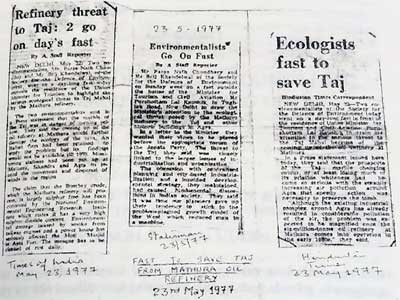
{Photo: The image is a collection of three old newspaper clippings from May 1977, documenting an environmental protest to protect the Taj Mahal from a proposed Mathura oil refinery.}
These reports describe how environmentalists, led by Brij Khandelwal and other conservationists, staged a day-long fast in Agra to oppose the refinery. They feared that emissions containing Sulphur dioxide and other pollutants would damage the Taj Mahal's white marble.
The campaign demanded that the refinery be relocated away from the Taj region and urged the government to prioritise protecting India's priceless heritage over industrial expansion. The protesters argued that once the Taj was harmed, the damage would be irreversible.
The three headlines capture the movement:
"Refinery threat to Taj: 2 go on day's fast" (The Times of India, 22 May 1977)
"Environmentalists Go On Fast" (The Statesman, 23 May 1977)
"Ecologists fast to save Taj" (Hindustan Times, 23 May 1977)
Overall, the clippings record one of the earliest public environmental campaigns in India, highlighting citizens' efforts to save the Taj Mahal from industrial pollution — an issue that later led to stronger environmental safeguards for the Taj Trapezium Zone.
The reason I'm sharing this today is that, at a meeting, people credited MC Mehta as the first environmentalist to fight to save the Taj Mahal from pollution.
I have no problem with giving him the recognition he deserves. But for the sake of historical accuracy, people should also know that we, too, had launched a campaign to protect the Taj long before MC Mehta's legal battle began. These newspaper reports are part of that record.
Brij Khandelwal
Agra
Related Items
Western Media is ‘tough’ on India but ‘soft’ on China!
From 'Beacons' to 'Landmarks', India’s changing ‘Lighthouse’ story…
Walking, a ‘fundamental right’ but a ‘struggle’ in Agra