
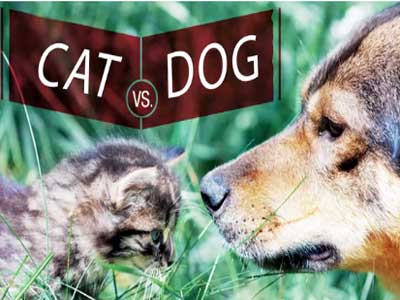
It has to do with their brains, specifically the number of neurons in their cerebral cortex: the “little gray cells” associated with thinking, planning and complex behavior —all considered hallmarks of intelligence.
The first study to actually count the number of cortical neurons in the brains of a number of carnivores, including cats and dogs, has found that dogs possess significantly more of them than cats.
“In this study, we were interested in comparing different species of carnivorans to see how the numbers of neurons in their brains relate to the size of their brains, including a few favorite species including cats and dogs, lions and brown bears,” said Associate Professor of Psychology and Biological Sciences Suzana Herculano-Houzel, who developed the method for accurately measuring the number of neurons in brains.
The results of the study are described in a paper titled “Dogs have the most neurons, though not the largest brain: Trade-off between body mass and number of neurons in the cerebral cortex of large carnivoran species” accepted for publication in the open access journal Frontiers in Neuro-anatomy.
As far as dogs and cats go, the study found that dogs have about 530 million cortical neurons while cats have about 250 million. (That compares to 16 billion in the human brain.)
“I believe the absolute number of neurons an animal has, especially in the cerebral cortex, determines the richness of their internal mental state and their ability to predict what is about to happen in their environment based on past experience,” Herculano-Houzel explained.
“I’m 100 percent a dog person,” she added, “but, with that disclaimer, our findings mean to me that dogs have the biological capability of doing much more complex and flexible things with their lives than cats can. At the least, we now have some biology that people can factor into their discussions about who’s smarter, cats or dogs.”
The researchers analyzed the brains of one or two specimens from each of eight carnivoran species: ferret, mongoose, raccoon, cat, dog, hyena, lion and brown bear.
They expected that their measurements would confirm the intuitive hypothesis that the brains of carnivores should have more cortical neurons than the herbivores they prey upon. That is because hunting is more demanding, cognitively speaking, compared to the herbivore’s primary strategy of finding safety in sheer numbers.
However, that proved not to be the case. The researchers determined that the ratio of neurons to brain size in small- and medium-sized carnivores was about the same as that of herbivores, suggesting that there is just as much evolutionary pressure on the herbivores to develop the brain power to escape from predators as there is on carnivores to catch them.
In fact, for the largest carnivorans the neuron-to-brain-size ratio is actually lower. They found that the brain of a golden retriever has more neurons than a hyena, lion or brown bear, even though the bigger predators have brains up to three times as large. The bear is an extreme example. Its brain is 10 times larger than a cat’s, but has about the same number of neurons.
“Meat eating is largely considered a problem-solver in terms of energy, but, in retrospect, it is clear that carnivory must impose a delicate balance between how much brain and body a species can afford,” said Herculano-Houzel.
Hunting requires a lot of energy, particularly for large predators, and the intervals between successful kills are unpredictable. That explains why large meat-eating carnivorans like lions spend most of their time resting and sleeping. In terms of energy, the brain is the most expensive organ in the body and its requirements are proportional to the number of neurons. It also needs energy continuously. As a consequence, the quantity of meat that large hunters can kill and consume and the intermittent nature of feeding appears to limit their brain development.
The study’s findings also challenge the prevailing view that domesticated animals have smaller brains than their wild cousins. The ratios of brain size to body weight of the domestic species they analyzed—ferret, cat and dog—did not scale in a significantly different manner from those of their wild relatives—mongoose, raccoon, hyena, lion and brown bear.
The analysis also discovered that the raccoon was an outlier—on the brainy side: It packs the same number of cortical neurons as a dog into a brain the size of a cat’s.
“Raccoons are not your typical carnivoran,” said Herculano-Houzel. “They have a fairly small brain but they have as many neurons as you would expect to find in a primate … and that’s a lot of neurons.”
According to the neuro-scientist, studying the brains of different species teaches an important lesson: “Diversity is enormous. Not every species is made the same way. Yes, there are recognizable patterns, but there are multiple ways that nature has found of putting brains together—and we’re trying to figure out what difference that makes.”
Related Items
Brain Activity Data can predict what will be popular with consumers
Unique Drug Delivery Method to improve treatment of Brain TB
Just 4,000 Steps A Day For Better Brain Fitness