
 Santosh Kumar / Sarla Meena / Rishita Aggarwal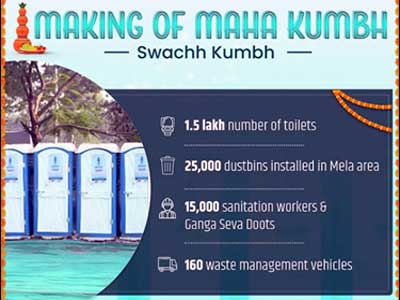
The Maha Kumbh 2025 is a significant religious gathering and a model of environmental conservation and cleanliness. With millions of devotees attending this festive fair, maintaining sanitation and hygiene is a top priority.
The event sets new global benchmarks in waste management, river conservation, and eco-friendly practices. With innovative waste management systems, strict regulations on single-use plastics, and widespread awareness campaigns, the aim is to create a greener and cleaner pilgrimage. This initiative reflects a commitment to environmental stewardship, promoting harmonious coexistence of spirituality and sustainability during the grand gathering.
Read in Hindi: महाकुंभ में स्वच्छता व पवित्रता है पहली प्राथमिकता
One of the key objectives of Maha Kumbh is to maintain the purity of the Ganga. To achieve this, strict regulations have been imposed to prevent pollution, and continuous river monitoring is being conducted. The fairgrounds have been designated as plastic-free zones, with an absolute ban on single-use plastics. This initiative is reinforced by awareness campaigns urging pilgrims to avoid plastic waste and dispose of their garbage in designated bins.
To accommodate the vast influx of devotees, a robust sanitation infrastructure has been established. This includes 12,000 Fiber Reinforced Plastic toilets with septic tanks, 16,100 prefabricated steel toilets with soak pits, and 20,000 community urinals strategically placed across the fairgrounds.
These facilities ensure that pilgrims have access to clean and hygienic restrooms, reducing the risk of open defecation and related health hazards.
A well-organized waste management system is in place also to keep the event area clean and eco-friendly. Measures include 20,000 trash bins to facilitate waste segregation at the source, 37.75 lakh liner bags for systematic waste collection and disposal as well as special sanitation teams for rapid waste clearance, particularly after major bathing rituals. These efforts promote recycling and reuse while minimizing environmental impact.
In addition to sanitation measures, the government has implemented the Miyawaki afforestation technique to improve air quality and enhance the green cover in Prayagraj. The Miyawaki technique, developed by renowned Japanese botanist Akira Miyawaki in the 1970s, is a revolutionary method for creating dense forests in limited spaces. Often referred to as the ‘pot plantation method’, it involves planting trees and shrubs close to one another to accelerate their growth. Plants grow 10 times faster with this technique, making it a practical solution for urban areas. Trees planted using the Miyawaki technique absorb more carbon, grow faster, and support richer biodiversity compared to traditional forests.
Around four years ago, in 2020-21, the Miyawaki Project was initiated in Prayagraj on a small scale. This project was significantly expanded in 2023-24 when 119,700 saplings of 63 different species were planted across a 34,200-square-meter area in Nevada Samogar, Naini Industrial Zone. Previously, this area was heavily polluted with industrial waste, as local factories routinely dumped their refuse there.
The city's largest garbage dumping yard, Buswar, has also undergone a remarkable transformation under the Miyawaki project. The site, once filled with waste, was cleaned, and over 9,000 square meters were utilized to plant 27,000 saplings of 27 different species. Today, these saplings have grown into a dense forest, drastically improving the environment. The Miyawaki technique has been used to create forests at 13 other locations across the city of Prayagraj.
Key species planted under the project include mango, mahua, neem, peepal, tamarind, arjuna, teak, tulsi, amla, and ber. Additionally, ornamental and medicinal plants like hibiscus, kadamba, gulmohar, jungle jalebi, bougainvillea, and brahmi have also been incorporated. These green spaces are helping to regulate temperatures, by 4-7 degrees Celsius, enhance biodiversity, reduce air and water pollution, prevent soil erosion, and contribute to overall environmental conservation efforts during Maha Kumbh.
Public participation is also a crucial aspect of maintaining cleanliness at Maha Kumbh. The administration has urged pilgrims not to litter in the fairgrounds and to dispose of waste at designated locations to help maintain cleanliness. Several initiatives have been launched to engage citizens and promote awareness.
Swachhata Rath Yatra, organized by the Municipal Corporation of Prayagraj, has traversed through various city routes to encourage cleanliness. Street plays and musical performances educate pilgrims on proper waste segregation and disposal. Public address systems at ghats too continuously broadcast messages urging devotees to maintain cleanliness.
After major bathing dates, large-scale cleaning operations are being carried out to restore sanitation across the fairgrounds. Special sanitation teams have been deployed to clean public toilets regularly. A large-scale cleaning operation is being carried out for the public toilets used during the fair. Additional teams of sanitation workers have been deployed for this purpose. Special attention is being given to the cleanliness of toilets established from parking areas to the ghats.
The waste is being collected and disposed of at designated locations. The collected waste is being systematically stored in black liner bags for disposal, with rapid progress being made in executing this plan. These swift responses reinforce the commitment to maintaining a clean and healthy environment throughout the event.
The state government has prioritized the well-being of sanitation workers, named Safai Mitras, recognizing their crucial role in maintaining cleanliness at Maha Kumbh and making the Swachh Maha Kumbh Abhiyan a huge success. Measures include sanitation colonies to provide proper housing and amenities, Primary schools for their children, ensuring access to education, uniforms and mid-day meals, through the Vidya Kumbh initiative, and adequate food, accommodation, and timely salary payments for all sanitation workers.
To further promote environmental awareness, Green Maha Kumbh will be held on January 31, bringing together over 1,000 environmental and water conservation experts. Organized as part of the Gyan Maha Kumbh - 2081 series organized by Shiksha Sanskriti Utthan Nyas, this event will focus on issues related to nature, the environment, water, and cleanliness. The event will serve as a platform for sharing knowledge and reinforcing the vision of an environmentally responsible Maha Kumbh.
Overall, the initiatives were undertaken not only to ensure a cleaner Maha Kumbh but also to set an example for future large-scale events worldwide. Through community participation, technological advancements, and policy-driven measures, Maha Kumbh is proving to be a milestone in environmental responsibility and public sanitation.
Related Items
Big stories of transformation in the journey of cleanliness
Collective action and behaviour change transforming rural sanitation
Earliest public environmental campaigns in India