Latest News: Union Budget 2026–27 Highlights: New Income Tax Act, 2025 to be effective from April 2026; simplified tax rules and forms will be notified soon * Safe harbor limit for IT services raised from ₹300 crore to ₹2000 crore * Foreign cloud service providers granted a tax holiday until 2047 * All non-residents paying tax on an estimated basis exempted from Minimum Alternate Tax * Securities Transaction Tax on futures trading increased from 0.02% to 0.05% * Customs duty exemption extended for capital goods used in lithium-ion battery cell manufacturing * Customs duty exemption granted for capital goods required in processing critical minerals * Tariff rate on goods imported for personal use reduced from 20% to 10% * Basic customs duty exemption extended to 17 medicines and drugs * BioPharma Shakti program with an outlay of ₹10,000 crore to build an ecosystem for domestic production of biologics and biosimilars * Proposal for a ₹10,000 crore SME Development Fund to support MSMEs * Public capital expenditure increased from ₹11.2 lakh crore to ₹12.2 lakh crore in FY 2026–27 * Seven high-speed rail corridors to be developed as Growth Transport Links for sustainable passenger systems * Indian Institute of Design Technology, Mumbai to set up AVGC content creation labs in 15,000 high schools and 500 colleges * A girls’ hostel to be built in every district to address challenges faced by female students in higher education and STEM institutions * In partnership with IIMs, a 12-week hybrid training program will upgrade skills of 10,000 guides across 20 tourist destinations * ICAR packages on agricultural portals and practices to be integrated with AI systems as a multilingual AI tool * Tax on foreign travel packages reduced from current five per cent and 20% to two per cent * Customs bonded warehouse framework revamped into an operator-centric system with self-declaration, electronic monitoring, and risk-based accounting * Indian share markets will be open for trading on Sunday, February 01, as the Union Budget is being presented on that day * Key Highlights of Economic Survey 2025–26: GDP & GVA Growth Estimates for FY 2026: First advance estimates at 7.4% and 7.3% respectively * India’s Core Growth Projection: Around 7%, with real GDP growth for FY 2027 expected between 6.8% and 7.2% * Central Government Revenue: Rose to 11.6% of GDP in FY 2025 * Non-Performing Assets: Declined to a multi-decade low of 2.2% * PMJDY Accounts: Over 552 million bank accounts opened by March 2025; 366 million in rural and semi-urban areas * Investor Base: Surpassed 120 million by September 2025, with women comprising ~25% * Global Trade Share: India’s export share doubled from 1% in 2005 to 1.8% in 2024 * Services Export: Reached an all-time high of $387.6 billion in FY 2025, up 13.6% * Global Deposits: India became the largest recipient in FY 2025 with $135.4 billion * Foreign Exchange Reserves: Hit $701.4 billion on January 16, 2026—covering 11 months of imports and 94% of external debt * Inflation: Averaged 1.7% from April to December 2025 * Foodgrain Production: Reached 357.73 million metric tons in 2024–25, up 25.43 MMT from the previous year * PM-Kisan Scheme: Over ₹4.09 lakh crore disbursed to eligible farmers since inception * Rural Employment Alignment: “Viksit Bharat – Jee Ram Ji” initiative launched to replace MGNREGA in the vision for a developed India by 2047 * Manufacturing Growth: 7.72% in Q1 and 9.13% in Q2 of FY 2026 * PLI Scheme Impact: ₹2 lakh crore in actual investment across 14 sectors; production and sales exceeded ₹18.7 lakh crore; over 1.26 million jobs created by September 2025 * Semiconductor Mission: Domestic capacity boosted with ₹1.6 lakh crore invested across 10 projects * Railway High-Speed Corridor: Expanded from 550 km in FY 2014 to 5,364 km; 3,500 km added in FY 2026 * Civil Aviation: India became the third-largest domestic air travel market; airports increased from 74 in 2014 to 164 in 2025 * DISCOMs Turnaround: Recorded first-ever positive PAT of ₹20,701 crore in FY 2025 * Renewable Energy: India ranked third globally in total renewable and installed solar capacity * Satellite Docking: India became the fourth country to achieve autonomous satellite docking capability * School Enrollment Ratios: Primary – 90.9%, Upper Primary – 90.3%, Secondary – 78.7% * Higher Education Expansion: India now has 23 IITs, 21 IIMs, and 20 AIIMS; international IIT campuses established in Zanzibar and Abu Dhabi * Maternal & Infant Mortality: Declined since 1990, now below global average

Can You Judge A Man By His Fingers?


The findings might help explain why these men tend to have more children. The study, showing a link between a biological event in fetal life and adult behaviour, was published in the journal Personality and Individual Differences.

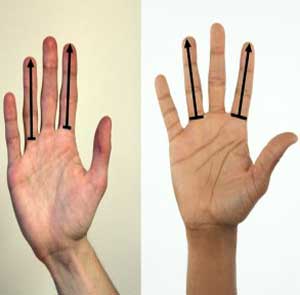
Men’s index fingers are generally shorter than their ring fingers. The difference is less pronounced in women. Previous research has found that digit ratio – defined as the second digit length divided by the fourth digit length – is an indication of the amount of male hormones, chiefly testosterone, someone has been exposed to as a fetus: the smaller the ratio, the more male hormones. The McGill study suggests that this has an impact on how adult men behave, especially with women.

“It is fascinating to see that moderate variations of hormones before birth can actually influence adult behaviour in a selective way,” says Simon Young, a McGill Emeritus Professor in Psychiatry and coauthor of the study.

Smiles and compliments

Several studies have been conducted previously to try to assess the impact of digit ratio on adult behaviour. This one is the first to highlight how finger lengths affect behaviour differently depending on the sex of the person you are interacting with. “When with women, men with smaller ratios were more likely to listen attentively, smile and laugh, compromise or compliment the other person,” says Debbie Moskowitz, lead author and Professor of Psychology at McGill. They acted that way in sexual relationships, but also with female friends or colleagues. These men were also less quarrelsome with women than with men, whereas the men with larger ratios were equally quarrelsome with both. For women though, digit ratio variation did not seem to predict how they behaved, the researchers report.

Digit ratio and children

For 20 days, 155 participants in the study filled out forms for every social interaction that lasted 5 minutes or more, and checked off a list of behaviours they engaged in. Based on prior work, the scientists classified the behaviours as agreeable or quarrelsome. Men with small digit ratios reported approximately a third more agreeable behaviours and approximately a third fewer quarrelsome behaviours than men with large digit ratios.

A previous study had found that men with smaller digit ratios have more children. “Our research suggests they have more harmonious relationships with women; these behaviors support the formation and maintenance of relationships with women,” Moskowitz says. “This might explain why they have more children on average.”

The researchers were surprised to find no statistically relevant link between dominant behaviours and digit ratios. They suggest future research could study specific situations where male dominance varies – such as competitive situations with other men – to see whether a correlation can be established.