
 Brij Khandelwal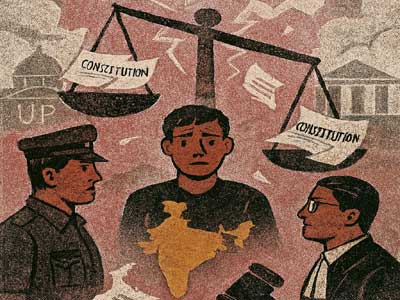
Has law and order genuinely improved under Yogi Adityanath, or has peace simply been enforced at gunpoint? This question now sits at the heart of an escalating confrontation between the Allahabad High Court and the Uttar Pradesh government, a debate that transcends individual encounters to challenge the very definition of governance.
The spark for this clash is the High Court’s recent critique of the state’s emerging "encounter culture". Asserting that the power to punish resides solely with the judiciary, the court took particular aim at police vernacular like "Half Fry" and "Operation Langda", euphemisms for shooting suspects in the legs to bypass the judicial process.
Read in Hindi: ‘एंकाउंटर संस्कृति’ को लेकर ‘न्यायिक सोच’ व ‘प्रशासनिक दृष्टिकोण’ में टकराव
Expressing concern that encounters are being fueled by promotions and social media "likes" rather than self-defence, the court issued a rigorous mandate: Mandatory FIRs for every encounter. Independent probes by the CBCID. Withholding gallantry awards until investigations conclude. Contempt proceedings for officials who bypass these protocols.
Chief Minister Yogi Adityanath’s rebuttal was characteristically blunt. To him, questioning the police breaks morale and emboldens the lawless. His "Yogi Formula" is simple: If criminals fire first, the state will not respond with silence.
To appreciate the current "Bullet Justice" model, one must recall Uttar Pradesh of a decade ago. Before 2017, the state was often defined by the political patronage of gangsters. Kidnapping, land grabbing, and contract killings were industry standards. NCRB data paints a grim picture: between 2012 and 2017, the state witnessed 815 communal riots and over 12,000 kidnappings in 2016 alone.
Upon taking office, Adityanath inverted the power dynamic. The message to the police was clear: Act. Between 2017 and 2025, the UP Police conducted 16,284 operations, resulting in 266 deaths and nearly 11,000 injuries. In 2025 alone, 48 deaths were recorded—the highest annual toll since the policy began.
The government defends these numbers with a stark reduction in traditional crime. By 2023, compared to 2016 levels, dacoity had plummeted by 94 per cent. Robbery dropped by 82 per cent. Communal Riots reported in 2023 reached zero. Overall Crime Rate: At 335.3 per lakh population, UP’s rate is now 25 per cent lower than the national average.
Beyond the ledger, the ground reality has shifted. Markets stay open later; highway transit is safer; and the "Anti-Romeo Squads" and "Mission Shakti" have, despite their own controversies, signalled a more proactive stance on women’s safety. This is the "Yogi Formula": the strategic use of fear to paralyse the criminal element. It is not an academic theory, but a response to decades of systemic failure.
However, the standoff with the Allahabad High Court highlights a deepening fracture. While the streets are quieter and the police more assertive, the fundamental tension remains: Can a society maintain the "Rule of Law" if it relies on "Rule by the Gun"?
Uttar Pradesh has achieved a hard-won stability, but the ultimate test will be whether "Bullet Justice" is a temporary bridge to a functioning judiciary, or if it has become a permanent substitute for it.
Related Items
Yamuna carries sewage, Government watches in silence
Which way is the wind blowing in UP? Cockroaches or Yogi’s Hat-Trick?
Where the Modi Government has fallen short…