
 Brij Khandelwal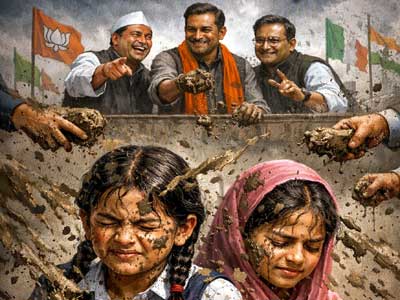
The sun had set, but the lights were still on in an old Lucknow mansion. Newspapers lay scattered across the table while television anchors shouted over one another in a noisy prime-time debate. Amid the chaos, 22-year-old Priya sat surrounded by her books. Then her phone buzzed.
A message from a friend read: “Priya, are you okay? Have you seen what’s happening on social media?” The moment she opened her screen, her world collapsed. Read in Hindi: बेटियों पर न उछालें सियासत की कीचड़...
There were fabricated stories about theft, false claims of her disappearance, and doctored photographs circulating online. One troll posted: “The real face of the politician’s daughter is finally exposed.” Within minutes, likes, comments and shares began pouring in. Some called it a joke. Others weaponised it for political gain. Her family was stunned. Her mother wept silently. Her father’s anger was buried beneath helplessness.
Politics was not always like this. There were ideological battles, fierce debates and sharp criticism, but families were rarely dragged into the arena. Opponents attacked policies and decisions, not daughters and spouses. Today, however, public discourse is increasingly turning into a mud-slinging contest where decency is the first casualty.
Across India, such incidents are becoming alarmingly common. Daughters of political leaders are targeted with fake videos and malicious rumours. Wives and mothers face vulgar comments and online abuse. From election rallies to social media platforms, political rivalry is steadily crossing the line from public scrutiny to personal attacks.
No state appears immune. From Tamil Nadu and Maharashtra to Bihar, Rajasthan and Uttar Pradesh, families are being dragged into political battles. Social media has amplified the problem dramatically. A false post can reach millions within minutes. Some seek attention. Others crave likes and shares. Many simply want to humiliate political opponents.
When Uttar Pradesh Chief Minister Yogi Adityanath recently said, “A daughter is a daughter,” it was more than a political statement. It was a reminder of a basic civilisational value: respect for daughters transcends party lines, caste, religion and ideology.
The police acted swiftly in the recent case, and leaders across the political spectrum condemned the incident. That collective response was reassuring. Yet the problem runs far deeper than any single episode.
Political parties must also hold their own supporters accountable. Leaders cannot denounce online abuse in public while quietly benefiting from it in private.
Now imagine a young girl with no interest in politics. She goes to school, laughs with her friends and dreams about her future. Suddenly, her father’s political identity overshadows her own. Her photographs are taken out of context and shared widely. Classmates begin asking uncomfortable questions. Neighbours whisper. Her family loses sleep. What crime did she commit?
Democracy depends on disagreement. Governments must be criticised. Opposition parties must be questioned. Public figures must be held accountable. But when political debate extends to families, real issues are pushed aside.
Unemployment, education, healthcare, inflation and farmers’ concerns disappear from the conversation. Rumours replace reason. Humiliation replaces dialogue.
We need to pause and reflect. Before sharing a sensational post, verify it. Political workers, influencers and ordinary citizens all have a responsibility to exercise restraint. Those who create falsehoods are guilty, but those who forward them without verification are not innocent either.
Power changes hands. Politicians come and go. But once a society loses its sense of decency, rebuilding it takes generations.
A daughter is a daughter. It should not remain a slogan or a convenient political line. It must become a collective social principle. Because when politics targets daughters, the defeat does not belong to one party alone. It belongs to all of us. And no electoral victory can ever compensate for that loss.
Related Items
When Politics turns the Ballot into a Pandora's Box…
Jaipur’s Jantar Mantar, measuring time for centuries...
Heidelberg, from Banks to Books and a Little Seductive Romance…