
 Dharmendra Kumar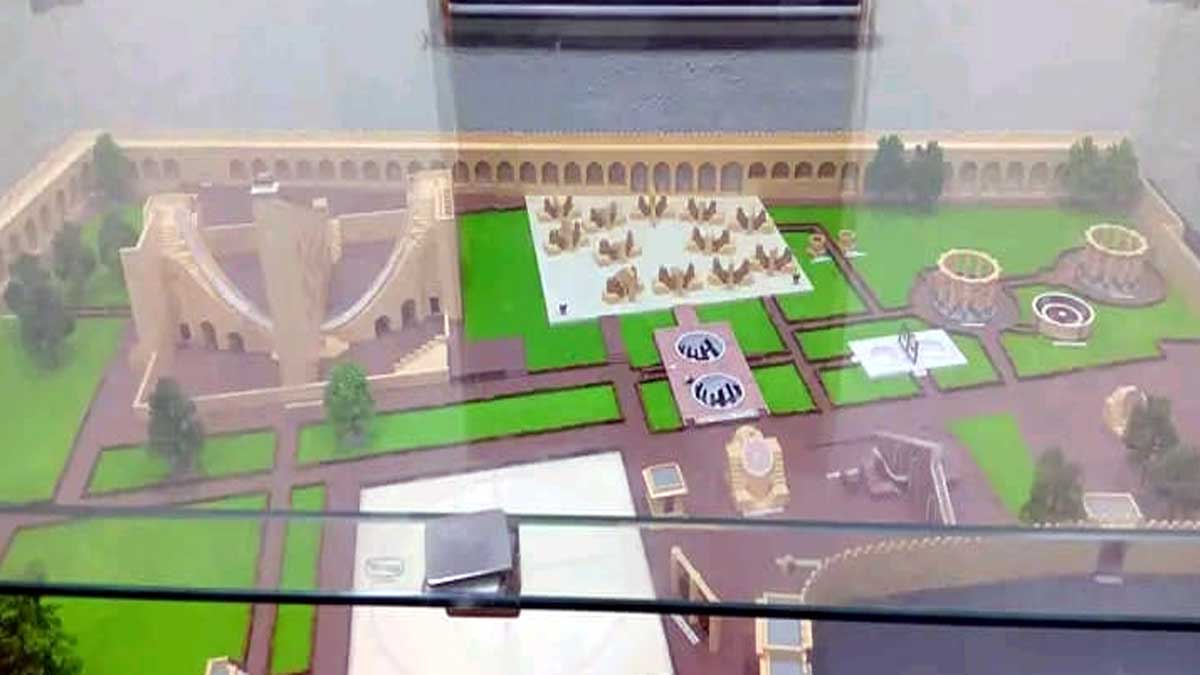
Moving beyond the bustle around Hawa Mahal, I entered Jaipur’s Jantar Mantar and immediately noticed a different atmosphere. Geometric shapes spread across the complex; towering walls, angular structures and enormous arches naturally arouse curiosity. It is neither a traditional palace nor a temple, yet the entire complex appears extraordinary in its own way.
Maharaja Sawai Jai Singh II built Jaipur's Jantar Mantar in the 18th century. He had a deep interest in astronomy and mathematics. He built similar observatories at different locations in India and commissioned enormous instruments to make astronomical calculations more precise. Jaipur’s Jantar Mantar is the largest and perhaps the most famous of these observatories.
Also read: सदियों से समय को मापता जयपुर का जंतर-मंतर
The first thing that catches your attention upon entering the complex is the sheer size of the instruments used here. Why were they built on such a massive scale? In the modern age, when a mobile phone can provide information about time, direction and the position of planets within seconds, it is fascinating to imagine such enormous instruments made of stone and lime. But at that time, their large scale was itself a means of improving the accuracy of calculations.
The most famous instrument at Jantar Mantar is perhaps the ‘Samrat Yantra’. At first glance, it is not easy to understand the scientific purpose of its enormous triangular structure. Yet this very structure was used to measure time through the movement of the sun’s shadow. Looking at its massive stepped incline and the structures built on either side, one begins to appreciate how precise the calculations required to understand astronomy must have been at that time.
Standing near the Samrat Yantra for a while and thinking about time was an unusual experience. In our everyday lives, the hands of a clock make time seem effortless and ordinary. Here, however, time is not displayed as a set of digital numbers but through the movement of the sun and the changing position of its shadow. It reminds us that long before clocks were invented, human beings understood time by observing the movement of nature.
The other instruments at Jantar Mantar were also designed for different astronomical calculations. They were used to determine the positions of planets and stars, measure time and study the movement of celestial bodies. The size, angles and structures of each instrument are based on mathematical principles. Looking at them makes it easier to understand how closely mathematics and astronomy were connected in the scientific traditions of the past.
Perhaps the most fascinating aspect of this complex is that science is not presented here as a book kept inside a room or as an instrument confined to a laboratory. It is visible beneath the open sky. The sun is right there, its shadow falls upon the ground, and the stone structures become a means of reading that shadow. It offers a very different way of seeing and experiencing science.
Looking at Jantar Mantar also makes one imagine the curiosity of Sawai Jai Singh II that made the construction of such large-scale observatories possible. Modern technology, as we know it today, was not available at the time. Yet the effort to understand celestial phenomena, improve calculations and measure time with greater precision was so serious that enormous architectural structures were built for the purpose.
For me, a visit to Jantar Mantar was not merely an experience of seeing a historical monument. Walking through the complex, I felt that science perhaps begins with the same curiosity that creates questions in the mind when we encounter something unfamiliar. Where is the sun? Why is the shadow changing? How much of the day has passed? In which direction is a celestial body visible in the sky? Such seemingly simple questions may well have laid the foundation for complex calculations and scientific instruments in the centuries that followed.
Overall, Jantar Mantar is a monument to humanity’s scientific curiosity. It reminds us that history is not only about wars, kings and palaces; it is also about those who looked at the sky, asked questions and gave mathematics a physical form in stone in their search for answers.
As I walked out of the campus, one thought stayed with me more than anything else: the instruments built to measure time have themselves survived the test of time and stand before us today. Instruments once used to understand the sky have now become part of our historical and scientific heritage. Yet their fundamental message remains unchanged—look at the sky, ask questions and try to understand the world around you.
Related Items
Where the forest whispers and the cuckoo keeps time…
Tata stocks under pressure, Is this the right time to 'buy'...!
Not just a ‘Star', Dharmendra was a ‘Legacy’...