
 Brij Khandelwal
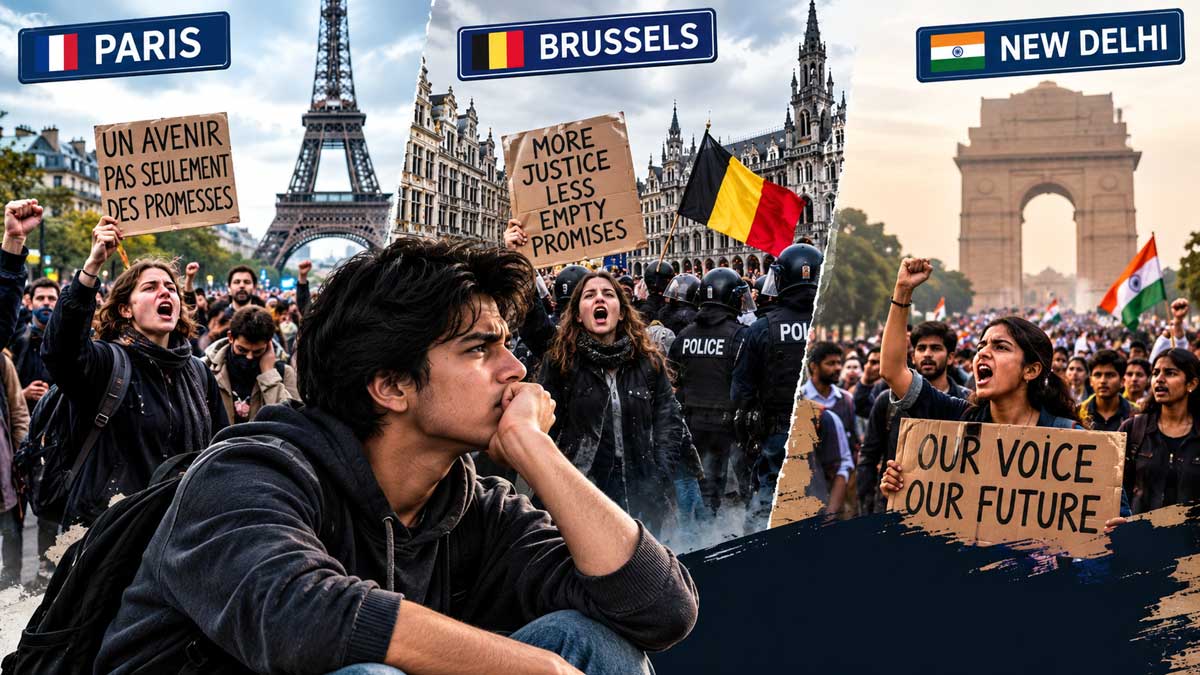
From the streets of Paris and Brussels to New Delhi, young people are running out of patience.
What happens when a bigger segment of an entire generation loses faith in its leaders? What happens when getting an education no longer guarantees a job, working hard cannot buy a home, and years of preparation lead nowhere? Patience has its limits. When official promises turn into empty slogans, anger takes over.
Across Europe and India, youth are challenging the political establishment. Their tactics and demands differ, but their main message is identical: the system is failing the people who must inherit it.
In France, students have taken to the streets over overcrowded classrooms, crumbling infrastructure, teacher shortages, and unfair admission rules. In Belgium, protests have flared over education budget cuts, rising tuition fees, and shrinking career options.
Governments often respond with heavy-handed police action, mass arrests, and stern warnings about public safety. While violent outbursts deserve criticism, focusing only on riots misses the point. Demanding decent schools and fair opportunities is not a criminal conspiracy.
The crisis extends far beyond the classroom. Across Europe, skyrocketing rents have priced young people out of major cities. In Spain, young workers cannot afford basic housing while real estate speculators make profits. Homeownership has become a distant dream.
Frustration is reshaping politics. In Berlin, young voters have backed radical groups promising strict rent controls. In New York, progressive leaders have gained traction by focusing on the cost-of-living crisis. The lesson for mainstream political parties is clear: when traditional leaders fail to provide answers, voters look elsewhere. Some shift left, others lean right, and many abandon politics altogether.
India presents a different yet deeply familiar picture. Consider the rise of the ‘Cockroach Janta Party’; a movement that took an insult aimed at unemployed youth and turned it into a badge of defiance.
Through satire, social media, and shared outrage, Indian youth turned mockery into political resistance. A major trigger was the widespread fury over paper leaks and cheating scandals, particularly involving the NEET-UG entrance exam, alongside broader worries about unemployment and systemic corruption.
When national exams are compromised, the damage goes far beyond the test hall. Dreams shatter, trust vanishes, and frustration boils over. Digital activism and clever satire gave a voice to anxious youth, putting intense pressure on political leaders and sparking calls for top-level accountability.
Yet India’s youth activism is not a copy of European radicalism. Its main focus is secure jobs, clean examinations, and institutional fairness rather than ideological shifts. Today’s Gen Z protests also differ sharply from the historic student movements of the 1960s and 1970s. Many college campuses remain largely quiet, and critics often dismiss these sporadic protests as proxy battles led by political rivals.
Europe and India are not exact mirror images. Western Europe has stronger social safety nets, active labour unions, and a long tradition of organised street protest.
India faces a unique demographic challenge. Millions of young people compete fiercely for a tiny pool of government jobs and university seats. High-stakes entrance exams become narrow gateways to a better future.
Political affiliations differ as well. Western youth movements often align with traditional left-wing parties. Indian protests are more fragmented, uniting around specific issues like exam corruption rather than political dogma.
Economic desperation does not push everyone in the same direction. Extreme political groups on both ends of the spectrum exploit economic fear and cultural anxiety. Anger can bring people together, but it does not guarantee a constructive path forward.
A packed street is not a revolution, and forcing a politician to resign does not automatically fix a broken system. Youth movements can easily lose focus, get co-opted by political opportunists, or fade away when public attention moves on.
The danger for democratic nations is real. When governments repeatedly ignore legitimate complaints, disappointment turns into deep distrust of public institutions. Police can clear a protest, but they cannot repair a school. Political speeches cannot lower rent or rebuild lost trust.
Whether marching as students, tenants, or political activists, young people deserve real solutions, not empty promises.
Related Items
A revolt of the feet in Paris and the ‘2026 Handbag Thriller’
Roads belong to people, not just vehicles…
Agra, where the streets belong to the animals…