
 Brij Khandelwal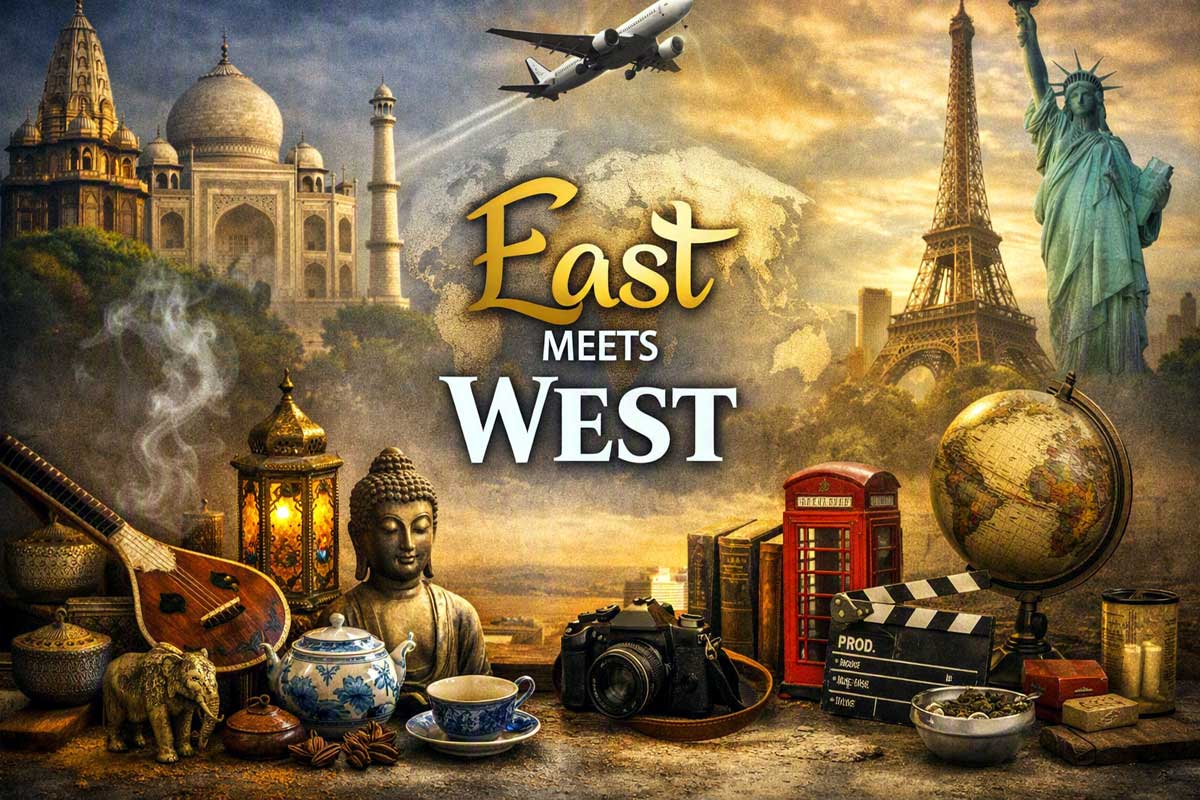
There are many benefits to travelling around the country. Narrow-mindedness and many misconceptions break down on the road. If you travel from north to south or east to west, many prejudices fall away by themselves.
India is changing beautifully. Tall glass buildings touch the sky. Next to them stands an old Hanuman temple. Inside the building, young people talk about artificial intelligence, robotics, and global markets. Outside, someone takes off their shoes, rings the temple bell, and folds their hands in devotion. No one finds this contradiction strange. This is today’s India.
Go to Bangalore, Mumbai, Hyderabad, Chennai, Gurugram, or Chandigarh. The scenes may change, but the story is the same. Expressways, metros, shiny airports, shopping malls, and skyscrapers are changing the face of cities. Mobile phones are in our hands. Digital payments have replaced wallets. Artificial intelligence is entering offices, schools, and homes.
India is rushing quickly toward the future. But it is not leaving its past behind. This is the beauty of India’s current journey. It is not only a story of Westernisation. Nor is it a stubborn return to the old days. It is an interesting coordination, the spirit of the East meeting Western modernity.
Old things are not being thrown into junkyards. New things are not blindly accepted either. India is choosing, testing, and then shaping them in its own colours.
Rohit from Hyderabad works for an American tech company. He speaks English at the office and uses the latest technology. In the evening, he joins prayers or helps his family prepare for festivals. Both worlds live inside him comfortably.
Today’s Indian may be influenced by Silicon Valley’s progress, but still keeps ties to the lanes of Varanasi. He can study quantum physics and look for life’s meaning in the Gita. He can travel across oceans by plane, yet remember the soil of his village. A laptop and a lamp can sit on the same table. This is India’s new style. This coordination did not appear suddenly.
Contact with the West brought many institutional changes. Colonial rule was full of exploitation and theft. Still, independent India adopted some modern institutions and shaped them for democratic aims.
Parliamentary democracy, an independent judiciary, the civil service, modern universities, and written laws became part of this process. These institutions opened new paths for ordinary people.
Earlier, birth, land, and family determined a person’s status. Modern education and competitive exams opened new doors. A child from an ordinary family could reach university. A rural boy or girl could compete for a government job. A citizen could knock on the door of the courts.
The system is not perfect today. It has flaws and mistakes. But new steps have been created to climb upward. There are also escalators. Democracy added another force to this change. The ballot gave political importance to people who had long been kept away from power. Universal adult voting brought millions into the national conversation.
India did not adopt democracy as a ready-made machine. It made it Indian in its own way. Elections became large public events. Caste, language, region, and communities came into politics, but along with them came new hopes and aspirations. Those whose voices were weak earlier began slowly reaching the stage.
Western institutional structures connected with the heartbeat of Indian society. Social reform followed a similar path. Modern ideas of freedom, equality, and rights influenced Indian thinkers. But reform did not come only from outside. Social reformers used modern reasoning plus their moral and religious traditions to challenge harmful practices.
On one side were new ideas. On the other were deep roots. Together they prepared the ground for change. Education became the strongest bridge between East and West. Modern schools and universities taught scientific thinking, questioning, and vocational skills. Despite being a colonial legacy, English became a useful connecting language in a country with many tongues.
Venkatesh from Tamil Nadu can work in Delhi. Dinesh, an engineer from Bihar, can find a job in Chennai. Subrato from Bengal can study in Bangalore.
Modern communication reduced distance. As distance fell, opportunities grew. Railways, telegraphs, and the postal system were built for administration at first. Later they connected India’s people. Ideas spread faster. Newspapers reached more people. The national movement gained new strength.
History sometimes acts strangely. Facilities built for the empire became a force for national unity. Economic modernity also changed social structure. Industry, trade, banking, and city jobs weakened the walls of traditional trades. A son no longer always had to follow his father’s work. A daughter did not have to remain confined by old limits.
Education and jobs opened new skies for women. Economic independence, legal rights, and professional opportunities changed social thinking. Modernity changed life’s outer form. But India’s cultural heartbeat remained.
Festivals still colour the calendar. Weddings are big family events. Young people flock to religious pilgrimages. Tradition has not disappeared. It has learned to upgrade. Diwali now shines with LED lights. Temple bells are caught on mobile cameras. Puja items are ordered online. Darshan bookings are made through apps. Yoga classes run online worldwide. Old traditions have entered the digital age. But they keep their identity. This change is adaptation.
Indian civilisation has always grown by exchanging ideas. It did not accept things from outside unchanged. It adapted them to its needs and values.
Today’s era is a new chapter in that long process. The West gave powerful tools: science, technology, and modern institutions. It offered new ways of law, administration, and democratic participation.
Indian tradition kept strong ideas of family, duty, community, and moral responsibility. One showed the path of progress. The other asked: for whom and in which direction is this progress?
A society can become very advanced technically and still be empty inside. It can be rich but lonely. There can be personal freedom, but community ties may weaken.
India’s attachment to family and society is not just rigid tradition. It is an effort to preserve human relationships. Of course, not every tradition deserves respect.
Traditions that hurt human dignity or equality must be questioned. Being old does not make something sacred. Likewise, being new or foreign does not make every idea superior. True understanding lies in balance.
East and West are not standing as enemies on a battlefield. They meet at the same crossroads now. One brings old memories, cultural continuity, and spiritual experience.
The other brings modern institutions, scientific knowledge, and technical power. Together they are creating a new Indian coordination. Perhaps the greatest lesson of India’s modern journey is that you do not always have to burn the past to build the future.
Sometimes the strongest buildings of the future are built on foundations that include good bricks from the past. In this journey, East and West are not rivals. They are two companions of India’s new era.
Related Items
Liechtenstein: A 'tiny' country and a 'giant' surprise...
Is the 'great' Britain heading for a ‘Break-Up’…
Song that echoed across South India, but never became ‘National Song’