
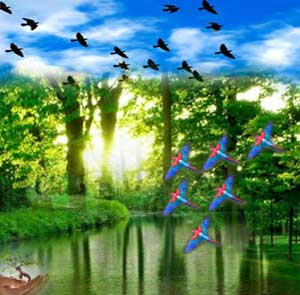
The cool fragrance of myriad flowers, the chirping of birds, the pristine and sparkling waters of river Yamuna, are now only confined to the religious books. The whole Braj mandal is waiting for another Kanhaiya to tame the god of pollution Kali Nag. But will he oblige?
A dozen odd forests and countless number of “bagichis” gardens of the legendary Braj Mandal of Sri Krishna, in a radius of 100 kms around Mathura, have vanished. The ponds (holy Kunds) and streams had disappeared long ago, while the river Yamuna is slowly dying a poisonous death.
Old records available mention Vrindavan, Agravan (Agra), Kotvan, Mahavan, Kamvan, Bahulavan, Madhuvan, which were once dense forests constituting the “Leela Bhoomi” of Sri Krishna and Radha. “It was the attraction and spiritual pull of these forests that drew Chaitanya Mahaprabhu to Vrindavan, Mahaprabhu Ballabhacharya to Goverdhan from Andhra, Goswami Hit Harivansh, Swami Hari Das, Soor Das, Ras Khan, Meera to Braj Bhoomi,” says Acharya Madhukar Chaturvedi.
Dr. Harsh Nandini Bhatia says Braj culture is essentially Forest oriented culture. “The leelas of Sri Krishna and Radha like Cheerharan Leela, Nag Leela, Ras Leela, etc., center around trees, flowers and meadows, lush green gardens. Vrindavan itself was a dense Tulsi ka van,” explains Hari Das ji.
Prof. R Nath, noted historian, says the Mughal rulers were fond of gardens and forests and took all necessary steps to not only preserve but also to develop them. All Mughal monuments have lush green lawns and well developed parks.
With passage of time, increase in population and urban centers gobbling up land for civic infrastructure, the legendary forests of Braj mandal were the first casualty, according to president of the Braj Mandal Heritage Conservation Society Surendra Sharma who is firmly opposed to construction of multi-storeyed buildings and new townships in the holy spots of Sri Krishna. “What is the need for a golf course in Goverdhan,” he asks.
The Braj area had 12 big forests and 24 smaller forests, in addition to scores of sprawling gardens around temples. “Today the whole ecology of the area has been imbalanced and disturbed. The desert is closing in from the western side as large scale mining activity has denuded the hill sides of dense forest cover.
The Central Pollution Control Board’s recent report presents a very gloomy scenario,” says Prof. BB Barik, a social forestry expert of Bichpuri Rural Institute.
Agra University’s School of Life Sciences director Prof. SVS Chauhan has been among the few who have raised an alarm warning of grim consequences as a result of vanishing forests. Prof. Emeritus Dr. AK Sinha has expressed concern over the loss of bio diversity in the Braj Mandal. “So many species of plants and shrubs have vanished and nothing is being done,” Sinha laments. Prof Ipe M Ipe, former principal of St. John’s College, says there used to be more than 50 varieties of butterflies, now hardly a few remain. “It’s really shocking how we criminally assault our natural resources that sustain us,” Ipe adds.
While forests have disappeared in the Braj Mandal at an alarming rate, new townships and concrete ashrams of all the famous gurus and acharyas have consumed all the land in Vrindavan, where real estate prices have sky rocketed in recent years.
“If all these mahatmas and sadhus collectively lead an afforestation drive with their lakhs of followers and take remedial measures to rejuvenate the Braj forests, a lot of lost ground can still be regained. How can they sing songs in praise of Sri Krishna and Radha or perform Raslilas without thinking of the forests that were once the pride of this area,” ask Shravan Bharti of Yamuna Foundation for Blue Waters. The original flora and fauna of Braj has to be saved from predators masquerading as developers, Shravan adds.
Related Items
Collapsing environment of Braj Mandal…
Vanishing forests of Braj, the Krishna land…
Braj Bhoomi, the overlooked living civilisation…