
 Brij Khandelwal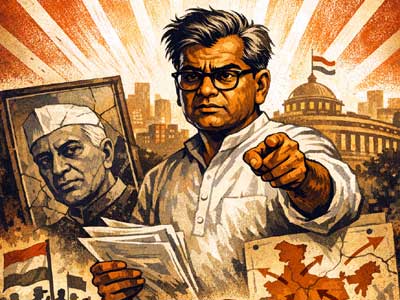
“Congress-free India”; the slogan thunders through today's political arenas, but who truly owns it? Its first murmur stirred in the defiant mind of Dr Ram Manohar Lohia, a restless soul whose birth we mark today, not with mere flowers, but with the grit to face uncomfortable truths. Small in stature, colossal in impact, Lohia reshaped India's rebellion from within.
In 1934, alongside Jayaprakash Narayan and Acharya Narendra Dev, he ignited the Congress Socialist Party, becoming its foreign affairs secretary. By 1942, during the Quit India Movement, he fueled underground resistance through Congress Radio, dodging every attempt to muzzle its fire. Independence dawned, yet Lohia chafed at Nehru's blueprint, a mixed economy and centralised planning that felt like top-down elitism, remote from the masses and tethered to power. He broke away.
Read in Hindi: लोहिया की बेचैन विरासत, कांग्रेस-मुक्त भारत का पहला खाका
By 1955, he launched the Socialist Party, evolving into the Samyukta Socialist Party, his arena, his war. In Parliament, he brandished data like a blade: “Three annas a day,” he thundered, stripping poverty bare for the nation to see. On the streets, his barbs targeted caste tyranny, English dominance, and farmers' plunder. Then, in 1967, came “Non-Congressism”, no mere chant, but the pioneering blueprint for a Congress-free India. Lohia forged opposition alliances, shattering Congress's strongholds in states and birthing coalition politics.
Yet here's the sting: as that slogan roars today, does anyone credit its architect? Shouldn't power tip its hat to its ideological forebears? Lohia's path wasn't linear; his razor-sharp tongue bred foes even among allies, fracturing his movement even as it spread.
Peer into his world. At Berlin University, his PhD dissected the Salt Tax; he absorbed Marx but spurned blind faith, rejecting Soviet rigidity and class-war dogma. He forged “New Socialism”, equidistant from capitalism and communism, rooted in human needs over machines. Production by necessity, with people at the core.
Enter Sapta Kranti: a seven-pronged assault on inequality, caste, gender bias, racial wrong, and foreign chains, a multidimensional war, not abstract theory. “Chaukhamba Raj” envisioned power cascading from village to district, province, and centre, dismantling Delhi's vice, Nehru's nightmare inverted.
Lohia inherited Gandhi but supercharged him: non-violence and Gram Swaraj fused with socialist dynamite. Gandhi urged moral tweaks; Lohia demanded structural demolition. “Roti and Beti”, share meals, wed across castes, struck at hierarchy's heart, rebranding Gandhism into a native explosive, neither fluffy idealism nor import.
His legacy was passed through disciples like Raj Narain, Madhu Limaye, George Fernandes, Karpoori Thakur, Lalu Yadav, Nitish Kumar, and Mulayam Singh Yadav. Critics nitpick: Did decentralisation flirt with chaos? Anti-English fervour snubs the middle class? Personal jabs eclipse grand visions? Fair questions, yet picture his end: 1967, a life of penury, a death in stark simplicity, untouched by power's allure or wealth's grasp.
As inequality surges, neoliberal gloss masks deepening rifts, Lohia haunts us anew. His “New Socialism”, armed Gandhism, redefines Swaraj as raw equality. No saint, this rebellious Gandhian held society's mirror high, challenging thrones.
His voice still cuts: “When streets hush, Parliament strays.” On caste: “It cramps opportunity… and opportunity cramps ability.” On women: not Sita, but Draupadi, brains and bravery unbound.
Lohia was unsettling, essential. Are we just commemorating him, or finally grasping the fire he lit?
Related Items
Western Media is ‘tough’ on India but ‘soft’ on China!
Congress at crossroads, RG leading or pushing it into the abyss…
From 'Beacons' to 'Landmarks', India’s changing ‘Lighthouse’ story…