
 Brij Khandelwal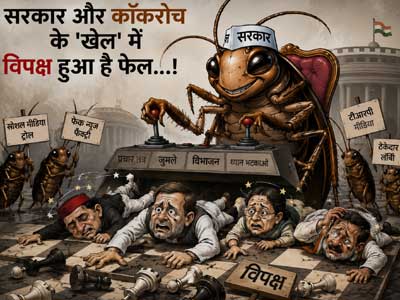
History has strange habits. Sometimes mighty empires fall because of wars. Sometimes governments stumble because of inflation. And sometimes, a political storm begins with... a meme.
That is exactly what happened in India. A few students were mocked as ‘cockroaches’. Instead of taking offence, they wore the label like a badge of honour. Soon the Cockroach Janata Party was born. What began as an online joke marched into Jantar Mantar and became the biggest youth protest of 2026.
Read in Hindi: सरकार और कॉकरोच के 'खेल' में विपक्ष हुआ है फेल…!
The joke was on the political class. For months the opposition had shouted itself hoarse inside Parliament. It staged walkouts, protests and press conferences. Yet it could not force the government to blink.
Then came a few thousand students armed with smartphones, memes, music and boundless energy. They succeeded where seasoned politicians failed.
As the old saying goes, where there is a will, there is a way. This time, the road to political change ran through Instagram.
Then came the NEET-UG paper leak. The examination was cancelled. Nearly two million students faced uncertainty. Families panicked. Reports of student suicides shocked the nation. Years of anger over paper leaks, costly coaching centres, unemployment and a creaking education system burst like a dam after heavy rain.
CJP spoke the language of Generation Z. Forget polished speeches. Instagram reels replaced press conferences. Memes replaced manifestos. Sarcasm became a political weapon. Humour carried a message that long speeches never could.
Jantar Mantar turned into a festival of dissent. Students sang, debated, painted posters and read poetry. Parents stood beside them. Teachers and social activists joined in. Sonam Wangchuk's 26-day fast added moral force. Police batons and tear gas only poured petrol on the fire.
The movement had no complicated ideology. It had only one simple demand. Someone must be held accountable. That changed everything.
Governments often survive endless debates. But when public anger points at one face, the political temperature rises very quickly.
The government understood the danger. Parliament remained paralysed. Social media overflowed with protest videos. Public sympathy kept growing. Stretching the confrontation any further would have been risky.
So the government acted. Dharmendra Pradhan resigned. An inquiry was announced. Students were assured they would not face harassment. The immediate political fire was brought under control.
The real embarrassment, however, belonged to the opposition. It arrived after the crowd had already gathered.
For years, opposition parties claimed they spoke for students, unemployed youth and ordinary families. Yet when a genuine people's movement erupted, they became passengers instead of drivers.
They waved from the sidelines while others stole the show. That exposed every weakness they have tried to hide.
The INDI Alliance still looks more united against Narendra Modi than united for any common vision. Election season quickly brings quarrels over seats. Allies become rivals. Everyone wants the steering wheel, but nobody agrees on the route.
Too many cooks spoil the broth. Leadership remains unsettled. Rahul Gandhi remains the Congress face, but Mamata Banerjee, Akhilesh Yadav and other regional leaders are unwilling to play second fiddle. A boat with many captains rarely reaches the shore.
Organisation is another headache. The BJP spent decades building workers booth by booth. Many opposition parties continue to struggle with weak local networks, factional fights and fading grassroots workers.
Dynastic politics has not helped either. Many parties still revolve around powerful families. Young leaders often wait endlessly for their turn. The BJP has successfully projected itself as a party where organisation matters more than family surname. In politics, perception often becomes reality.
The opposition also suffers from another chronic illness. It diagnoses problems well but prescribes very few convincing cures.
Inflation, unemployment, paper leaks and institutional failures are real issues. But voters want solutions, not only speeches. Elections are not won by complaints alone.
Political commentator Prof Paras Nath Chaudhary believes repeated electoral defeats have left the opposition chasing headlines instead of building public confidence. The Cockroach movement looked like a golden opportunity.
But politics rewards quick thinking. Narendra Modi read the situation faster. Instead of digging in his heels, he changed course. The government accepted the movement's central demand, the minister resigned, talks began, and the immediate reason for the protests disappeared.
It was a classic political escape act. One minister was sacrificed, but a much bigger crisis was avoided.
The opposition suddenly found that the wind had gone out of its sails. Parliament continued to echo with slogans, but the country had already moved on.
The deeper problems remain. India still needs a trustworthy examination system. Young people still demand jobs, fairness and accountability. Winning back their confidence will take much more than one resignation.
Yet, for the moment, Modi has wriggled out of a dangerous political imbroglio. The Cockroach Janata Party has proved something remarkable.
In today's India, young people do not merely cast votes. They can shape the national conversation.
The final question is impossible to ignore. If a handful of students armed with memes and mobile phones achieved what veteran politicians could not accomplish in months, who really deserves the report card: the government or the opposition?
Related Items
'GDN' documents the industrial and political challenges of GD Naidu's era
Indian politics changing faster than desert sands in a storm
‘Dancing Girl’ from Mohenjo‑daro: Are we ashamed of our history…!