
 Brij Khandelwal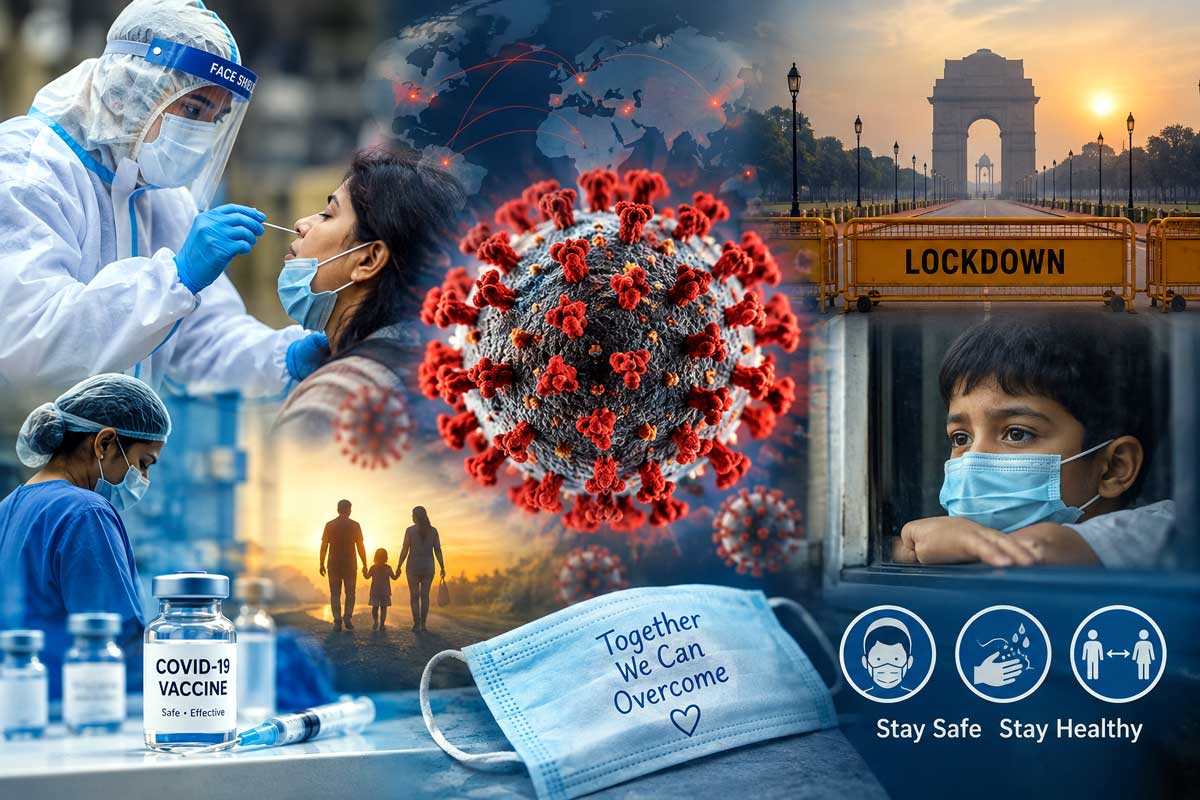
Do you remember that dark night in March 2020? The screams of ambulances cut through the silence. Deserted streets, closed airports, locked schools, and queues of people waiting anxiously outside hospitals. A cough became a cause for fear; a sneeze became a disaster. People were confined to their own homes. Families were separated. Doctors and nurses were pushed to the breaking point. Many people could not even touch their loved ones for the last time.
The world has emerged from that nightmare, but its questions remain wide awake. Where did the virus come from? From nature, or from the growing contact between humans and wildlife? Was it simply an event in the natural evolution of a virus, or did a laboratory also play a role? Six years later, we still do not have complete answers.
Read in Hindi: कोविड का रहस्य सुलझाने को संरा कराए निष्पक्ष जांच
Masks have disappeared, airports are crowded again, and children have returned to school. But the return of normal life does not mean the questions have disappeared. That is why the United Nations should support an independent, impartial and international investigation into the origins of COVID-19 and the way the pandemic was handled. This is not a demand to find someone to blame. It is a demand to find the truth.
SARS-CoV-2 appeared suddenly and spread across the world. The possibility of a natural origin remains serious, while the debate over a possible laboratory accident has not ended either. Yet no conclusive body of evidence has established either explanation beyond doubt. This distinction matters. A laboratory origin, even if proven, would not automatically mean that the virus was deliberately released. And the persistence of unanswered questions is not, by itself, proof of a conspiracy. But such uncertainty cannot be accepted forever after a historic global tragedy.
Questions have continued to surround access to early data, samples and records. No definitive intermediate animal host has been identified even today. The world does not need speculation. It needs evidence.
For some, COVID was a few days of fever and cough. For others, it was a death sentence. Some otherwise healthy people suddenly became critically ill, while others survived despite living with infected family members. The latter were sometimes informally described as ‘super-dodgers’. Age, genetics and immunity explain much of this difference, yet science has still not assembled all the pieces of the puzzle. Why does the same virus become a mild storm in one person and a catastrophe in another?
For millions, COVID did not end when the fever disappeared. Fatigue, breathlessness, brain fog and neurological problems continued long after the infection. Today, this condition is broadly known as Long COVID. Changes in the immune system, persistent inflammation, autoimmune responses and the possible persistence of viral remnants are among the hypotheses being investigated. But there is still no single universal explanation, simple diagnostic test or magic cure. For millions, the mystery remains a deeply personal tragedy.
The official figures are frightening enough, but the real cost may have been far higher. Studies of excess mortality suggest that direct and indirect deaths could have substantially exceeded the officially recorded numbers. Some died because they could not get hospital care. Some died for want of oxygen. Delayed cancer treatment or postponed surgery proved fatal for others. Some elderly people died completely alone.
And beyond the statistics lies an enormous human cost. Education was disrupted. Jobs disappeared. Loneliness and psychological trauma increased. The full price of the pandemic may not yet have been counted.
Statistics cannot capture the pain inside those hospitals. Patients died without holding the hands of their families. Relatives saw their loved ones for the last time through mobile-phone screens. Doctors and nurses worked relentlessly while fearing that the infection might reach their own homes.
Many who survived did not immediately return to normal life. Weakness, fear and memories of the deaths they witnessed continued to haunt them. COVID was not merely a health crisis. It was a global test of fear, loneliness, grief and human endurance.
For decades, humans have been cutting down forests, moving closer to wildlife and expanding cities. The distance between humans and other species is shrinking. The threat of new infectious diseases is therefore not imaginary.
COVID may have been a warning about this growing imbalance. It may have been an event in the natural evolution of a virus. Or human activity may have helped transform a natural biological risk into a global catastrophe.
Whatever the truth, we do not know it completely. And that is precisely why an investigation is necessary. The world naturally wants to forget COVID. But forgetting history is an invitation to repeat its tragedies.
We need transparency about the virus's origins, better pandemic surveillance, stronger biosafety standards and serious research into Long COVID. We also need to understand why some healthcare systems collapsed so quickly under pressure.
Such an investigation must not be controlled by any government, institution or ideology. It must be independent, impartial, international and evidence-based.
This is not an exercise in proving a favourite theory or spreading conspiracy stories. It is a search for facts.
Science does not become weaker when it says, “We don't know.” It becomes stronger when it says, “Let us find out.”
An invisible microscopic organism brought economies to a standstill, emptied cities, separated families and humbled a civilisation that believed it had mastered nature.
Whatever the truth may be, we need to know it. The next pandemic may not give us six years to find the answers.
Six years later, the world has moved on. But the questions surrounding COVID are still alive. Instead of burying them, it is time to confront them.
Let the United Nations open the way for an impartial international investigation.
History demands answers. The future demands lessons.
Related Items
Yamuna carries sewage, Government watches in silence
When students march, cockroaches protest and toilets charge €2...
Roads belong to people, not just vehicles…