
 Brij Khandelwal
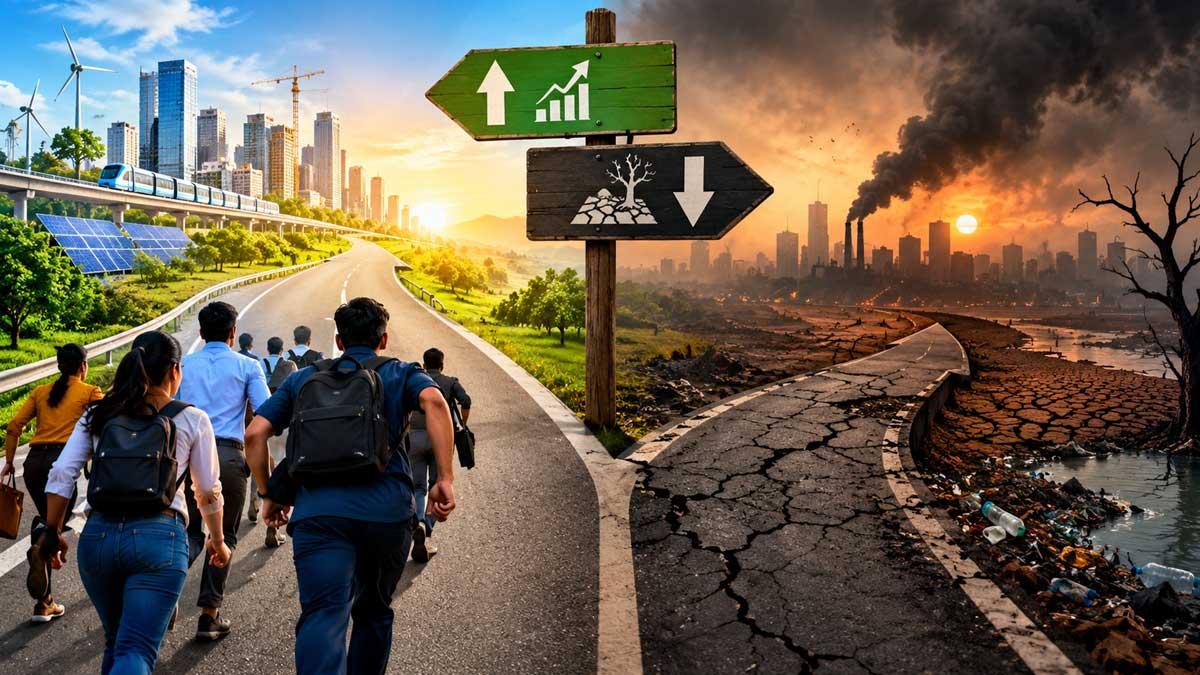
Will we leave our children a green and flourishing India, or a land of dust storms, poisoned air and dying rivers? This is no longer a question for environmental activists alone. It confronts every citizen standing on the banks of Agra's shrinking Yamuna, every farmer watching erratic monsoons destroy crops, and every family forced to breathe toxic air through long winter months.
India is racing ahead on the highway of development. New expressways crisscross the landscape, metro networks expand, industries multiply, and cities sprawl relentlessly outward. The nation's economic ambitions are undeniable.
Yet behind this impressive growth story lies an uncomfortable truth. Forests are disappearing, rivers are choking, groundwater is declining, and the air in many cities has become hazardous. A model of development that treats nature as collateral damage may ultimately prove far more expensive than any short-term gains it delivers.
Agra stands as a powerful symbol of this contradiction. On one side rises the magnificent Taj Mahal, admired across the world. On the other flows the Yamuna, increasingly reduced to a polluted and depleted channel. While crores of rupees are spent on beautification projects and tourism infrastructure, the river that once sustained the city continues to decline. Black water, sewage foam and shrinking flow tell a story that official reports often struggle to explain.
Across India, deforestation continues at an alarming pace. Vast stretches of forest in the Northeast, central India and the Western Ghats are being cleared for roads, mining projects and industrial expansion. Around growing cities, fertile farmland and green belts are steadily giving way to concrete. Trees are not merely decorative assets. They regulate temperatures, recharge groundwater, prevent soil erosion and sustain countless forms of life. When forests disappear, entire ecosystems begin to unravel.
Air pollution has emerged as one of India's gravest public health emergencies. Delhi, Agra, Kanpur and Lucknow repeatedly feature among the world's most polluted cities. Construction dust, vehicular emissions, industrial smoke and unchecked urban growth have created a toxic cocktail that affects millions. Asthma, respiratory illnesses, cardiovascular diseases and other pollution-linked health problems are rising at an alarming rate.
Water pollution presents an equally disturbing picture. Rivers such as the Yamuna and the Ganga remain lifelines for hundreds of millions of people, yet they continue to receive enormous quantities of untreated sewage and industrial waste every day. In Agra, stretches of the Yamuna often resemble a drain more than a living river. Numerous river-cleaning programmes have been announced, and substantial funds allocated, yet visible improvements remain frustratingly elusive.
The crisis is compounded by unplanned urbanisation. India's cities are increasingly dominated by private vehicles, inadequate public transport systems, shrinking green spaces and growing traffic congestion. Concrete and asphalt have replaced natural drainage channels, making cities vulnerable to flooding after even moderate rainfall. Simultaneously, urban heat islands are driving temperatures to record highs during summer months.
Several major development projects have also raised environmental concerns. Proposed nuclear facilities near Haridwar have sparked debates over seismic safety and ecological risks in the fragile Himalayan region. The Great Nicobar development project has generated concerns about large-scale deforestation, threats to marine ecosystems and the survival of rare wildlife species. The debate is not about opposing development; it is about determining the environmental price society is willing to pay.
Climate change has further intensified these challenges. Heatwaves are becoming more frequent and severe. Rainfall patterns are increasingly unpredictable. Floods and droughts often occur in rapid succession. Farmers struggle with uncertain growing seasons, while cities face mounting water shortages. The poorest and most vulnerable communities bear the heaviest burden.
India is not short of environmental laws or institutions. The Ministry of Environment, Forest and Climate Change, the Central Pollution Control Board and various state agencies are tasked with safeguarding natural resources. The Supreme Court has repeatedly intervened on environmental issues, from pollution control measures in the Taj Trapezium Zone to directives aimed at Yamuna rejuvenation. These interventions have often provided a glimmer of hope.
The challenge lies elsewhere: implementation. Environmental impact assessments are frequently treated as procedural formalities. Regulatory clearances are often granted with inadequate scrutiny. Monitoring remains weak, enforcement inconsistent, and accountability limited. Laws on paper mean little if violations continue unchecked. What, then, must be done?
Environmental regulators require greater independence, authority and resources. Real-time monitoring systems should become standard, and serious violations must attract substantial penalties, including project suspension where necessary.
Economic growth must be aligned with environmental responsibility. Renewable energy, afforestation, water conservation and circular-economy industries deserve stronger financial incentives. Polluters should bear the true environmental costs of their activities.
Urban planning requires a fundamental rethink. Cities must prioritise pedestrians, cyclists and efficient public transport. Every new development should include mandatory green spaces. Riverfronts should be restored as ecological corridors rather than treated merely as real-estate opportunities.
Technology can become a powerful ally. Satellite surveillance, artificial intelligence, sensor networks and GIS mapping can improve environmental monitoring and resource management. However, technology alone cannot substitute for political will, transparency and public accountability.
Protecting the environment is not solely the responsibility of governments. Industry, universities, civil society organisations, local communities and individual citizens all have crucial roles to play. Rivers will not be saved by court orders alone. Trees will not survive through speeches. Cleaner air will not emerge from promises. Lasting change requires collective action.
India today stands at a crossroads. One path promises quick gains but risks long-term ecological ruin. The other demands difficult choices, greater restraint and smarter planning, but offers a future built on sustainability and balance.
Nature is already sending unmistakable warnings. The shrinking waters of the Yamuna, the crumbling slopes of the Himalayas and the toxic air hanging over our cities are all delivering the same message.
The question is simple: Are we listening, or will we wait until the damage becomes irreversible?
Related Items
Western Media is ‘tough’ on India but ‘soft’ on China!
Yamuna carries sewage, Government watches in silence
10 countries, 17 destinations and one Yamuna in the heart…