
 Brij Khandelwal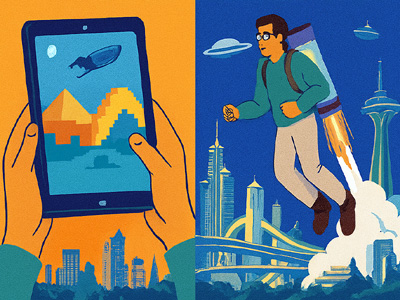
A submarine dives into uncharted ocean depths... powered by electricity in 1870, when batteries were barely a thing. Aliens invade with tripod death machines... inspiring real rockets to the Moon. A zombie zap with lightning... now saving hearts in hospitals. Hold on, what if I told you these ‘wild’ stories didn't just entertain? They blueprinted our world. When stories dream big, science snaps awake, and reality plays catch-up. Ideas crash the party first, tools trailing behind.
At 2 AM, somewhere between your third cup of tea and the glow of a phone screen, a strange thought creeps in: What if the future has already happened, just quietly, without a dramatic soundtrack? What if the gadgets you swipe, the machines that think, and the screens that watch you were all imagined long before engineers got their lab coats dirty? Looks like the future didn’t arrive suddenly. It leaked, chapter by chapter.
Read in Hindi: विज्ञान के वे जादुई आविष्कार जो कभी महज साहित्यिक सपने थे...!
Long before laboratories, patents, and TED Talks, there were storytellers. Armed with nothing more than ink, imagination, and a disregard for feasibility, they sketched tomorrow. Science, it turns out, has been playing catch-up ever since.
Arthur C Clarke famously said that any sufficiently advanced technology looks like magic. What he didn’t add, but clearly implied, is that magic often begins as a story someone dared to write.
In 1870, Jules Verne launched Twenty Thousand Leagues Under the Sea into a world that barely understood the ocean, let alone dared to live inside it. His submarine, Nautilus, ran on electricity, had ballast tanks, sleek interiors, and a crew that vanished beneath the waves for months. At the time, batteries were clunky novelties. Submarines were floating coffins. Verne was politely labelled imaginative.
Fast-forward a few decades, and nuclear submarines patrol oceans with an uncanny resemblance to his fictional craft. The periscope peers. The hull glides. The silence hums. Verne didn’t just predict the submarine; he described its lifestyle.
In 1898, HG Wells terrified readers with The War of the Worlds. Martians stomped Earth in tripod machines, firing heat rays and rewriting the rulebook of invasion. Among the stunned readers was a young boy named Robert Goddard. Goddard didn’t grow up fearing aliens. He grew up wanting rockets.
That fascination led him to pioneer liquid-fuel rockets, earning him the title ‘father of modern rocketry’. No Martians ever landed, but humans did—on the Moon. Fiction didn’t invade Earth; it propelled us beyond it.
Wells went further. In The World Set Free (1914), he imagined an ‘atomic bomb’, decades before nuclear physics matured. Scientists like Leo Szilard later admitted the idea nudged their thinking. A frightening reminder: ideas don’t ask permission before becoming reality. Mary Shelley’s Frankenstein (1818) is often remembered as a horror story. But strip away the thunder and tragedy, and it’s a tale about reanimating life using electricity.
Today, defibrillators do precisely that, minus the monster. Hearts stop. Electricity flows. Life resumes. What once made readers shiver now saves lives daily. Science fiction doesn’t always get the mood right, but it often nails the method.
Bradbury imagined tiny radios tucked into ears, hello, wireless earbuds. Arthur C Clarke’s space station screens resemble modern tablets. Star Trek’s communicators inspired the first flip phones. Neal Stephenson coined ‘metaverse’ in Snow Crash. William Gibson gave us ‘cyberspace’. Even today’s AI debates echo Isaac Asimov’s robot laws, written in the 1940s. Engineers may write code, but philosophers of the future were often novelists first.
George Orwell’s 1984 warned of constant surveillance. We nodded solemnly… and then installed cameras everywhere. Aldous Huxley imagined manufactured happiness through cloning and genetic sorting in Brave New World. We now argue ethics over designer babies.
Modern tales like Black Mirror don’t ask whether technology can advance, but whether humans can keep their dignity while it does. Writers imagine. Scientists test. Engineers build. But without storytellers, innovation runs without a moral compass. Without science, stories remain dreams.
In an age of artificial intelligence, climate uncertainty, and digital dependence, this partnership matters more than ever. Fiction gives science a conscience. Science gives fiction a chance to come true.
So, the next time a sci-fi story feels outrageous, don’t laugh too quickly. You might just be reading tomorrow’s instruction manual.
Related Items
Big stories of transformation in the journey of cleanliness
Death does not arrive uninvited, it is summoned…
Where mountains touch the sky and machines rule the clock…