Latest News: SAIL records highest-ever January ’26 and best-ever April – January FY26 performance * Over 2.5 crore Aadhaar Numbers of deceased persons deactivated to prevent identity fraud * Prime Minister Narendra Modi thanks US President Donald Trump for reducing tariff on Indian products to 18 per cent * Union Budget 2026–27 Highlights: New Income Tax Act, 2025 to be effective from April 2026; simplified tax rules and forms will be notified soon * Safe harbor limit for IT services raised from ₹300 crore to ₹2000 crore * Foreign cloud service providers granted a tax holiday until 2047 * All non-residents paying tax on an estimated basis exempted from Minimum Alternate Tax * Securities Transaction Tax on futures trading increased from 0.02% to 0.05% * Customs duty exemption extended for capital goods used in lithium-ion battery cell manufacturing * Customs duty exemption granted for capital goods required in processing critical minerals * Tariff rate on goods imported for personal use reduced from 20% to 10% * Basic customs duty exemption extended to 17 medicines and drugs * BioPharma Shakti program with an outlay of ₹10,000 crore to build an ecosystem for domestic production of biologics and biosimilars * Proposal for a ₹10,000 crore SME Development Fund to support MSMEs * Public capital expenditure increased from ₹11.2 lakh crore to ₹12.2 lakh crore in FY 2026–27 * Seven high-speed rail corridors to be developed as Growth Transport Links for sustainable passenger systems * Indian Institute of Design Technology, Mumbai to set up AVGC content creation labs in 15,000 high schools and 500 colleges * A girls’ hostel to be built in every district to address challenges faced by female students in higher education and STEM institutions * In partnership with IIMs, a 12-week hybrid training program will upgrade skills of 10,000 guides across 20 tourist destinations * ICAR packages on agricultural portals and practices to be integrated with AI systems as a multilingual AI tool * Tax on foreign travel packages reduced from current five per cent and 20% to two per cent * Customs bonded warehouse framework revamped into an operator-centric system with self-declaration, electronic monitoring, and risk-based accounting * Indian share markets will be open for trading on Sunday, February 01, as the Union Budget is being presented on that day * Key Highlights of Economic Survey 2025–26: GDP & GVA Growth Estimates for FY 2026: First advance estimates at 7.4% and 7.3% respectively * India’s Core Growth Projection: Around 7%, with real GDP growth for FY 2027 expected between 6.8% and 7.2% * Central Government Revenue: Rose to 11.6% of GDP in FY 2025 * Non-Performing Assets: Declined to a multi-decade low of 2.2% * PMJDY Accounts: Over 552 million bank accounts opened by March 2025; 366 million in rural and semi-urban areas * Investor Base: Surpassed 120 million by September 2025, with women comprising ~25% * Global Trade Share: India’s export share doubled from 1% in 2005 to 1.8% in 2024 * Services Export: Reached an all-time high of $387.6 billion in FY 2025, up 13.6% * Global Deposits: India became the largest recipient in FY 2025 with $135.4 billion * Foreign Exchange Reserves: Hit $701.4 billion on January 16, 2026—covering 11 months of imports and 94% of external debt * Inflation: Averaged 1.7% from April to December 2025 * Foodgrain Production: Reached 357.73 million metric tons in 2024–25, up 25.43 MMT from the previous year * PM-Kisan Scheme: Over ₹4.09 lakh crore disbursed to eligible farmers since inception * Rural Employment Alignment: “Viksit Bharat – Jee Ram Ji” initiative launched to replace MGNREGA in the vision for a developed India by 2047 * Manufacturing Growth: 7.72% in Q1 and 9.13% in Q2 of FY 2026 * PLI Scheme Impact: ₹2 lakh crore in actual investment across 14 sectors; production and sales exceeded ₹18.7 lakh crore; over 1.26 million jobs created by September 2025 * Semiconductor Mission: Domestic capacity boosted with ₹1.6 lakh crore invested across 10 projects * Railway High-Speed Corridor: Expanded from 550 km in FY 2014 to 5,364 km; 3,500 km added in FY 2026 * Civil Aviation: India became the third-largest domestic air travel market; airports increased from 74 in 2014 to 164 in 2025 * DISCOMs Turnaround: Recorded first-ever positive PAT of ₹20,701 crore in FY 2025 * Renewable Energy: India ranked third globally in total renewable and installed solar capacity * Satellite Docking: India became the fourth country to achieve autonomous satellite docking capability

Photoactive natural protein could reshape electronic materials' future


A newly discovered semiconductor property of a known self-assembling bacterial shell protein could pave the way for safe, environmentally friendly electronics—from mobile phones and smart watches to medical instruments and environmental sensors.

Traditional semiconductor materials, such as silicon, are valuable technological tools but come with limitations. They are rigid, require high-energy processing, and contribute to the growing problem of electronic waste. Thus, there is increasing demand for sustainable, soft, and biocompatible electronics as wearables, implantable, and green sensors.

Read in Hindi: फोटोएक्टिव प्राकृतिक प्रोटीन गढ़ेगा इलेक्ट्रॉनिक्स मैटीरियल का नया भविष्य

A team of scientists from the Institute of Nano Science and Technology in Mohali, experimenting with self-assembling bacterial shell proteins, explored whether the proteins that naturally form stable, large flat 2D sheets with built-in electron density patterns and aromatic residues could be intrinsically photoactive.

A research team led by Dr Sharmistha Sinha, together with student researchers Silky Bedi and SM Rose, found that when the proteins form flat, sheet-like films, they absorb UV light and generate an electrical current without any added dyes, metals, or external power and act as light-driven, scaffold-free semiconductors, much like the materials used in electronic circuits and sensors.

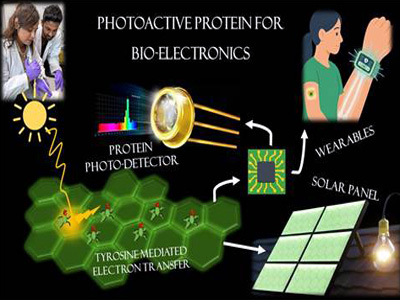
The researchers discovered that these proteins naturally arrange themselves into thin, sheet-like structures. When UV light shines on them, tiny electrical charges begin to move across the protein surface. This happens because the proteins contain tyrosine, a natural amino acid that can release electrons when excited by light. As these electrons and protons move, the protein sheet produces an electrical signal—similar to how a miniature solar cell would operate. This light-driven effect relies on the protein’s internal order and does not require any synthetic additives or high-temperature manufacturing.

The discovery opens up exciting possibilities for real-world applications. Because the material is flexible and body-friendly, it could be used to create wearable health monitors, skin-safe UV-detection patches, and implantable medical sensors that work safely inside the human body. It could also be used in temporary or disposable environmental sensors, such as pollution detectors or sunlight trackers, that naturally break down after use without harming the environment. Families, patients, and consumers may one day benefit from soft, comfortable, and environmentally responsible devices that integrate smoothly into daily life.

To reach this understanding, the INST team examined how the proteins assemble, how they behave under light, and how electricity moves across them. Using advanced microscopes and precisely controlled electrical tests, the researchers confirmed that this semiconductor-like behaviour depends on the protein’s neatly arranged structure and on the special orientation of tyrosine residues at the central region of the protein. By comparing the results with unfolded or disordered proteins having tyrosine, the team demonstrated that the effect is unique to the naturally ordered protein sheets.

The study, published in the journal ‘Chemical Science’ of the Royal Society of Chemistry, represents a promising step toward bio-inspired electronics, where materials are designed by learning directly from the ingenious mechanisms found in nature. Such materials could lead to a new generation of electronic technologies that are not only functional and efficient but also sustainable, safe, and aligned with the needs of both people and the planet.

This could provide a genetically tunable, low-energy route to make light-sensitive materials that are useful for low-cost detectors, biocompatible sensors and safe, less invasive implantable devices.