
 Brij Khandelwal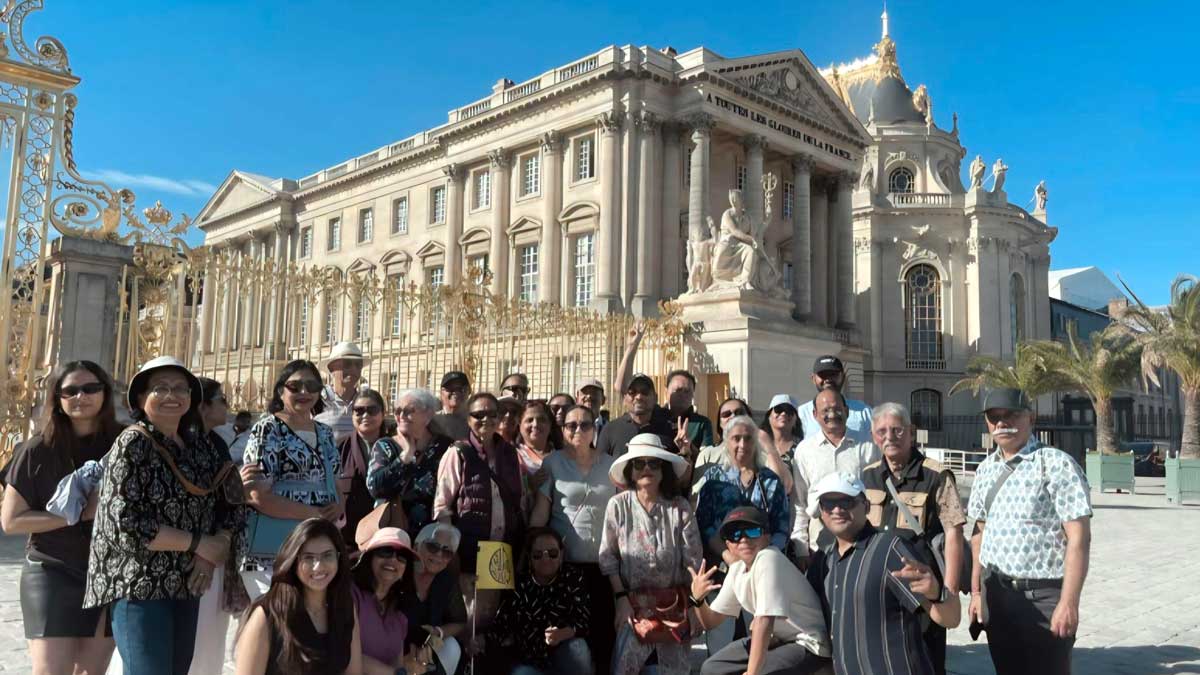
What happens when two Indians in their seventies decide to conquer Europe in seventeen days? They discover ten countries, seventeen destinations, countless monuments, several rivers, hundreds of photographs and one very stubborn truth. Europe is beautiful, but the body has its own travel itinerary.
We began in Bangalore, flew to Abu Dhabi and landed in London. Then came Paris, Brussels, Amsterdam, Germany, Switzerland, Liechtenstein, Austria and Italy, with Vatican City providing the grand finale.
Also read: दस देश और सत्रह पड़ाव, फिर भी दिल अटका रहा यमुना में...
We crossed borders almost casually, like Indians crossing a busy road. Sometimes with confidence, sometimes with caution and sometimes with the kind of prayer that has no language. But the real journey was not from city to city. It was from river to river.
The Thames flowed through London. The Seine carried Paris on its shoulders. The Rhine thundered at its falls. The Neckar moved quietly past Heidelberg. The Inn accompanied Innsbruck. The canals gave Venice its watery soul. The Arno flowed through Florence.
Europe seemed to be saying something again and again. Cities change. Kings disappear. Empires collapse. Buildings become museums. But rivers remember. And every river made me think of the Yamuna. That was perhaps the most unexpected souvenir of the journey.
The more we saw European rivers, the more one question followed us. Why do we so often treat our own rivers as drains waiting for a beautification scheme?
The point is not that European rivers are perfect. The point is that they are generally treated as valuable parts of public life. The river is allowed to be a river. It is not merely something to be hidden behind concrete, advertisements and ambitious government announcements.
Padmini Iyer put the feeling beautifully. “At the Rhine Falls, the sheer force of water was almost theatrical. At Heidelberg, the Neckar quietly carried the weight of centuries. In Venice, water was not scenery. It was the city’s bloodstream. Even the gondola seemed to whisper that civilisation and water have always travelled together.” That sentence stayed with me.
So did the rivers. But Europe had more lessons. Swiss trains arrived with punctuality. Roads were orderly. Pedestrians had space. Public transport worked. Heritage was protected. In many places, the old and the new seemed to live together without fighting for parking space.
Then there was our own contribution to Europe. Desi warmth. Our bus, driven by a sturdy and sober gentleman from Poland whom Martha called Bugdan, slowly transformed into a moving Indian wedding.
Bhajans started. Antakshari followed. Strangers became relatives. Jaimin and Saket always had snacks. Anitaji had flavoured supari and good advice. Lady Martha always knew where the next toilet was.
That last skill deserves special mention. After a certain age, knowledge of European toilets becomes more useful than knowledge of European architecture.
Martha became part philosopher, part traffic controller, part emergency manager and part mother superior of a travelling Indian family.
A misplaced handbag in Paris gave us suspense. A misunderstanding at the Rhine Falls gave us adventure. Endless walking gave us sore feet and a new scientific discovery. Indian aunties can probably qualify for the Olympics if the event includes shopping and finding a toilet.
Then came Rome. Near the Colosseum, Padmini hurt her ankle. Suddenly the ruins, fountains, piazzas and Roman emperors became background scenery. The ankle delivered the most practical lesson of the entire journey.
Enjoy the world, but respect the body carrying you through it. At seventy-plus, the passport may still be enthusiastic, but the knees have started negotiating.
Pisa made us smile. Rome made us think. Venice made us dream. Switzerland made us admire systems. Vatican City reminded us of faith, history and the astonishing human desire to build things that survive centuries.
But the rivers gave us the deepest perspective. They showed us that civilisation is ultimately a conversation with water.
We travelled thousands of kilometres to see Europe, but Europe repeatedly sent our thoughts back to India.
The Thames made me think of the Yamuna. The Rhine made me think of the Yamuna. The canals of Venice, shimmering under gondolas and ancient buildings, somehow carried a little Yamuna in their reflection.
Perhaps that is what travel should do. It should not make us fall in love with foreign lands and fall out of love with home. It should make us see home more clearly.
We return with photographs, souvenirs, stories and chocolates. But the real souvenir is invisible. It is a wider horizon. A little humility. A lot of gratitude. And perhaps a renewed determination to make our own rivers worthy of the civilisations that grew beside them.
The suitcase will be emptied. The clothes will be washed. The photographs will be shared. The WhatsApp groups will explode. And after a few days, someone will ask the inevitable question. “So, what was the best place?”
I may have an answer. It was not London. It was not Paris. It was not Rome. It was not Venice. It was the moment when all those European rivers quietly brought me back to the Yamuna. Because after seeing the world, home does not become smaller. It becomes larger.
We went looking for Europe. Europe gave us many answers. But the questions brought us home.
Related Items
London for a ‘few days’ with a ‘Global Family’
Why are people drowning in the Yamuna...!
Zomato, beneath the glitter lies a sobering truth…