
 Brij Khandelwal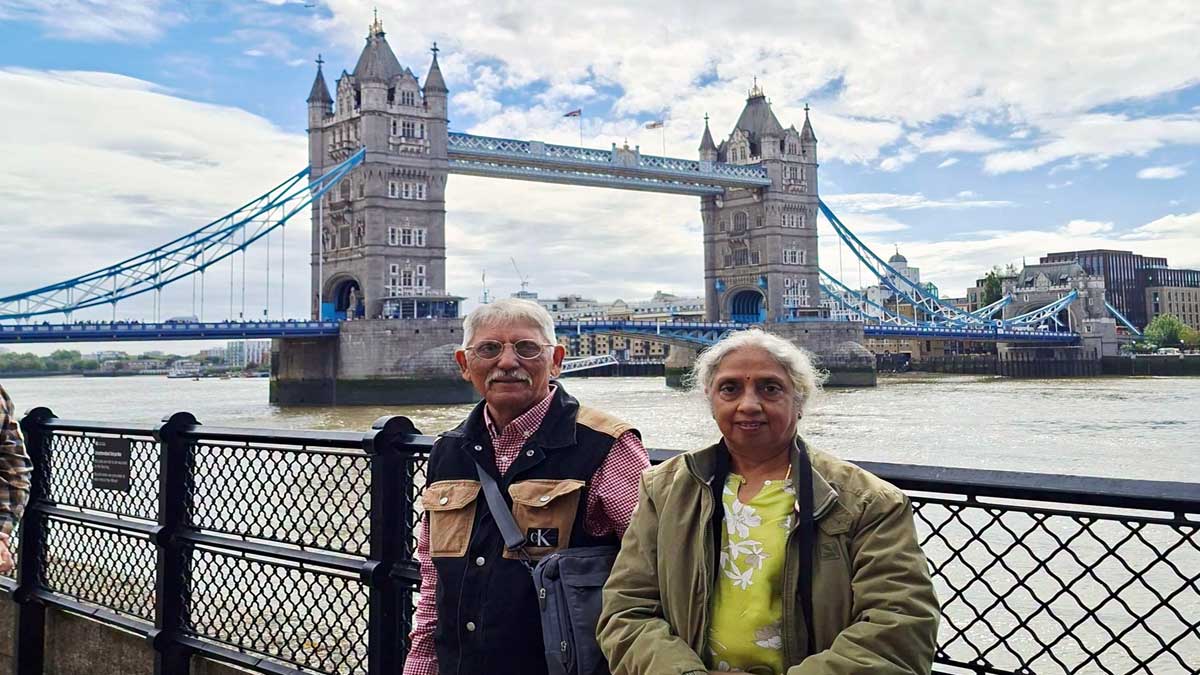
Is London just Big Ben, Buckingham Palace and the Thames? After spending a few days there, I felt the real story of London isn’t in its stone buildings but in the people who live their lives among them.
And our story? It was being written on the bus of a global family of some forty members, sometimes with songs, sometimes with loud laughs, and sometimes with the urgent question: where will we eat today?
Also read: स्मारकों से ज्यादा याद रहेंगे ‘लंदन’ के लोग…!
Our trip was called ‘Global Family’. Indians from different parts of the country were part of this family. Some came from Australia, some from the United States. Addresses and passports were different, but the heart that beat for India was the same.
That was the beauty of this group. Some had lived abroad for years, some had just come from India, but after two minutes of talking, it felt like we had known each other for years. Indians have this trait: it doesn’t take long to form a connection. Just ask, “Where are you from?” and you might get a whole family history in reply!
Our young, energetic tour leader was Martha Gomes. Her job was not just to get us from one place to another. The real challenge was to gather so many Indians at the same place on time!
Who got on the bus, who was still taking pictures, who was stuck in a shop, who went off looking for food- Martha watched everything. Her smile was always ready. Whether we were on time or running on ‘Indian time’, Martha stayed patient. Maybe the first quality of a good tour leader is the ability to smile at other people’s delays.
Her energy and calm kept the group together. She was the link in our trip that, if it broke, would have scattered everything.
Then there was our bus driver Ravinder, whom people lovingly called Robin. His voice had a rasp that sounded like an old-time radio announcer. And his desi humour! The bus was driving, but the mood sometimes turned into a comedy show. On the return trip, he even made the bus dance to Hindi film songs. Even an hour stuck in traffic never felt boring.
On the magnificent streets of London, Ravinder’s comments added an Indian flavour. Hearing him, you felt he could stop driving and become a stage performer. For us, he was more than a driver. He became one of the characters without whom the story would feel incomplete later.
On the long journey, the antakshari started. The bus turned into a music meet. The difference was that here the listeners also sang. One group would sing, another would reply. Someone’s tune would reach the sky; someone would lose the rhythm halfway. No one cared. When Padmini sang “Rimjhim gire saavan”, the bus filled with romance and rain. Outside the window was London; inside the bus was Mumbai’s monsoon!
Some lost the tune, some the beat. But no one lost their enthusiasm. That is the real charm of the global family.
The question bigger than London’s politics was, “Where is the food?” Where will the next meal be? What will they serve? Is there anything vegetarian? Is there dal? Will there be roti or will we have to settle for salad? These questions often outran London’s history and politics. After all, the stomach also wants democracy. It wants its preferred government, dal, vegetables and roti.
When Mumtaz and the Rasoi Ghar served pure vegetarian food, many faces showed relief as if someone had suddenly opened the door to home in a foreign land. One spoonful of dal bridges thousands of kilometres. When spices touch the vegetables, memories of India decorate the plate.
London, one city, many worlds; we saw many faces of London. We visited Big Ben, Westminster Abbey, Buckingham Palace, Trafalgar Square, Oxford Street, Madame Tussauds, art galleries and Hyde Park. Cameras came out everywhere. Photos were taken, then looked at, then shown to others.
The Thames became like a constant travel companion. We took a cruise and saw the river up close, looked at bridges from below, and viewed the city from the water.
And by the Thames there was a Ganga Aarti. It felt like India’s Ganga and Britain’s Thames, thousands of kilometres apart, were still familiar with each other. One gave birth to civilisations, the other witnessed an empire. Both watched history flow.
History followed us too. We saw the fortress and remembered the story of the Kohinoor. The diamond still shines, but its past raises questions.
A gem’s sparkle pleases the eye. The truth of history sometimes pricks the heart. Perhaps this is history’s irony: the victor holds the trophy while the defeated carry the story.
But what drew us most were the ordinary people of London. People walk fast. Very fast. It seems everyone’s pockets are short on time. Someone is running, someone cycling, someone walking. Wide sidewalks hold people’s private worlds.
Traffic was busy, but noise was low. Streets were full, but chaos was less. For us, this was special: horns were rare. You do not see vehicles stopping for long arguments. I thought, if Indian streets became this calm, many people would sell their horns and go on a pilgrimage!
Asian faces were everywhere: in shops, on buses, on streets, at work. London truly felt like a place where people from many parts of the world lived at the same address.
The most exciting stop was Lord’s ground. For cricket lovers, Lord’s is not just a field. It is a temple of cricket. Standing there felt like the bat and ball could write history. Cricket’s memories shout inside every Indian.
Alistair guided us and told many fascinating stories about Lord’s and famous players. When he showed Ganguly’s balcony, many Indian cricket memories came alive. For some it was that historic moment, for others Indian team victories, for some maybe Ganguly’s famous shirt!
Standing in Lord’s made me realise cricket is more than a sport. It is a language between India and England that needs no translation. On the bus, at the dining table, between monuments and while walking, we talked a lot.
We heard the experiences of Indians living in India and abroad. Whose child studies where, who lives in which city, what they miss about India- conversations went on.
Suddenly I felt the world has spread us across countries, but it still can’t fence the Indian heart. Indians abroad miss Indian food. Those in India miss relatives living abroad. Someone complains about the weather, someone about prices, someone about politics.
London showed us many things and also left us thinking. What is a generous society? How do different cultures live together in one city? How much do clean streets, wide sidewalks and smooth traffic ease ordinary life? And the biggest question—is development just tall buildings, or is it making daily life a little better? London’s streets answered some of these questions without speeches.
We returned with a small treasure of memories: the waves of the Thames, Big Ben’s bells, Lord’s history, Martha’s smile, Ravinder’s raspy voice, and the antakshari that filled the bus. And yes, the endless talks at the dining table.
Photos stay in the phone after a trip, but stories stay in both the stomach and the heart. The global family reminded us that no matter how big the world is, for an Indian heart, family never feels far.
The London trip ended, but the conversations continue. Next stop, Paris. This time the journey won’t be any less interesting. Undersea train. Eurostar. Let’s see whether the Eiffel Tower will stand taller than our expectations!
Related Items
When our buildings become death traps...
From the ‘Tree of Life’ to ‘Global Prominence’...
From village crossroads to global future, English is India's new strength