
 Samiksha Bharti News Service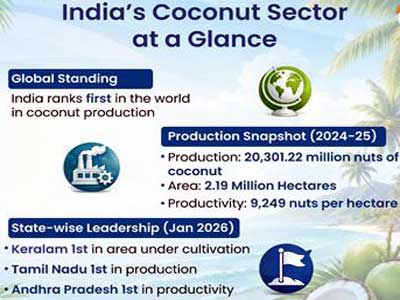
India’s coconut sector supports rural livelihoods, agricultural growth, and cultural traditions. Nearly 30 million people, including around 10 million farmers, depend on the sector. India ranks first in global coconut production, with Keralam leading in area, Tamil Nadu in production, and Andhra Pradesh in productivity.
India’s export basket has expanded from traditional products to value-added products like virgin coconut oil, coconut milk, and activated carbon. During 2025-26, about 2,175 hectares were added under cultivation, while 1,672 hectares were covered under rejuvenation.
Read in Hindi: भारत में परंपरा से बहुत आगे निकल चुकी है नारियल की खेती
Revered as the ‘Kalpavriksha’, the tree providing all necessities of life, the coconut is rooted in India’s heritage, culture, and agrarian economy. Celebrated across civilisations as a tree of a thousand uses, the coconut's enduring symbolism is rooted in its remarkable versatility. It provides food, drink, medicine, fibre, timber, fuel, and a diverse range of raw materials. These resources sustain households, traditional practices, and a growing ecosystem of value-added industries.
In India, coconut cultivation has a well-documented history spanning nearly three millennia and remains a critical driver of rural employment and economic resilience. About 30 million people, including 10 million farmers, depend on the coconut sector, making it vital to rural livelihoods. Predominantly cultivated by small and marginal farmers, coconut aligns closely with inclusive growth and the strengthening of farm-based economies. One such example of its growing significance can be seen in Chhattisgarh, where farmers have begun adopting coconut cultivation as a viable livelihood option.
In the Bastar Plateau of Chhattisgarh, farmers traditionally depended on paddy, millets, maize, and minor florets. Through the efforts of the Coconut Development Board’s DSP Farm, Kondagaon, coconut cultivation gradually emerged as a promising livelihood option. Farmers were trained to utilise the vacant spaces between young coconut palms with suitable intercrops. The practice provided income until coconut production commenced.
India holds a prominent place in the global coconut economy. The country ranks first in production and third in cultivation area, accounting for 31.24 per cent and 17.90 per cent of global totals, respectively. According to the DA&FW statistics, India produced about 20,301.22 million nuts of coconut during 2024-25 from 2.19 million hectares. Average productivity stood at 9,249 nuts per hectare.
Within the country, Keralam has the largest area under coconut cultivation, covering nearly 7.54 lakh hectares and producing about 5,149.87 million nuts. Tamil Nadu leads coconut production, while Andhra Pradesh records the highest productivity, followed by West Bengal and Tamil Nadu.
Beyond primary production, the coconut sector has emerged as an important contributor to agricultural exports, supporting India’s export ambitions. The Government aims to achieve USD 2 trillion in exports by 2030 and USD 21 trillion by 2047.
Supporting these export ambitions, India's coconut exports have recorded sustained growth in recent years. Coconut product exports reached ₹7,038.35 crore in 2025-26. This marked a 62 per cent increase over ₹4,349.03 crore recorded in the previous year. This underscores the growing global demand for coconut products from India. The growth also highlights the significant progress made since 2001-02, when exports were only ₹25.3 crore. During that period, exports were largely restricted to traditional products such as coconut shell charcoal, coconut oil, desiccated coconut, etc.
Over time, India’s coconut export basket has evolved from traditional commodities to a diversified range of value-added products. The sector now caters to global demand for virgin coconut oil, coconut milk, and coconut water. It also supplies other application-oriented products, strengthening India’s competitiveness in international markets. Market outreach has expanded beyond the Middle East, once the primary destination. Exports now reach markets across Europe, the Americas, and Australia.
Over the past five years, the USA, UAE, Sri Lanka, Germany, Russia, Turkey, Belgium, UK, and Netherlands have emerged as major trading partners. Key export products include activated carbon, coconut oil, fresh, frozen and grated coconut, copra, as well as desiccated coconut. Among these, activated carbon has consistently dominated export volumes.
Revered for generations as the ‘Tree of Life’, the coconut remains deeply woven into India’s cultural and rural landscape. Over time, the sector has expanded far beyond traditional cultivation practices. Strong policy support, farmer collectivisation, and skill development initiatives have strengthened the coconut value chain.
Efforts to improve planting material, expand cultivation, and rejuvenate ageing plantations are creating new opportunities for farmers. At the same time, rising demand for value-added coconut products is expanding India’s presence in global markets. With sustained institutional support, India’s coconut sector has evolved from a traditional cultural symbol to a globally prominent sector.
Related Items
Western Media is ‘tough’ on India but ‘soft’ on China!
Building the infrastructure for growth in Jammu and Kashmir…
An Indian traveller’s eye-opening lessons in the ‘Art of Living’