
 Dharmendra Kumar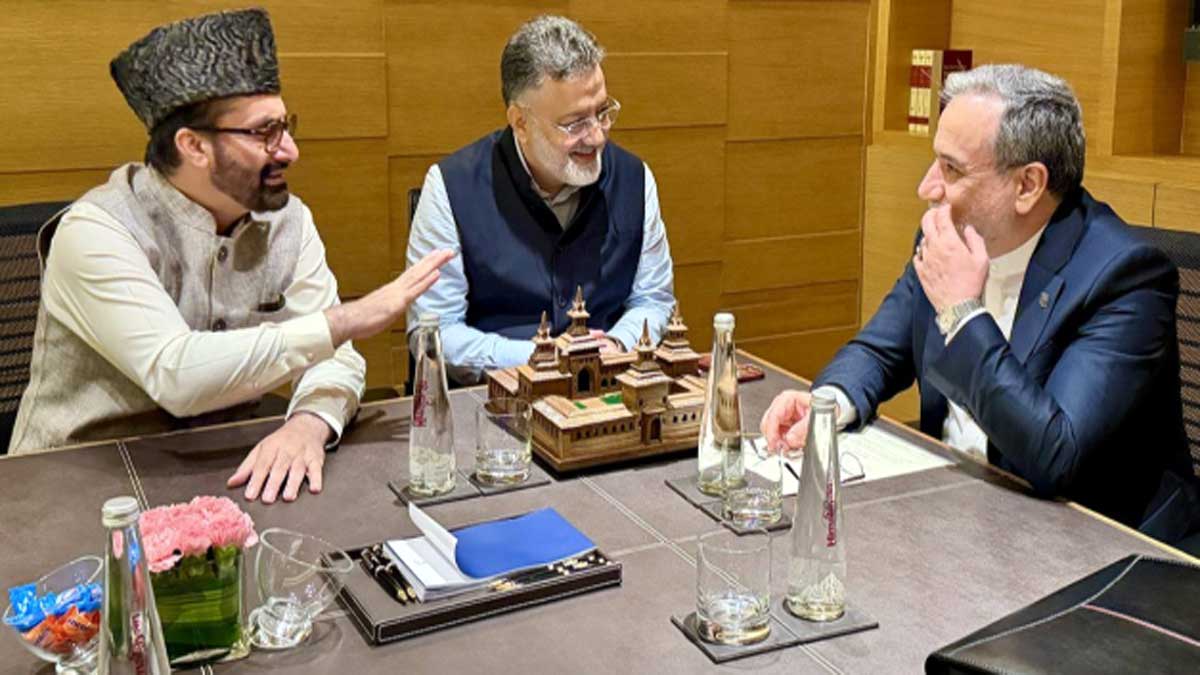
The meeting between Iranian President Masoud Pezeshkian and Mirwaiz Umar Farooq during the Iranian president’s visit to New Delhi has raised several questions about India’s diplomacy and Kashmir politics. An Iranian president meeting one of Kashmir’s prominent religious and political figures in the Indian capital cannot certainly be regarded as an ordinary development. Yet, viewing the meeting solely through the Kashmir lens may not fully capture Iran’s current diplomatic strategy.
Pezeshkian met Mirwaiz at an event organised by the Iranian Embassy in India. Religious leaders, intellectuals, businesspeople and several other prominent personalities were invited to the gathering. In other words, this was not a formal India-Iran dialogue on Kashmir. Mirwaiz was only one participant in this broader interaction. Nevertheless, his presence and his meeting with the Iranian president carry political significance because Mirwaiz is not merely a religious leader; he has long played an influential role in Kashmir’s social and political discourse.
Also read: पेजेश्कियन और मीरवाइज की मुलाकात के कूटनीतिक मायने
Iran’s engagement with the Kashmir issue is not new. Tehran has expressed concern over Kashmir on several occasions, while the Iranian leadership has referred to the issue in the broader context of matters concerning Muslim communities. India, in turn, has expressed its disagreement with such comments in the past. Differences between New Delhi and Tehran over the issue became particularly visible following changes to the constitutional status of Jammu and Kashmir.
However, Iran’s foreign policy cannot be understood solely based on such statements. Tehran has never allowed the Kashmir issue to overshadow its broader relationship with India. There are clear strategic and economic reasons for this. India is important to Iran in terms of trade, connectivity, access to Central Asia and the regional balance of power. For India, on the other hand, Iran is an important gateway to West and Central Asia. The Chabahar port is one of the most significant links between the two countries.
Chabahar plays an important role in India’s strategy of reaching Afghanistan and Central Asia while bypassing Pakistan. Similarly, the International North-South Transport Corridor offers India the possibility of connecting with Central Asia and Europe through Iran. Therefore, relations between New Delhi and Tehran are not limited to traditional friendship or energy cooperation; they are underpinned by long-term geopolitical interests.
Against this backdrop, it would be premature to interpret Pezeshkian’s meeting with Mirwaiz as an anti-India signal. Rather, it can be seen as part of an Iranian diplomatic approach that seeks to strengthen its governmental and strategic relationship with India while maintaining contact with influential sections of Indian society. Engagement with religious leadership is not unusual in Iranian diplomacy, and the presence of other Indian religious figures at the New Delhi event also points in the same direction.
However, the meeting has a different significance for Pakistan. Islamabad has long sought to place Kashmir prominently on international platforms. For Pakistan, therefore, the image of a prominent Kashmiri religious leader meeting the president of an important Muslim country in the Indian capital is politically useful. It provides Islamabad with an opportunity to reiterate its argument that Kashmir is not merely an issue between India and Pakistan but a matter of broader international concern.
There is, however, an important distinction to be made. Iran maintaining contact with Mirwaiz and Iran endorsing Pakistan’s position on Kashmir are two entirely different things. There is no clear indication from the available developments that Pezeshkian endorsed Pakistan’s position against India or that Iran has changed its official policy on Kashmir. It would therefore be inappropriate to treat a single meeting as evidence of such a policy shift.
In fact, Iran’s relationship with Pakistan is itself highly complex. Despite their geographical and religious proximity, the two countries have experienced tensions over issues such as border security, terrorism and regional influence. For Tehran, therefore, maintaining an independent foreign policy remains essential even while its relationship with Islamabad remains important. Balancing its relations with India and Pakistan is both a necessity and an opportunity for Iranian diplomacy.
The broader strategic relationship was also at the centre of Pezeshkian’s visit to India. His discussions with Prime Minister Narendra Modi covered not only bilateral cooperation but also issues such as the situation in West Asia, maritime security, trade and regional stability. At a time when Iran itself is facing considerable regional pressures and the security of maritime routes has become a global concern, maintaining dialogue with a major country such as India carries particular importance for Tehran.
This provides another way of understanding the meeting with Mirwaiz. Iran may be signalling that it views its state-to-state relationship with India on one level and its engagement with Indian Muslim and Kashmiri leadership on another. The two do not necessarily have to be alternatives. Such multi-layered diplomacy gives Iran room to maintain contact with different constituencies while pursuing its broader national interests.
For India, however, the situation may not be entirely comfortable. New Delhi would certainly not want any foreign power to once again push the political question of Kashmir towards the centre of international discourse, particularly when India has consistently maintained that issues relating to Jammu and Kashmir with Pakistan are bilateral matters. Therefore, even if Pezeshkian’s meeting with Mirwaiz does not develop into a formal diplomatic dispute, its political implications are naturally something India will watch closely.
Even so, the broader picture of India’s relationship with Iran is considerably more important. Changing power equations in West Asia, energy security, Chabahar, connectivity with Afghanistan and Central Asia, and maritime trade bring the two countries closer. This is why dialogue between New Delhi and Tehran has continued despite differences on several issues.
Perhaps the most interesting aspect of the entire episode is that during the same visit, Pezeshkian held strategic discussions with India’s top political leadership while also engaging with Indian Muslim and Kashmiri religious figures. Rather than viewing this as a contradiction, it would be more appropriate to see it as an example of Iran’s pragmatic foreign policy. Tehran wants to maintain relationships with different centres of influence based on its national interests and does not want any single issue to dominate its entire bilateral relationship with India.
Viewed from the Indian perspective, the episode also demonstrates the space provided by India’s democratic system for people and institutions across society to engage in dialogue despite big ideological differences. The fact that an Iranian president could interact with a prominent Kashmiri religious leader in New Delhi is, in itself, a reflection of that democratic space.
Therefore, the most important question arising from the Pezeshkian-Mirwaiz meeting is not whether Iran has suddenly changed its position on Kashmir. The bigger question is whether Tehran will become more vocal in its public position on Kashmir in the future. If the Iranian leadership begins referring to Kashmir more frequently at the official level or makes direct comments on Indian policies, the meeting could then be viewed as part of a broader strategic signal. At present, however, there is insufficient evidence to draw such a conclusion.
The current developments suggest that Iran continues to prioritise its strategic interests with India while also keeping its channels of communication open with India’s Muslim and Kashmiri leadership. Pakistan may use this engagement to reinforce its political narrative, but it would be incorrect to interpret it as Iran’s endorsement of Pakistan’s position on Kashmir.
Perhaps the real message of Pezeshkian’s Delhi visit is that Iran wants to keep its options open amid changing global and regional circumstances. His meeting with Mirwaiz is one element of this broader diplomatic picture. It certainly carries significance, but interpreting it without considering the full strategic background of India-Iran relations would make the picture far more simplistic than it actually is.
Related Items
An Indian traveller’s eye-opening lessons in the ‘Art of Living’
When Politics turns the Ballot into a Pandora's Box…
From 'Beacons' to 'Landmarks', India’s changing ‘Lighthouse’ story…