
 Brij Khandelwal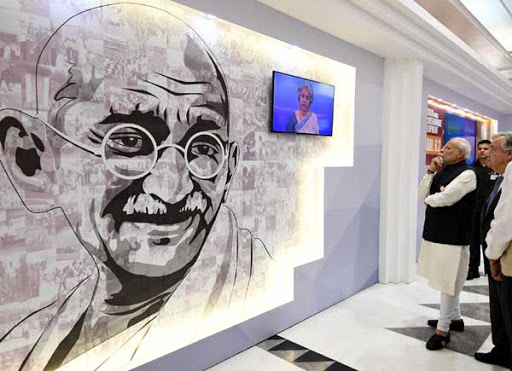
Despite numerous efforts, the captains of India's current political system have not been able to free themselves from Mahatma Gandhi's life ideals and Gandhian ideology. Congressmen never truly embodied Gandhi's principles, and Hindutva thinkers have been irritated by the name Gandhi since the beginning.
To diminish Gandhi's stature, many pygmy-sized leaders were promoted, but the world did not accept them. Even now, whenever any leader comes from abroad, the government first takes them to Raj Ghat to pay homage to Gandhiji. The reality is that at the level of ideological thinking, the world is divided into two parts: Pro-Gandhi and Anti-Gandhi.
Read in Hindi: बापू की विचारधारा और प्रासंगिकता, घटी या बढ़ी...!
West Asia and Northern Europe are grappling with the horrors of war. Gandhi represents the helplessness of humanity, restless in the shadow of increasing violence, counter-violence, hatred, hostility, terrorism, and fear. War and violence have never permanently solved any issue.
For instance, recall the days of the 1950s and 1960s in the dreaded Chambal ravines, which were infested with dacoits called Baghis, who terrorised the whole area in parts of UP, MP and Rajasthan. Gandhians like Vinoba Bhave, Jayaprakash Narayan took the plunge at great risk and persuaded hundreds of bandits to surrender. This was a great victory for Gandhism in independent India. Again, it was the non-violent resistance by Socialists and Gandhians that forced Indira Gandhi to lift the emergency and order elections, which led to her ouster.
The problem today is hypocrisy and double standards. "All the political leaders and religious gurus who attend the wedding of any industrial family should not pretend to love Gandhism," says Baba Ram Kishore of Lucknow. It is not within the power of today's leaders to fully understand Gandhi and apply his principles to their own lives.
From one perspective, it was fortunate that Gandhiji passed away before his time; otherwise, his last days could have been harrowing, witnessing the misdeeds of post-independence leaders.
An accusation often levelled against Gandhi is that the partition of the country happened because of him. Today, many believe that Hindi, Hindu, and Hindustan survived only because of the partition.
Mahatma Gandhi is not only a historical great man but also an ideology that can neither be forgotten nor ignored. Despite questions about Mahatma Gandhi's relevance, his contributions as a political strategist and promoter of non-violent resistance techniques are unparalleled.
However, we often remember him only on October 2 and January 30, limiting his teachings to symbolic activities such as spinning the charkha, reciting bhajans, and selling khadi at a discount.
The great scientist Albert Einstein once said that future generations would find it hard to believe that a man like Gandhi ever existed. Decades after his death, Gandhi has become a legend and myth in his own country, his words and deeds largely forgotten.
Today, when hypocrisy and lies have taken root in modern India, the number of those questioning Gandhi's relevance is growing rapidly. The world, especially poor countries, needs Gandhi's insights about socio-economic problems and human psychology. His methods of non-violent resistance have demonstrated the weakness of modern states that rely on deceit and fraud.
It is time to revisit Gandhian values, including non-violent resistance, to carry forward his methods of satyagraha, fasting, and strikes, which are still relevant today. Gandhi's ideas are for the 21st century.
Unfortunately, we have failed to expand the scope of non-violent movements, and Gandhian institutions, which have come to be called the Church of Gandhi, have mushroomed everywhere without any new thinking. The time has come to counter the fallacious logic that propagates that the prestige of a nation is measured by its military might rather than the well-being of its people.
In fact, global health experts emphasise that good health is determined by factors outside the direct control of the health sector, such as education, income, and living conditions. This aligns with Gandhi's holistic approach to well-being.
Let us revisit Gandhi's teachings and values, moving beyond symbolic gestures to meaningful action. The world needs his non-violence, love, and brotherhood today more than ever.
Related Items
An Indian traveller’s eye-opening lessons in the ‘Art of Living’
Are Indian borders just lines on a map!
How the 'Indian Solar Revolution' is transforming rural lives…